

CRISIS AT THE CENTRE: WHAT THE PRECABÉ VISIT REALLY REVEALS:
By Reason Wafawarova
When a President visits another country and nobody can explain why, the story is no longer the visit. The story is the silence.
Cyril Ramaphosa did not come to Zimbabwe on a State visit. There was no advance communication, no official reception, no Cabinet-level engagement, no joint press briefing, and no statement from the Ministry of Foreign Affairs in either country.
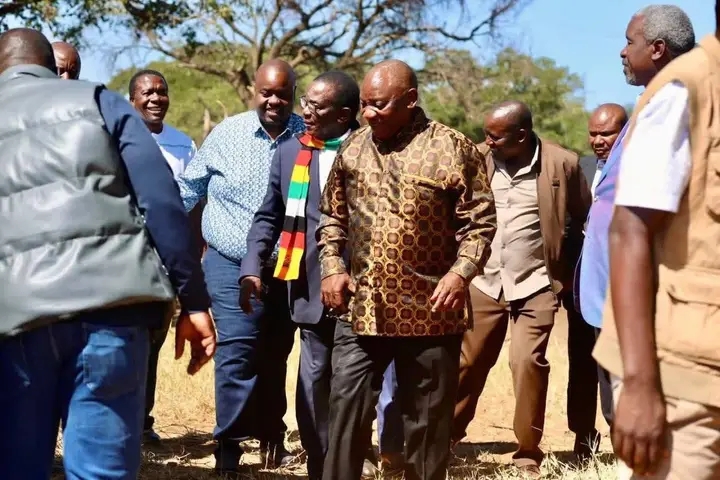
Instead, he arrived quietly and proceeded to Precabé Farm in Kwekwe—the private property of Emmerson Mnangagwa—where he met a delegation not of government officials, but of businessmen.
Zimbabweans would eventually learn about the visit not from the State, but from Wicknell Chivayo. In most countries, diplomacy is conducted by governments.
In Zimbabwe, it is now narrated by tenderpreneurs.
THREE STORIES, ONE EVENT:
In the absence of official explanation, the visit has generated multiple interpretations—each of them plausible, each of them incomplete, and all of them pointing to the same conclusion: something is not stable at the centre of power.
The first version is the official one—if it can be called that. It comes not from the State, but from Chivayo’s elaborate account of a “rare and profound” encounter between two leaders, framed through images of cattle, wheat fields, fish ponds, and Vision 2030 optimism. It is a story of calm, productivity, and continuity. A story designed to reassure.
The second version is analytical. It suggests that Ramaphosa came to mediate a growing rift between Mnangagwa and Vice President Constantino Chiwenga—a rift that, if left unmanaged, could destabilise Zimbabwe and ripple across the region. This interpretation draws from history. The African National Congress has lived through similar conflicts—between Thabo Mbeki and Jacob Zuma, and later between Zuma and Ramaphosa himself. Those internal wars fractured the party and reshaped South African politics.
The third version is more unsettling. Widely circulating claims—shared across WhatsApp networks and informal political channels—suggest that the visit was triggered by an appeal from Mnangagwa himself, expressing concern for his personal safety and requesting regional intervention. These claims further suggest that the mediation effort extended beyond Zimbabwe, involving regional actors, and that attempts were made to bring Chiwenga into a private engagement at Precabé—an invitation he is said to have declined, insisting instead that any such meeting must take place within formal State structures.
These claims cannot be independently verified. But they do not need to be. Because their significance lies not in their factual certainty—but in what their existence reveals.
When a single event produces three radically different explanations, the truth is no longer merely hidden. It is contested. And when truth is contested, power is unstable.
THE CHIWENGA MOMENT:
To understand why this instability has emerged now, one must return to a moment that, on the surface, appeared modest.
Vice President Constantino Chiwenga stood in a Catholic church and delivered what was presented as a sermon. It was, in reality, a political signal—carefully constructed, deliberately restrained, but unmistakable in its meaning.
He spoke of time. He spoke of limits. He spoke of the dangers of leadership that refuses to recognise when its moment has passed.
And then, without naming anyone, he invoked a moral framework that cut through the technocratic language of Constitutional Amendment Bill No. 3.
Something shifted. What had been a managed process—public hearings, parliamentary alignment, controlled narratives—suddenly encountered resistance that could not be easily dismissed.
War veterans began to speak. Retired commanders found voice. Political insiders—long silent—began to reposition. Ordinary Zimbabweans, conditioned to accept that the system was immovable, began to sense movement.
Not because structures had changed. But because momentum had.
POWER REFUSES—AND THAT MATTERS:
Within that shifting landscape, one detail from the circulating narratives stands out—not because it is confirmed, but because it is consistent with the logic of power. From where I stand, the answer has been, “we cannot confirm or deny.”
The reported refusal by Chiwenga to meet Ramaphosa at a private farm, insisting instead on a formal State setting. Power does not refuse meetings casually. It refuses them deliberately.
A refusal of that nature is not about logistics. It is about legitimacy. It is a statement that the arena of engagement matters—that power will not be negotiated in informal spaces when the stakes are national.
Whether or not that specific interaction occurred exactly as described, the fact that it is widely believed—and that it aligns with the broader shift in political posture—tells us something critical: The internal balance of power is no longer settled.
THE SYSTEM BEHIND THE POLITICS:
At this point, it becomes necessary to move beyond personalities and into structures. Because what is at stake is not simply a political contest between a President and his deputy. It is the survival of a system.
That system is anchored in a particular model of accumulation—one in which access to the State is the primary route to wealth creation. Contracts, tenders, procurement processes, and financial instruments have, over time, become the channels through which public resources are converted into private capital.
Within this system, certain figures have emerged as central nodes. Kudakwashe Tagwirei.
Wicknell Chivayo. Paul Tungwarara.
Their presence at Precabé is not incidental. It is structural. Because the meeting was not simply about politics. It was about alignment—between political authority and economic power.
WHY CAB3 MATTERS TO THEM:
Constitutional Amendment Bill No. 3 is often presented as a political instrument—an attempt to extend a presidential term. But in the context of this system, it is something else.
It is a mechanism of continuity. A way to ensure that the flows—financial, institutional, and contractual—remain uninterrupted. Because the moment continuity is broken, the system becomes exposed.
The Reserve Bank IT upgrade episode, widely discussed in financial circles, raised questions about procurement integrity, pricing structures, and the alignment between technical requirements and contractual outcomes. Similarly, the Zimbabwe Defence Industries (ZDI) ammunition supply arrangements have been cited as examples of how strategic sectors can intersect with commercial interests in ways that invite scrutiny.
These are not isolated controversies. They are patterns. And patterns of that nature cannot survive uncertainty.
Introduce a change in leadership, a shift in institutional alignment, or an opening of the system to competitive political processes—and those patterns become subject to investigation.
Not rhetorical investigation. Forensic investigation. That is what is at stake.
SOUTH AFRICA’S DILEMMA:
Against this backdrop, Ramaphosa’s visit acquires a different dimension. South Africa is not an external observer in Zimbabwe’s affairs. It is directly affected.
Zimbabwe’s economic and political instability translates into migration pressures, social tensions, and political consequences within South Africa itself. The recent wave of xenophobic attacks—targeting primarily African migrants, including Zimbabweans—has exposed the fragility of South Africa’s internal balance.
And yet, the response from the South African government has been cautious. Measured. At times, silent.
This creates a contradiction. At home, African migrants face violence. Across the border, African elites meet in private.
It is a contradiction that underscores the complexity of regional politics—where principles are often subordinated to pragmatism.
WHEN RUMOURS MOVE FASTER THAN STATES:
Perhaps the most revealing aspect of this entire episode is not the visit itself, but the information environment around it.
Rumours moved faster than official communication. Narratives emerged before statements. Interpretations multiplied in the absence of clarity.
In such an environment, power loses one of its most important tools: Control of the story.
When businessmen speak before governments, when unofficial accounts shape public understanding, and when multiple versions of reality coexist, the system is no longer managing perception.
It is reacting to it.
FINAL WORD:
The Precabé meeting did not resolve Zimbabwe’s tensions. It exposed them. It showed a leadership navigating uncertainty. An elite network seeking alignment. A regional actor engaging—carefully, quietly, without full commitment.
Most importantly, it revealed a country in transition—not yet transformed, not yet settled, but undeniably moving.
Because when power retreats into private spaces, it is rarely a sign of confidence. It is a sign of recalibration. And when recalibration begins, the outcome is no longer guaranteed.
Zimbabwe is no longer defined by what is being decided in Parliament. Parliament was not there in ZANLA/ZIPRA battalions and battlefields, Vapositori were not there on November 17 2017, and ED affiliates were not there when power was shifting from Mugabe.
Power is defined by what is shifting beneath it. And certainly, there is something unstoppably shifting beneath the Mnangagwa throne.
And that shift—is now visible.