

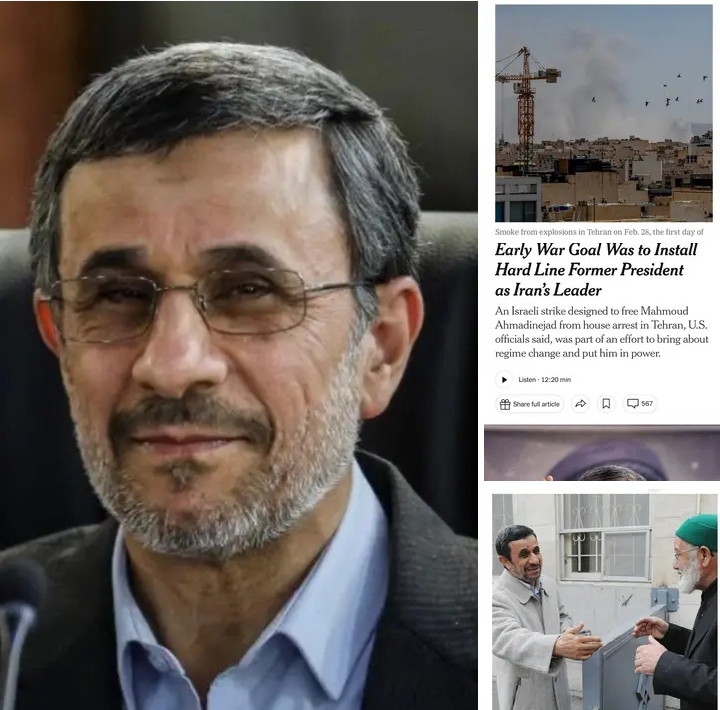
Breaking News – He Is Still Alive: The Secret Plot to Install Ahmadinejad as Iran’s New Leader Backfired Spectacularly
⸻
The Man They Claimed Was Finished
⸻
For years, the world viewed Mahmoud Ahmadinejad as politically dead, isolated, discredited, and buried inside Iran’s collapsing internal power struggles. He had disappeared from the center of global headlines after years of confrontation with the West, anti-Israel rhetoric, nuclear escalation, and internal crackdowns during his presidency.
But according to a shocking report by The New York Times, behind the scenes a far more dangerous and extraordinary game was unfolding.
Not only was Ahmadinejad allegedly alive and under close watch during the Iran war, but Israeli and American officials were reportedly exploring a plan to position him as part of a post-war leadership structure in Tehran.
The same man once presented as one of Israel’s fiercest enemies was allegedly being considered as a possible vehicle for regime transition.
That revelation alone destroys the simplistic public narrative surrounding the war.
The Alleged Regime Change Operation
⸻
According to the report, the United States and Israel entered the conflict with a broader multistage strategy that went beyond destroying Iran’s military infrastructure and nuclear facilities.
The alleged plan involved:
* assassinating top Iranian leadership,
* destabilizing the state internally,
* creating infrastructure collapse,
* triggering political fragmentation,
* mobilizing Kurdish forces,
* and ultimately paving the way for an “alternative government” inside Iran.
And somehow, Ahmadinejad became part of that equation.
American officials reportedly believed there were figures inside the Iranian system willing to cooperate with Washington after the collapse of the ruling structure. These figures may not have been “moderates,” but they were allegedly seen as pragmatic enough to stabilize Iran under a more manageable political order.
That calculation led to one of the most bizarre twists of the entire conflict.
The Strike Was Allegedly Meant to Free Him
⸻
During the opening phase of the war, Israeli airstrikes reportedly targeted Ahmadinejad’s residence in Tehran.
At first, Iranian media reported that he had been killed.
Later, those reports quietly changed.
He survived.
According to American officials cited in the report, the strike was allegedly never intended to kill Ahmadinejad. Instead, the operation reportedly aimed to eliminate the IRGC guards supervising him under house arrest and free him as part of a larger regime change strategy.
Satellite imagery reportedly showed that the security outpost near his residence was destroyed while his home itself suffered limited damage.
What initially appeared to be an assassination attempt suddenly began to resemble something entirely different: a covert jailbreak operation carried out through military strikes.
Then Ahmadinejad disappeared from public view completely.
His whereabouts and condition remain unknown.
The Contradiction That Changes Everything
⸻
This is what makes the entire story so explosive.
Ahmadinejad was not some hidden moderate secretly aligned with the West. During his presidency from 2005 to 2013, he became globally known for:
* harsh anti-Israel rhetoric,
* fierce support for Iran’s nuclear program,
* confrontations with the United States,
* Holocaust denial controversies,
* and violent crackdowns on internal dissent.
He openly spoke at conferences calling for “a world without Zionism.”
Western media portrayed him for years as the face of militant Iranian defiance.
Yet according to this report, Israeli and American planners allegedly saw him as someone who could potentially help manage Iran after the collapse of the theocratic system.
That reveals the brutal reality of geopolitical strategy: today’s enemy can quickly become tomorrow’s asset when power calculations shift.
His Fall From Iran’s Inner Circle
⸻
Over the years, Ahmadinejad increasingly clashed with Iran’s ruling establishment.
He criticized corruption, challenged senior officials, and gradually became politically isolated. Iran’s Guardian Council repeatedly blocked him from running for president again in 2017, 2021, and 2024.
His allies faced arrests.
His movements became restricted.
He was reportedly placed under close supervision.
At the same time, speculation about his external ties grew louder.
The report notes that Ahmadinejad traveled to Guatemala and Hungary before the war — countries viewed as maintaining close ties with Israel. He returned from Budapest only days before Israeli attacks on Iran began.
For someone once defined by relentless hostility toward Israel, his unusually low profile during the conflict raised major questions across Iranian political circles and social media.
The Plan Collapsed
⸻
According to the report, the broader strategy quickly unraveled.
Iran’s system proved far more resilient than planners expected. The rapid collapse envisioned by some Israeli officials never materialized. Internal fragmentation did not occur at the scale anticipated.
And after surviving the strike, Ahmadinejad reportedly became disillusioned with the alleged regime change effort.
Even inside Washington, some officials reportedly doubted from the beginning that reinstalling Ahmadinejad was realistic.
Still, the fact that such discussions allegedly occurred at all exposes how deep the ambitions behind the war may have gone.
Because beneath the public language about nuclear threats, missiles, and regional security, there appears to have been a much larger objective:
reshaping the political leadership of Iran itself.
The War Behind the War
⸻
This story changes how many people may interpret the conflict entirely.
The public was told the war was about deterrence, nuclear facilities, and regional security.
But according to this report, there were also discussions about assassinations, political engineering, internal destabilization, covert influence campaigns, and leadership replacement inside Tehran.
And in the middle of that storm stood one of the most unlikely figures imaginable:
Mahmoud Ahmadinejad.
The man the world thought was politically finished.
The man many thought was dead after the strikes.
The man who vanished from public sight.
He is still alive.
And the alleged plan to reinstall him appears to have backfired spectacularly.
_____
Source: New York Times
Christiaan Triebert contributed research for this article.
Mark Mazzetti is an investigative reporter based in Washington, D.C., focusing on national security, intelligence, and foreign affairs. He has written a book about the C.I.A.
Julian E. Barnes covers the U.S. intelligence agencies and international security matters for The Times. He has written about security issues for more than two decades.
Farnaz Fassihi is the United Nations bureau chief for The Times, leading coverage of the organization. She also covers Iran and has written about conflict in the Middle East for 15 years.
Ronen Bergman is a staff writer for The New York Times Magazine, based in Tel Aviv.