

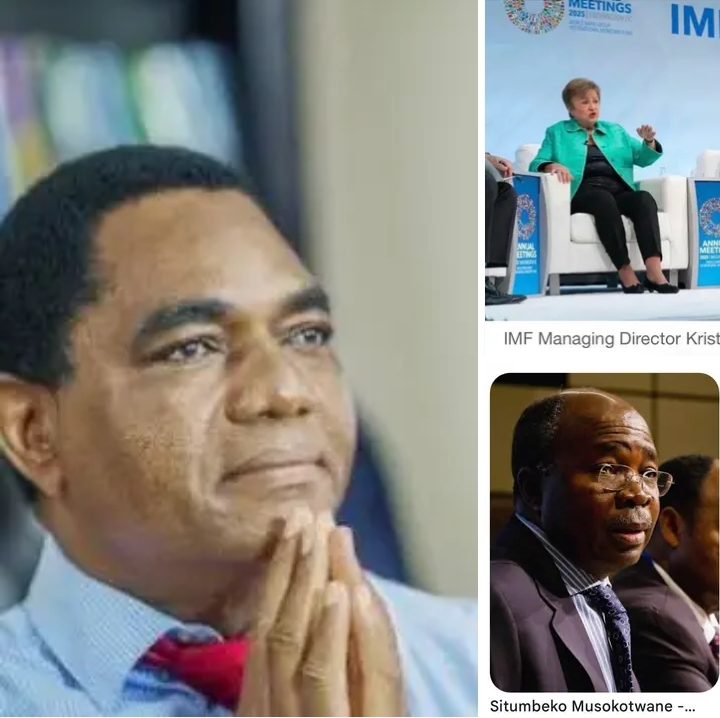
If Zambia’s economy and currency are truly performing so well, why has the IMF downgraded growth and stepped back from a new programme?
By Linda Banks
#BanaBaabo- For months, Zambians have been presented with a confident narrative about the state of the nation’s economy. Government officials have repeatedly assured the public that the country is on a strong recovery path, that the currency has been among the best performers in the region, and that Zambia is benefiting from what has been described as the most capable economic leadership in its history. These assurances have painted a picture of stability, renewed investor confidence, and a country steadily emerging from years of economic difficulty.
However, recent developments have introduced a more cautious perspective. The International Monetary Fund, one of the world’s most influential financial institutions, has downgraded Zambia’s projected economic growth from 5.5 percent to 4.5 percent. At the same time, it has chosen not to advance discussions on a new economic programme for the moment.
These decisions raise important questions about the true condition of the economy. If Zambia’s economic trajectory is indeed as strong as government messaging suggests, why are international assessments becoming more guarded rather than more optimistic?
Part of the concern appears to lie in the mining sector, historically the backbone of Zambia’s economy. For decades, the country’s vast copper reserves have been expected to drive growth, generate employment, and provide vital revenue for national development.
Yet the sector that should be the engine of prosperity is now being cited as one of the reasons for slower growth. This raises critical questions about policy direction, investment conditions, and whether the sector is operating at its full potential.
Adding further complexity to the debate are discussions about tax incentives and concessions granted to large mining companies. Governments often provide such incentives to attract foreign investment and encourage expansion.
However, these decisions also come with trade-offs. When generous concessions are offered, the country may collect less immediate revenue from its most valuable natural resources.
In a nation that continues to face energy shortages, fiscal pressures, and constrained public resources, it is reasonable for citizens to ask how much potential national income has been sacrificed and who ultimately benefits from these arrangements.
Concerns raised by the IMF extend beyond the mining sector. The institution has also pointed to issues related to governance, fiscal discipline, and policy direction. Such observations stand in contrast to the confident domestic narrative that the country’s economic management is stronger than ever.
If the economy is firmly on the path to recovery, it becomes important to understand why respected international institutions are expressing caution about the same policies being celebrated at home.
Perhaps the most striking development is the IMF’s hesitation to move forward with discussions on a new programme at this stage. International financial partners typically prefer clear policy consistency and predictable governance when entering long-term financial arrangements.
The decision to delay further programme discussions until after the next elections inevitably raises questions about the level of confidence international partners have in the current economic trajectory.
Ultimately, these questions should not be viewed simply through a political lens. They are fundamentally questions of accountability. When citizens are assured that their country stands on its strongest economic footing, they deserve clarity when global assessments suggest a more fragile reality. Economic policy affects every household, influencing employment opportunities, the cost of living, and the resources available for public services.
If Zambia’s economic recovery is indeed as robust as many have claimed, then clear and transparent explanations should be readily available. Citizens deserve to understand why growth projections have been lowered, why the mining sector is not driving the level of prosperity expected, and why international partners appear hesitant to proceed with further programme discussions. In a democratic society, honest answers are not an inconvenience; they are an essential part of responsible leadership and public trust.
All you want is to hear Zambia is in bad shape, economy not doing well then you start clapping, shameless chap. You’ve nothing positive to add to our country, go away like you’ve done and talk of where you stay not Zambia
It’s Hatred against Mr Hakainde Hichilema by the International Monetary Fund!!!
They are exercising caution and preventing crminals coming back and making noise. They are directly informing them that without HH, they will fail. They are awaiting his inauguration after August.
HAAMUSONDA, KEEP EXPOSING YOUR DULLNESS IN PUBLIC. TO YOU, YOU CLAP WHEN YOUR HERDMAN SAYS “SALT SAANA”. ALA MULI BATUTU IMWE, VERY BACKWARD. INCEST HAS MESSED YOU UP BADLY.
VOTE FOR CHANGE IN AUGUST.
MUNYAULE DEALER WA GOLD.
An imbecile from Congo/Tanzania is causing a disturbance dreaming of pf coming back. Economically, you lack education and morals as well. You continue to fantasize about being in the wilderness of Congo. People do not heed the words of a fool and a simpleton like yourself. You possess nothing except a tail trailing behind you. Continue dreaming of returning to receive free money, but fortunately, that will never occur. Idiot.
They have to wait PF criminals may use back door