

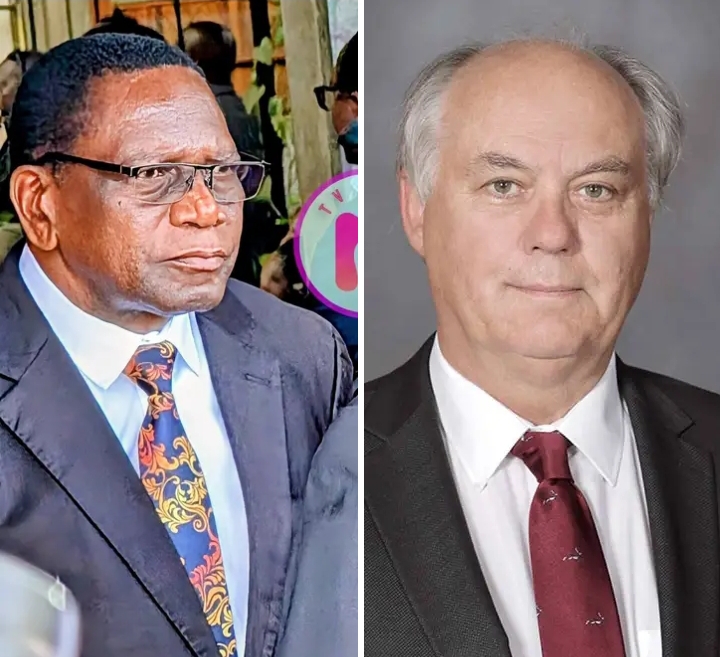
KK did not leave burial wishes, had not lost benefits, Court tells government lawyer in ECL case
THE South African Supreme Court of Appeal in Bloemfontein yesterday challenged the Zambian government’s reliance on the Kenneth Kaunda burial case in its legal battle with the family of former president Edgar Lungu over his final resting place.
During proceedings, the Court asked government lawyer Ben Stoop to provide expert evidence demonstrating that it was a recognised customary practice in Zambia for former heads of State to be buried at Embassy Park in Lusaka and who had burial rights.
The judges questioned the government’s argument that the Kaweche Kaunda case supported its position, noting significant differences between the circumstances surrounding the late First Republican President Kenneth Kaunda and those of former president Edgar Lungu.
“Where is the expert evidence on Zambian customary law? On the right to bury, you rely on Zambian customary law initially,” one of the judges asked.
In response, Stoop cited the Kaweche Kaunda case as authority.
However, the Court pointed out that the Kaunda matter involved a former president who had neither been stripped of his benefits nor left any express wishes regarding his burial.
“In the Kaunda matter, this wasn’t someone who had been stripped of benefits and had not made any express wish on where to be buried,” the judge observed.
When Stoop sought to rely on the Kaunda judgment as evidence of custom, the Court maintained that a court decision alone was insufficient to establish customary practice.
“That is just a decision of the Court. But with customs, one needs more,” the judge remarked.
Pressed further to provide expert evidence showing that the Zambian government had burial rights over a deceased former head of State, Stoop said he would rely on historical accounts outlined by Attorney General Mulilo Kabesha.
Stoop argued that Zambian law should govern the dispute because it had the closest connection to the parties involved.
“On burial rights, Zambian law should apply because that law has the closest connection to the parties in the matter,” he submitted.
But the Court insisted that expert testimony was required to establish customary practice, rather than relying on the opinion of a government official.
The judges further noted that historical examples of former presidents being buried without disputes could not, on their own, be treated as proof of a binding custom.
The appeal arises from an ongoing dispute between the Zambian government and the family of former president Edgar Lungu regarding the custody of his remains and the location of his burial.
The Court reserved judgment and indicated that a date for the ruling would be communicated to the parties.
©️ TV Yatu | David Kashiki | May 30, 2026.