

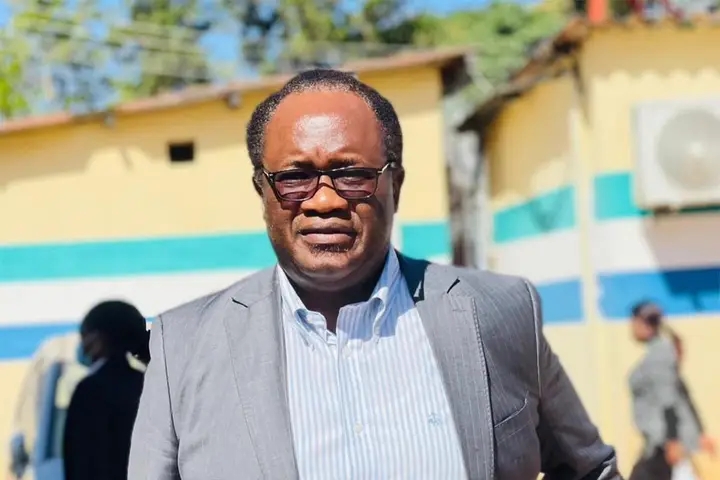
🇿🇲 VIEWPOINT | Mundubile Criticizes an Economy Without Offering Alternative
When Brian Mundubile appeared on EMV — Emmanuel Mwamba Verified — on Sunday night, he attempted to reduce Zambia’s economic debate to one issue: electricity. “On what basis has the economy grown? This country has had no power for three years,” he said, dismissing government claims of recovery under the United Party for National Development administration. It was a strong political line. But it was also politically selective, historically incomplete, and economically weak.
Because neither Mundubile nor the programme host, Emmanuel Mwamba, are detached observers. Both are products of the Patriotic Front era, the same administration that presided over Zambia’s debt collapse, weakening fiscal space, shrinking reserves, and eventual sovereign default. Zambia became Africa’s first Covid-era Eurobond defaulter under PF rule, not under UPND. The current economic strain did not emerge in isolation. It emerged from policy decisions made over many years.
This does not excuse the failures of the current administration. Load shedding became severe and prolonged. The cost of living remains high. Fuel prices remain politically painful. Fertiliser prices remain a major frustration for farmers. These are legitimate areas of criticism, and government must account for them honestly. But criticism also requires balance. If opposition leaders want voters to trust them again, they must equally account for what they left behind and what the current government has actually achieved.
And that is where the conversation becomes more complicated than political slogans.
Before entering office, UPND promised to recruit 30,000 teachers. It recruited more than 40,000. It promised to recruit health workers and proceeded to employ thousands across the country. It promised free education and not only implemented it, but turned it into law. It promised to reinstate student meal allowances that had been removed under PF, and restored them. It promised debt restructuring at a time many critics insisted it was impossible, and eventually concluded one of the most closely watched restructuring processes on the continent.
The government also promised to expand the Constituency Development Fund from K1.6 million. Today, CDF allocations have risen dramatically, transforming local authorities into serious centres of community-level development financing. Clinics, schools, desks, bursaries, skills programmes, and local projects are increasingly being funded through structures that barely functioned at scale before. One may criticise implementation inefficiencies, but the scale of decentralised funding expansion is historically significant.
The UPND further promised to revive sections of the mining sector and restore investor confidence. Major mining assets that had stalled are now operational again. Foreign reserves have strengthened considerably compared to 2021 levels. Inflation, though still painful for ordinary citizens, has moderated from earlier highs. The kwacha stabilised after years of extreme volatility. Zambia also recorded successive bumper harvests after years of severe agricultural stress. These are measurable outcomes, not campaign slogans.
Even on the politically explosive issue of cadre violence, there has been a noticeable reduction compared to the PF years when lawlessness around markets, bus stations, and public spaces became normalised in parts of the country. The difference is visible enough that even critics of government rarely argue that the current atmosphere resembles the peak of PF-era political disorder.
This does not mean government has succeeded everywhere. It has not.
The promise to lower fuel prices remains largely unmet. Fertiliser prices remain contentious. The energy crisis exposed serious vulnerabilities in national planning. Many citizens still feel economic recovery more in speeches than in their pockets. These frustrations are real and politically dangerous for the ruling party. Governments are ultimately judged not by macroeconomic reports, but by lived experience.
But this is precisely where Mundubile’s argument weakens further. Beyond criticising load shedding and economic hardship, he is not offering a materially different economic framework from what already exists. Mining-led industrialisation, tourism growth, agro-processing, digital economy participation, and formalisation of small-scale miners are already embedded within Zambia’s current policy direction. He speaks of what should be done without explaining what specifically would change under his leadership.
Where is the alternative fiscal model? Where is the energy diversification roadmap? How would his government borrow differently? What expenditure would be cut? What taxes would change? How would these programmes be financed without pushing Zambia back toward unsustainable debt accumulation?
Those questions matter because Zambia is no longer in a period where rhetoric alone is enough. Citizens have lived through economic collapse before. They remember the debt crisis. They remember the default. They remember the weakening kwacha and the instability of the PF years. And increasingly, voters are asking opposition figures a harder question than before: if you now understand the solutions, why were those solutions not implemented when you already held power?
The truth is that Zambia’s political debate is increasingly trapped between frustration and memory. Many citizens remain unhappy with the pace of economic relief under UPND. At the same time, many opposition leaders remain unable to escape the shadow of the PF record they helped create. That is why this election is becoming less about who can complain the loudest and more about who can present the most believable governing alternative.
And at this moment, Mundubile’s intervention sounds less like a coherent economic alternative and more like an argument built around public frustration without a sufficiently detailed replacement plan beneath it.
— The People’s Brief welcomes reader responses, analysis, and opinion submissions.
Write to us: editor.peoplesbrief@gmail.com
Share our work. Support independent journalism grounded in facts, context, and accountability.
© The People’s Brief | Ollus R. Ndomu
One important variable you forget to highlight move is that the rate of inflation has drastically slowed down and price hikes especially for food items have also slowed down.In reality ,the rate of Zambian’s poverty is stabilizing,It can only naturally begin to slowly unwind if we keep UPND in power to continue with its current socio-economic development policies which are working
Forget Mundubile and Ka Kalaba.These two twits are just talking heads without a body.They can never assemble a highly economically capable team such like has been gathered by HH.That is why they have no coherent and sustainable plan for this country.They will just take us back to unplanned borrowing.It is the quick fix solution to them.
God forbid
They will simply come back to continue sorting out complex issues with simple solutions.