

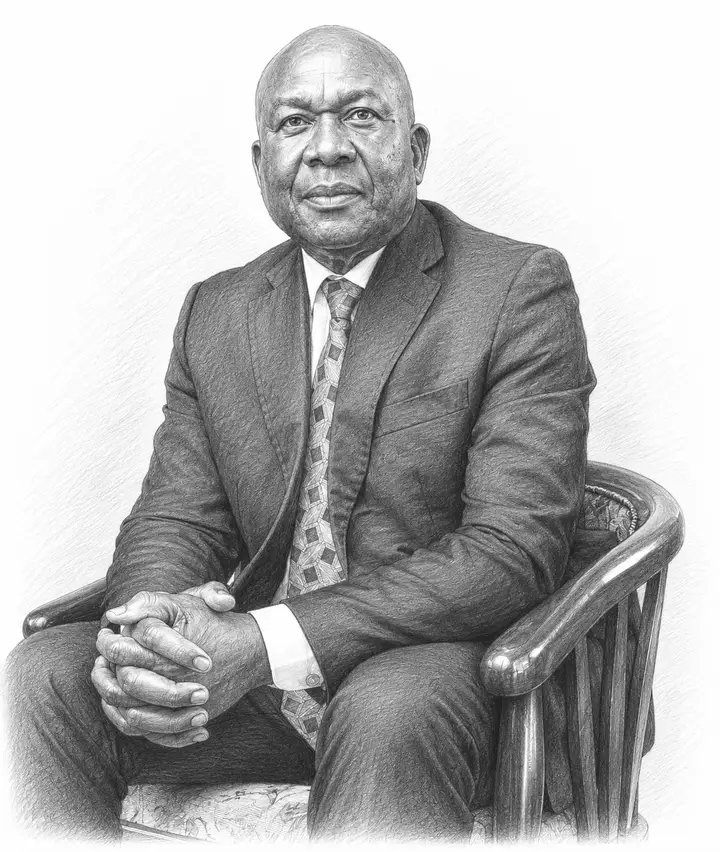
THE MAN IN THE SHADOWS: DECODING XAVIER FRANKLIN CHUNGU
In the tradecraft of intelligence, there is a term for an operative who accumulates so much leverage over a system that the system itself cannot move against him without risk of self-exposure. They call it *mutually assured compromise*. For ten years, Xavier Franklin Chungu was Zambia’s most dangerous practitioner of exactly that art.
He is back. And this time, he wants to be President.
OPERATIONAL PROFILE
Before you can assess the threat, you must first read the file.
Xavier Franklin Chungu served as Director General of the Zambia Security Intelligence Service (ZSIS) from 1991 to 2001 — a full decade in command of the nation’s most sensitive intelligence apparatus, under the administration of late Second Republican President Frederick Chiluba. Ten years is not a posting. Ten years is an empire.
In the intelligence world, a decade at the top of a national spy service means one thing above all else: the accumulation of files. Files on politicians, judges, journalists, businesspeople, generals, and diplomats. Files that never expire. Files that follow their subject long after the handler has left the building. Whoever holds those files holds power that no election can transfer and no court order can fully extinguish.
That is the first thing Zambians must understand about who is standing before them asking for the presidency.
THE ZAMTROP ACCOUNT: FOLLOW THE MONEY
Any competent intelligence analyst knows the oldest axiom in the business: *follow the money*.
Chungu was under investigation for misappropriation of approximately US$6 million from an intelligence account held at the Zambia National Commercial Bank in London, operating under the name “Zamtrop” — for which he was the sole signatory.
Sorry ba 2pin, this might be beyond you.
Read that sentence again. The sole signatory. Not the President. Not the Finance Minister. Chungu.
The Zamtrop account — number 58C/40/70185/01 held at the London branch of the Zambia National Commercial Bank in the name of ZSIS — sat outside ordinary Zambian government processes. It was a US Dollar account that received funds allegedly transferred for the payment of Zambia’s official debts and to purchase military hardware including helicopters and fighter aircraft. Most of those transactions never occurred.
In the intelligence community, an off-books account operated by a spy chief outside the normal treasury pipeline is not a bureaucratic irregularity. It is a slush fund. It is exactly the kind of financial infrastructure that enables deniable operations, personal enrichment, and the funding of activities that cannot survive exposure to daylight.
Then-President Levy Mwanawasa himself described what happened to that account as the “plunder of national resources.”
That was not a campaign slogan. That was a head of state, with access to the full intelligence brief, calling it what it was.
THE EXFILTRATION: A SPY WHO RAN
A man who believes he is innocent does not run. A man who knows exactly what is in the files runs.
A Zambian court locked up Chungu after a South African pilot confessed he had been hired to sneak Chungu out of the country. Magistrate Frank Tembo revoked his bail after the state asked to keep him in prison over fears he might flee. The ruling came after South African freelance pilot James Graham told the court he had been hired by a Congolese billionaire businessman, Katebe Katoto, to evacuate Chungu from Zambia. The plan was that Graham would pick up Chungu and five others in northern Zambia, but it was botched after the Zambia Air Force denied permission to fly to northern Zambia.
Allow that to settle.
The former head of Zambia’s intelligence service — the man constitutionally charged with protecting the Republic — had to be smuggled out of his own country in a private aircraft by a foreign billionaire. The escape route ran through the same northern Zambia that Chungu had spent a decade surveilling on behalf of the state.
What Chungu attempted was a *covert exfiltration* — the kind of operation typically reserved for burned assets fleeing hostile territory. Except here, the hostile territory was his own country, and the people he was fleeing were law enforcement officers trying to account for public funds he had controlled.
Chungu fled Zambia for approximately four years following allegations of plunder of national resources during the ten years he served as intelligence chief.
Four years in the cold. Living under an assumed identity. Moving through the region as a ghost.
And when he returned? He returned with a forged passport — number ZH 88471 — fraudulently processed to show it was issued in Ndola when in fact it was obtained in Lusaka. He was convicted for forgery and uttering a false document, served nine months, and walked to freedom.
A former spy chief. Convicted for operating under a false identity.
THE ANGOLA CONNECTION: A REGIONAL SHADOW NETWORK
Here is where the file becomes deeply concerning — not just for Zambia, but for the region.
A United Nations panel of experts on sanctions-busting in Angola accused Chungu of gun-running and aiding the rebel National Union for the Total Independence of Angola, UNITA.
This was not a tabloid allegation. This was a formal finding by a United Nations panel established specifically to investigate violations of international arms embargoes.
The UN report accused Chungu of maintaining ties with a UNITA representative known to trade in illegal diamonds and firearms.
Metex pilots — linked to alleged arms supply networks — were reportedly accommodated in a house in Ndola belonging to Chungu himself.
UNITA, for those who need the context, was Jonas Savimbi’s rebel movement responsible for one of the most devastating civil wars in African history. The conflict cost over half a million lives. The arms embargo Zambia allegedly helped circumvent was designed to prevent exactly that kind of bloodshed from continuing.
A sitting intelligence chief, the man responsible for Zambia’s national security and regional stability commitments, is accused of running weapons to a rebel movement while his country was hosting the peace talks designed to end that very war. The Lusaka Protocol of 1994, meant to bring peace to Angola, was signed on Zambian soil. The same soil, it appears, from which arms were allegedly being moved in the opposite direction.
In espionage circles, this is called a *double game*. It is also called treason.
THE LEGAL LABYRINTH: 168 COUNTS AND COUNTING
Chungu faced more than 100 counts of corruption and theft of public funds, on many of which he was jointly accused with former president Frederick Chiluba and other top officials.
He was jointly charged with Chiluba for theft of public funds, put under house arrest and remanded in prison for a cumulative period of 34 months on allegations of theft of motor vehicles and theft by public servant. Each time he was detained and the case taken to court, the state would enter a nolle prosequi — and the cycle of arrest and charge would begin again.
This is the pattern of a man with powerful protectors. In intelligence work, assets with deep institutional knowledge are rarely prosecuted to conclusion. The risk of what they might say on the witness stand in their own defence is simply too great. Chungu’s prosecution dragged, collapsed, restarted, and ultimately fizzled across nearly two decades — a timeline that speaks less to his innocence than to the systemic reluctance of a compromised political class to fully open the files.
The prosecution of Chungu proved especially difficult because, as head of Zambian intelligence, he reported only to the president — who determined whether his actions were in the public interest.
There it is. The structural immunity of a spy chief: accountable to no one but the very man he helped put and keep in power.
In 2016, the Director of Public Prosecutions cleared him of allegations linked to the ZamTrop intelligence account after years of investigations and court proceedings.
Cleared — not exonerated. There is a difference. In intelligence language, a case that disappears without a finding of fact is called a *burn notice*. The file is closed, not because the subject is clean, but because someone decided the cost of pursuing it was too high.
THE ELECTION GAMBIT: RUNNING FOR COVER OR RUNNING FOR CONVICTION?
Chungu has successfully paid the K100,000 presidential nomination fee and will contest the August 2026 presidency under the Liberal Democratic Party.
Any experienced counterintelligence officer reading this development will ask one question immediately: why now? He is likely not going to win, but WHY NOW?
A man who spent years in exile, spent 34 months in detention across multiple arrests, was convicted of operating on a forged identity, and was named in UN sanctions-busting reports is now presenting himself as the solution to Zambia’s governance problems. The target has moved from the dock to the campaign trail.
In intelligence doctrine, there is a known tactic called *legitimisation through political office* — the use of democratic participation to confer institutional protection, public visibility, and procedural immunity on an actor who might otherwise remain vulnerable to legal exposure. A presidential candidate is harder to arrest. A head of state is nearly impossible.
The Independent Broadcasting Authority has reportedly blocked Millennium TV from airing an interview with Chungu. The Zambia Security Intelligence Service Act establishes clear statutory provisions governing the conduct of intelligence personnel, and those provisions continue to apply even after leaving office. Penalties for breach range from 15 to 25 years imprisonment.
Whether or not you believe his interviews should be blocked — a debate worth having — the underlying question is more fundamental: is Zambia prepared to hand state power to a man whose entire career inside that state remains incompletely accounted for?
HERE IS THE THING…
Xavier Chungu is not simply a former spy. He is a man who ran the intelligence apparatus of a sovereign state for ten years, controlled a secret off-books foreign account as sole signatory, fled the country when called to account, returned on a forged document, was named by the United Nations in connection with arms running to a rebel movement that killed hundreds of thousands of people, and now asks ordinary Zambians — those who have no files on him — to trust him with the presidency.
In the tradecraft of power, a spy who was never fully burned retains his operational capacity long after he leaves the building.
The building Chungu now wants to enter is State House.
__________
Zambian Angle
Admin has written in the public interest. All facts cited are drawn from court records, UN reports, and published news accounts.
For sure this guy STINKS CRIMINALITY. He shouldn’t be allowed to be NEAR STATE HOUSE.
He is a nefarious guy!!
Mwa ona manje.Nabakawalala are attempting to become presidents.
Ikona man.It is evident that this individual is a serious criminal.
Exercise caution, Zambia.