

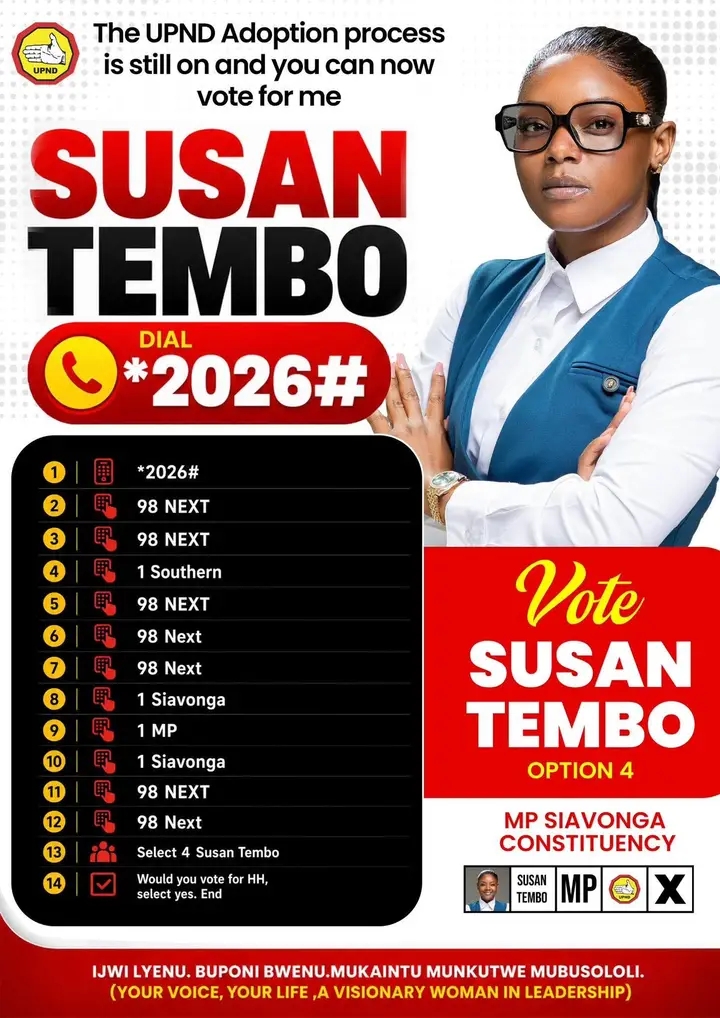
🇿🇲 BRIEFING | UPND Opens Candidate Adoption Process to Public Through *2026# Poll
The United Party for National Development has launched what is being described as a first in Zambia’s modern party politics by allowing members of the public to participate directly in its primary adoption process ahead of the August 2026 general elections.
Through a mobile-based opinion platform, citizens can now dial *2026# from any network and vote for their preferred aspiring candidates for Member of Parliament, Mayor, or Council Chairperson in their respective areas.
The initiative comes at a politically sensitive moment as parties scramble to manage intense adoption battles following delimitation, which created dozens of new constituencies and opened fresh political contests across the country.
According to the ruling party, the information collected through the two-day exercise will help guide final adoption decisions. In a memo circulated to aspiring candidates, Elections and Campaigns Chairperson Likando Mufalali encouraged participation in the process, urging members to “get involved and be counted.”
The move signals an attempt by the UPND to project openness and grassroots legitimacy at a time when adoption disputes are becoming increasingly contentious across the political landscape.
Candidate selection processes in Zambia have historically been dominated by party hierarchies, often triggering accusations of imposition, favouritism, and elite influence.
By introducing a public-facing opinion mechanism, the ruling party appears to be blending internal party structures with broader voter sentiment, particularly in highly competitive constituencies where popularity on the ground may carry more political weight than seniority within party ranks.
The process also reflects the growing role of technology in Zambia’s electoral politics. With mobile penetration rising and campaigns increasingly driven by public perception, parties are under pressure to demonstrate transparency and responsiveness, especially among younger voters and first-time participants.
However, the opinion poll is not legally binding and does not replace the formal adoption process. Final decisions will still rest with party structures and leadership, meaning the exercise is likely to serve more as a political temperature check than a definitive primary election.
Still, the symbolism matters.
At a time when political parties are facing growing scrutiny over internal democracy, the UPND is positioning itself as willing to test public sentiment before finalising candidates. Whether the process genuinely shapes outcomes or remains largely consultative will become clearer once the final adoption lists are released.
© The People’s Brief | Goran Handya
In rural areas where very is no network what are you going to do?
You can’t remove all Ministers & MPs and expect to build on the first foundation term! That would be like starting afresh. Yes, you need new extra young people joining, but you can’t do a complete sweeping of the system. That would be like starting anew which would end up taking loosing or the gains and lessons learnt in the first term. The Party leadership should take charge. The system of letting the people do primaries can open the party to sabotage and infiltration. The party has to be careful not to open itself to manipulations.
Very true. You are 100% RIGHT. There can be a sabotage to expose the party to that