

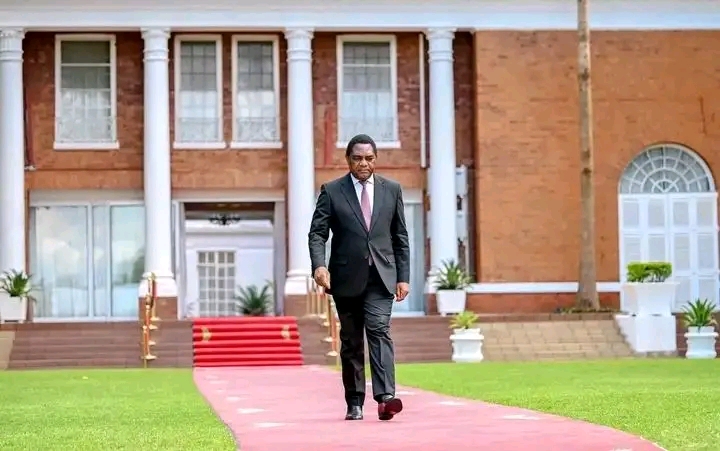
🇿🇲 EDITORIAL | Hichilema, Power, & Politics of Reality
There are moments in politics where noise must give way to clarity.
President Hakainde Hichilema has just gone through a process his critics long demanded. For years, the opposition argued that the United Party for National Development avoided internal contestation, that its leadership was closed, insulated, and untested. This argument has now met reality. The party has gone into a convention cycle, opened its processes, and the result is unmistakable. Hichilema has emerged unopposed.
The outcome must be read correctly. It is not the absence of democracy. It is the presence of dominance.
Within UPND, there is no credible alternative centre of power. No figure with the structure, legitimacy, or momentum to challenge him. Politics is not about theoretical openness. It is about actual viability. When a leader goes unopposed in an open field, it tells you less about restriction and more about consolidation.
And consolidation, in this case, has been earned in part through governance.
Hichilema’s administration has not been perfect. No serious government is. But to ignore what has been done is to abandon honesty. Free education has returned millions of children to school. The school feeding programme has stabilised attendance in vulnerable communities. The Constituency Development Fund has been expanded, decentralising resources in a way previous administrations only promised.
Traditional leadership, long treated as peripheral, has been brought closer into the national framework through increased support and recognition. This is not cosmetic. It is structural engagement with institutions that shape rural Zambia.
On the international front, Zambia has re-entered conversations it had quietly exited.
Engagement with global financial institutions has improved. Debt restructuring has been pursued with discipline. Investor confidence, while still cautious, has shifted from suspicion to consideration. Zambia is no longer being spoken about as a cautionary tale. It is being spoken about as a country attempting correction.
This is what the opposition is up against. Not a perfect government, but a functioning one.
And here lies the deeper problem for those seeking to unseat Hichilema. There is no clear alternative. No coherent economic programme that rivals what is currently being implemented. No unified political front capable of translating dissatisfaction into electoral victory. What exists instead is fragmentation, litigation, and recycled rhetoric.
It is not enough to say a leader must go. The country must know who replaces him, and with what.
This is where the current opposition, particularly those emerging from the Patriotic Front, struggles to persuade. Many of the loudest voices today are tied to a recent past that Zambians have not forgotten. Debt expansion without restraint. Cadre violence normalised. Governance reduced to survival politics. These are not distant memories. They are recent history.
That history weakens their moral authority.
It becomes difficult to convincingly challenge a government on governance when one’s own record remains unresolved in the public mind. Criticism is necessary in a democracy. But credibility matters.
Claims that the democratic space is shrinking must also be weighed carefully.
There are legitimate concerns in any administration, including the use of state institutions. But comparison must be honest. Zambia today is not operating under the same conditions that defined its immediate past. The scale, intensity, and normalisation of political excess are not the same. To collapse these differences into one narrative is to flatten reality for political convenience.
This is not a defence of power. It is a recognition of context.
Hichilema enters this election cycle ahead, not because he has done everything right, but because he has done enough to remain viable while his opponents have not done enough to become alternatives. That is the political equation.
Elections are not decided by perfection. They are decided by comparison.
As things stand, the comparison favours the incumbent. The UPND is consolidating. Its leadership is settled. Its message, whether one agrees with it or not, is coherent. The opposition remains divided, reactive, and in many cases, internally consumed.
Patriotism demands honesty.
Zambia does not benefit from exaggerated narratives or selective memory. It benefits from clear-eyed assessment. And the assessment today is this. Hichilema is ahead of the game.
This position may change. Politics is fluid. Momentum can shift. But for now, the balance of power, performance, and perception sits firmly in his hands.
© The People’s Brief | Editor-in-Chief
“The scale, intensity, and normalisation of political excess are not the same. To collapse these differences into one narrative is to flatten reality for political convenience.”
This is exactly what selective memory peddled by chaps at KBN kantemba TV station.while UPND and HH’s governance shortcomings are a function of his desires to sidestep established procedures and rules which has condemned as beauraucratic barriers to his need for speed in national transformation,Lungu’s governance shortcomings where fundamentally hinged on total lawlessness