

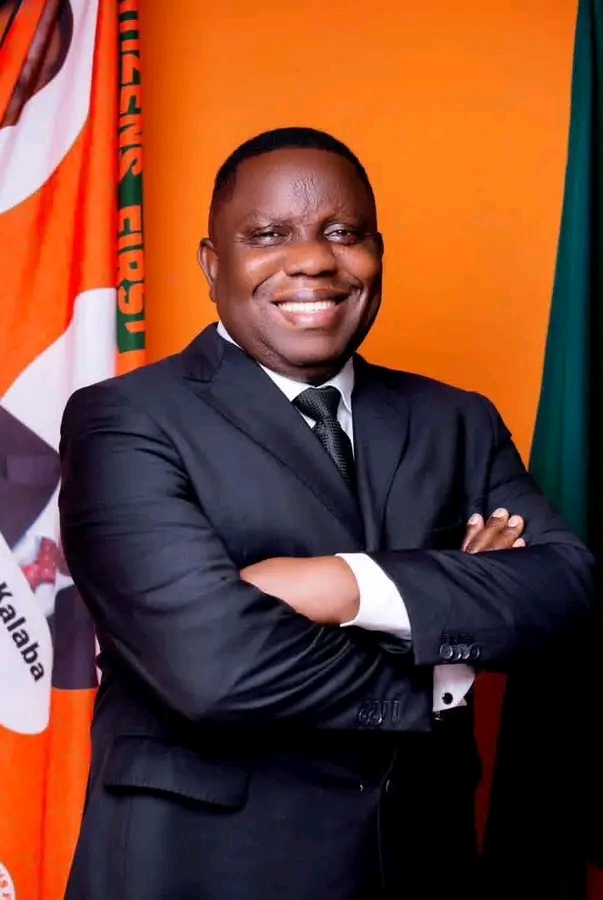
Harry Kalaba: The principled contender seeking State House
Headline option 2: Zambia’s conscience: Why Harry Kalaba believes his time has come
… With the 2026 elections on the horizon, Kalaba is making the case that integrity is not a weakness, it’s a strategy.
THERE are politicians who talk about sacrifice, and then there is Harry Kalaba, a man who has actually practised it repeatedly and at great personal cost. In 2018, at the height of his powers as Minister of Foreign Affairs, Mr Kalaba did something almost unheard of in African politics, he quit. Not for a better offer. Not for a rival faction. He walked out because, as he puts it, staying would have made him complicit.
“I did not enter public life to be comfortable,” he says, leaning forward with the measured intensity of a man who has rehearsed this conviction not in front of cameras, but in his own conscience.
“I entered to serve. And when serving means covering up for theft and impunity, then the most patriotic thing you can do is leave and tell the truth.”
Eight years on, Mr Kalaba is doing something even more audacious. He is coming back but this time not as a minister answering to a president, but as the Citizens First (CF) presidential candidate gunning for State House in the 2026 general elections. And he believes, with quiet but unsettling confidence, that Zambia is finally ready to listen.
Roots in Luapula
Mr Kalaba was born on 12 June 1976 in Bahati Constituency, deep in Luapula Province, a region of breathtaking lakes and stubborn poverty, where ambition has to outrun geography. His father was a politician who would later be installed as Royal Chief Chimese of the Ushi People, and from him, the young Harry absorbed an early and defining lesson that leadership is not a ladder to climb, it is a burden to carry on behalf of others.
His education took him on an improbable journey. From primary school in Mansa to St. Clements Secondary School, then later drawn by a Catholic faith that still underpins his moral compass, to the Seminary in Uganda, and eventually to the Urbaniana University in Rome, where he earned a degree in Philosophy.
It is a detail that surprises people, but perhaps it shouldn’t. There is something distinctly philosophical about a politician who keeps choosing principle over power.
He later studied Public Administration at Makerere University in Uganda and in 2018, added an MBA from LIUTEBM University in Zambia. The academic breadth tells the story of a man who never stopped sharpening himself, even as the political world around him grew increasingly blunt.
The making of a politician
Mr Kalaba entered the civil service in the late 1990s, spending a decade inside the machinery of government before politics claimed him fully. The turning point came in 2008, when he resigned from his government post on principle, a move that caught the eye of Michael Chilufya Sata, the iconic Patriotic Front (PF) leader who would become Zambia’s fifth Republican President. Mr Sata, who trusted few people easily, recognised in Mr Kalaba a rare thing, a man whose word meant something.
Elected to Parliament for Bahati Constituency in 2011, Mr Kalaba did not treat the seat as a salary. He redirected his earnings, his allowances, and whatever private resources he could mobilise toward building classrooms and supporting the children of one of Zambia’s most disadvantaged constituencies.
“The people of Bahati did not elect me to go to Lusaka and forget them,” he says. “They elected me to carry them with me.”
His rise through cabinet was swift. Deputy Minister overseeing disaster preparedness. Then Minister of Lands, where he automated land title issuance, a reform that gave ordinary Zambians access to formal land ownership and, by extension, financial credibility. Then, in 2014, the top diplomatic post o Minister of Foreign Affairs.
It was at this height that his character was most severely tested. When President Sata died in office, Mr Kalaba was among those who steadied the ship, supporting late former president Edgar Lungu (MHSRIP) through the transition. For years, he remained loyal. But loyalty, he eventually concluded, had its limits.
“There comes a point where silence is not loyalty, it is cowardice,” he says. “I was not prepared to be cowardly.”
Building something new
His 2019 revival of the Democratic Party (DP) and a creditable third-place finish in the 2021 general elections showed that Mr Kalaba had a constituency beyond Bahati. In 2022, after state-sponsored pressure dismantled the DP’s structures, he founded Citizens First (CF) launched on September 23, 2022 and ratified by its National Council in 2023. The party has grown rapidly into one of the more coherent voices in Zambia’s opposition, less interested in noise than in argument.
His policy platform is specific where many opposition manifestos are vague. He wants a citizen-driven economy that stops exporting raw materials and starts processing them at home. Industrialisation. Cottage industries linked to agriculture. Equitable land ownership. Education and health as non-negotiables. Democratic governance that is not simply declared, but demonstrated.
“We have been told for decades that Zambia is rich,” he says. “It is. But the wealth goes out of the country, and the poverty stays. That is not an accident. It is a policy choice. And it is a choice we can reverse.”
The man behind the candidate
Away from the podium, Mr Kalaba is married to Irene, his childhood sweetheart, with whom he has three children. The couple also care for a wider circle of children from extended family who include orphans and those facing hardship, a quiet, daily expression of the values he espouses publicly.
He holds an Honorary Doctorate in Transformational Leadership from Myles Leadership University in Cape Town, and in 2024 received the Global Inspirational Leadership Award from the International Forum on African-Caribbean Leadership in New York. The international recognition matters less to him, he insists, than the verdict of the villages.
With 2026 approaching, president Harry Kalaba knows the road to State House is steep and the incumbency advantage of the UPND formidable. But he has walked away from comfort before. Walking toward something harder is, for this particular politician, entirely in character.
“Leadership is not about enriching oneself at the expense of the people,” he says, rising to leave. “It is about giving, building, and leaving behind a better Zambia than we found.”
He has said it many times. He means it every time. Whether Zambia’s voters choose to believe him in 2026 may be the most consequential question the country faces.
Lie lie, he’s not anything good for anything close to leadership, he spoils things, very bad
Indeed a serious liar Kalaba is.
We were together at Bahati Seminary or St Clements secondary school in mansa/
kawambwa. Harry kalaba was not one of the 21 guys who made it to university. We all
know each other and most of us went to unza. Today there are many in the civil service and
military and other security systems. Kalaba failed after two years at that italian seminary.
He came back to Zambia and we his former classmates took turns in accomodating harry
kalaba in our rooms at unza. He stayed with us until one of his relations, a mr. mwila who was at cabinet office, organized him a job as an office orderly at cabinet office. Harry is telling a lie by saying that he had a degree when he joined the registry at cabinet office. His qualifications are on record and it can be verified. Harry kalaba does not have formal qualifications or degrees. He has not studied under any ugandan university bonly made friends in Uganda with some politicians when he was foreign affairs minister.
Politicians must stop lying and hiding behind political titles. If harry thinks it is oke ti cheat about your academic qualifications just because sata did it, let him allow a full investigation into his alleged qualifications. Harry never went to makelele. He may have enrolled at LIUBTUM but kalaba, nevery really bothered to read. That honorary Degree he organised from Ghana is not something he should be boasting about because kalaba neveer read a single page towards getting it. Feel shame harry and say the truth. Your party must not cheat about you . You have never graduated from the universities you claim to have attended. Harry , you came after flopping in Italy. Since when did that failure become
a degree from italy? Police must get interested here. This man wants to cheat the whole nation.
Thank you for this important information about Harry Kalaba. I wasn’t aware of his educational background; no wonder whatever he says does not make sense.
Why do people cheat about their qualifications once they become politicians in Zambia?
Isnt it a crime to claim academic qualifications one doesnt have ? Does kalaba know that
his academic record can be easily followed? This claim must be reported to the police so that an
investigation is carried out in public interest. Its criminal to claim qualifications you never took time to read for.
If he had those qualifications, why did he spend ten years in the registry at cabinet office? His best achieved position was registry clerk, a position higher than driver. People can go to the registry at PSMD at Cabinet office and they can be shown Kalaba’s qualifications. Why does he now want to cheat? He hasnt been talking about qualifications previously when he sought public office. Why now pretend he is qualified? Is it because Mweetwa told him to go back to school and read and he is too low a life to be taken seriously? Police and UPND , here is a case for your follow up in public interest. Harry Kalaba is masquarading as university graduate when in fact not. Please establish the truth for the public. If found wanting, police go ahead and prosecute please.
o
Don’t be swayed by that ka CV. Politics is something else. Contrast SATA and kalaba. SATA had a humble CV but great political capacity. Harry is going nowhere. The cabinet minister portfolio was actually his maximum political achievement.
Mr. Kalaba a principled contender? Really? Yes, he resigned from the corrupt PF which he helped to install after the demise of Mr. Sata. I recall very well how he would argue the case for the corrupt Mr. Lungu with bulging eyes and visible aggression. Even threatening to deport Dr. Guy Scott, the then acting president.
After resigning, he made a 180 degree turn and started working with Mr. Lungu whom he had denounced as corrupt. Is that a mark of a principled contender? To me he is more of an opportunist than anything else.