

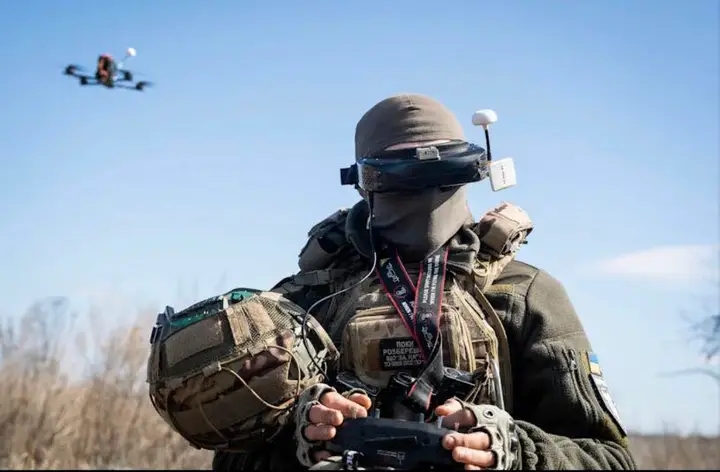
I listened to General David Petraeus this week say something that stopped me in my tracks: “Combined arms cannot survive. Tanks can’t survive on this battlefield.”
This isn’t a blogger’s hot take. This is the man who commanded US Central Command, ran the surge in Iraq, and led NATO forces in Afghanistan — telling us that the tactical grammar of warfare since 1945 has just been rewritten, in real time, in the fields of Donetsk. Here’s why he’s right, and why Ukraine’s genius was born entirely of necessity. 🧵👇
—–
THE DEATH OF COMBINED ARMS: HOW UKRAINE’S NECESSITY BECAME THE MOTHER OF A NEW WAY OF WAR
For a century, the logic of land warfare was settled doctrine. Tanks punched holes. Infantry and infantry fighting vehicles poured through them. Artillery cleared the way and covered the flanks. Air power sealed the deal. This was combined arms — the method that took Berlin in 1945, drove Iraq from Kuwait in 1991, and toppled Baghdad in 2003. Every serious army on Earth built itself around it.
General David Petraeus — four stars, former CIA Director, the man who literally co-authored the standard history of warfare since 1945 — has now said, plainly, that this era is over. In a recent interview, Petraeus described how the war began in 2022 as textbook combined arms, with Russian armor columns pushing on Kyiv and Ukraine retaking ground the same way that autumn. But something changed. Cheap drones, in overwhelming numbers, turned the battlefield into what he calls a death zone — a zone artillery can barely enter before being forced to withdraw or die, a zone where, in his words, tanks simply cannot survive.
The numbers back him up in a way that should unsettle every general staff in the world. Reporting this year found that the drone kill zone along the front has widened to roughly 50 kilometers — not the ten or fifteen originally estimated, but fifty, thick with fiber-optic-tethered drones immune to jamming. Some Russian soldiers, according to their own military bloggers, now survive only twenty to thirty-five minutes once they cross into forward positions. And the result is a front line that barely moves at all: the US-based Center for Strategic and International Studies assessed that Russia’s advance on the transport hub of Pokrovsk — fought over for nearly two years — was slower than the Allied advance during the Battle of the Somme in 1916. That is not a footnote. That is one of the bloodiest and most static campaigns in human history being used as the modern benchmark, and Russia still came in slower.
But here is the deeper truth, and the one I think matters most: this was not innovation for its own sake. It was necessity. Ukraine did not have the tank fleets of Russia. It did not have the artillery stockpiles, the air force, the sheer mass that Moscow could throw at the problem. What it had was engineers, urgency, and a battle for national survival that left no room for doctrinal sentimentality. Denied the tools of old warfare, Ukraine built new ones — an entire drone-industrial base, assembled and iterated at wartime speed, that Petraeus now calls potentially “the most important military industrial complex in the free world.” Constraint, not comfort, is what produced the breakthrough.
This is, in fact, an old and recurring pattern in the history of statecraft. Prussia, humiliated and stripped of its army by Napoleon after 1806, did not rebuild the old Prussian army — it built a new military system entirely, the Krümper system and the general staff model that would dominate European warfare for a century. Necessity, not privilege, is very often where military revolutions are born. Ukraine, denied the arsenal of a great power, has done something similar: it has not merely resisted Russia, it has quietly rewritten the rules that every army will now have to reckon with — from Washington to Beijing to Moscow itself.
Whether this is a permanent law of war or a feature of this particular static front remains to be tested. But no serious defense planner anywhere in the world is now designing tank fleets, force structures, or offensive doctrine without first asking: can it survive the drone. That is the measure of how completely the ground has shifted — and it was written not by the powerful, but by the besieged.
….. The Great Game
Please follow me also on substack at limtean.substack.com where I discuss in greater detail geopolitical issues.
Below: Ukraine’s drone boom, a blueprint for modern warfare on a budget.