

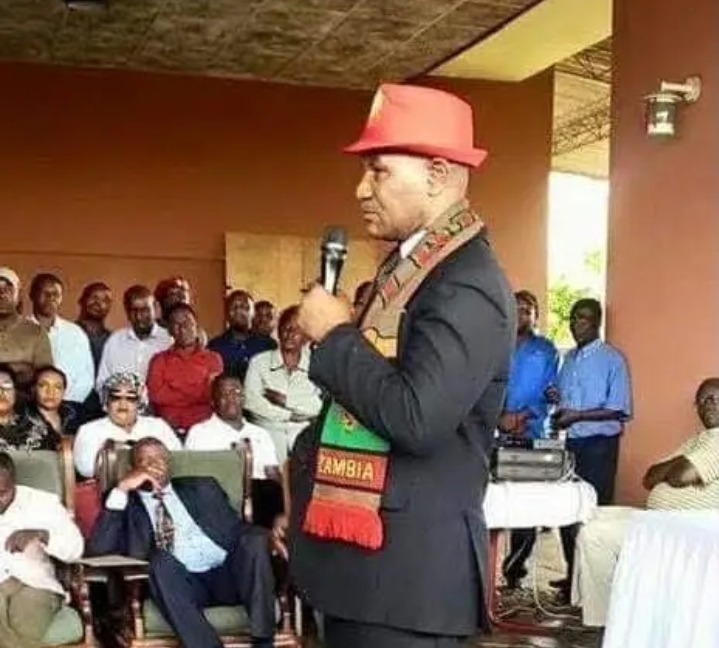
LUPANDO KATOLOSHI MWAPE—THE HUMBLE SERVANT WHO WAS DEMOTED, ONLY TO BE REWARDED WITH THE VEEP POSITION
In Zambian politics, sometimes being fired is not the end of your career.
Sometimes, apparently, it is merely a political internship before promotion.
Enter Mwape, a man whose political journey could easily be titled:
“From Aircraft Maintenance to Government House and Back to the Runway.”
Born on July 15, 1950, Mwape was an aircraft maintenance engineer, aircraft inspector, technical and vocational lecturer, educational administrator and curriculum development adviser.
In other words, while some politicians were learning how to make noise at rallies, Mwape was busy learning how to keep aircraft from falling out of the sky.
He held qualifications in aeronautical electronics and worked in technical education before eventually deciding to enter the far more unpredictable world of Zambian politics.
And perhaps the aircraft was safer.
Mwape entered Parliament through Lukashya Constituency in 2001 on the MMD ticket and won the seat with 5,562 votes against his closest rival, the UPND’s Pilate Chilambwe who got 2,419 votes.
Mwape was subsequently appointed Minister of Communications and Transport.
He also served as Chairman of the Africa Telecommunications Union and played a role in the TAZARA Council of Ministers.
Things appeared to be taking off nicely.
Then came the turbulence.
Mwape was dropped from Cabinet amid allegations of wrongdoing. Accounts from the period say he maintained that political enemies had fed President Levy Mwanawasa false information about him.
Whatever the political mechanics behind his removal, Mwanawasa later brought him back into government as Northern Province Minister.
Now, ordinarily, being moved from Cabinet to a provincial ministry would be interpreted as a demotion.
But Mwape apparently took it without throwing political furniture around.
He simply accepted his new assignment and continued working.
And then came one of the great plot twists in Zambian political history.
In October 2004, President Mwanawasa dismissed Vice President Nevers Mumba and appointed the relatively low-profile Northern Province Minister as his replacement.
Mwape became Zambia’s ninth Vice President, serving from 2004 until 2006. Contemporary and later accounts describe Mwanawasa as valuing his low-profile approach and public-service credentials.
His rise was particularly remarkable because he had not been one of the loudest political personalities within the MMD.
In fact, he seemed to demonstrate one of the rarest qualities in Zambian politics:
quietness.
A very dangerous commodity in politics.
Mwape’s political career was not without controversy.
In March 2005, he threatened to leave the MMD amid allegations that senior party figures were using corruption and bribery to secure support ahead of the party convention.
The party itself was experiencing intense internal competition, eventually freezing the vice-presidential position to reduce the infighting.
Because apparently even political parties need to occasionally put their members in timeout.
In 2006, Mwanawasa suffered a stroke and was evacuated to London.
With Mwanawasa receiving treatment abroad, Vice President Mwape became Acting President.
Enter Michael Sata.
Sata as opposition PF president, demanded that the Chief Justice constitute a medical board to determine whether Mwanawasa was medically fit to continue governing.
When Sata went to Cabinet Office to deliver his request to Mwape, accounts from the period say Mwape declined to meet him and left him waiting in the lobby.
Sata was not amused.
He reportedly sent a message through his private secretary telling Mwape, among other things, to stop making private “midnight phone calls” if he was unwilling to meet him face-to-face during the day.
Mwape subsequently rejected Sata’s request for a medical inquiry.
Sata then vowed to descend on Northern Province politically and dismantle Mwape’s influence.
And Northern Province, as usual, was about to become the battlefield.
In the 2006 general elections, Mwape returned to Lukashya seeking another parliamentary term.
But this time, the voters had other plans.
He was defeated by Alfreda Kansembe Mwamba, who was subsequently referred to in Parliament as the “Giant Killer” for defeating the former Vice President.
Mwape polled 9,228 votes against Mwamba’s 12,422.
Mwape lost both his parliamentary seat and, consequently, the platform from which he could have returned to the Vice Presidency.
He was succeeded by Rupiah Banda.
After leaving active frontline politics, Mwape was appointed Zambia’s Ambassador to China from 2007 to 2009.
China formally received his credentials in March 2007, and he concurrently represented Zambia in several other countries.
Not exactly a bad consolation prize.
From aircraft maintenance engineer to Cabinet minister, from provincial minister to Vice President, and from Vice President to Ambassador to China.
The man had more career changes than some politicians have manifestos.
In 2011, Mwape returned to Lukashya as an independent candidate, hoping to reclaim his old political territory.
But once again, he was unsuccessful as he finished fourth with 3,096 votes, while Mwamba again topped the poll with 10,793 votes.
At this point, Lukashya had effectively become Mwape’s political equivalent of an airport security checkpoint:
You can keep trying, but you’re not getting through.
He was later briefly associated with the PF during the 2015 presidential by election before joining the UPND in 2016 and campaigning for the party in that year’s general elections.
Mwape died on January 21, 2019, in South Africa while receiving specialised medical treatment. He was 68, and the Zambian government declared three days of national mourning.
President Edgar Lungu described him as a gallant son of Zambia and highlighted his approachable personality and public-service record.
Mwape’s political story remains one of the more unusual journeys in Zambia’s political history.
History remembers him not for the noise he made, but for the public positions he occupied and the unusually winding road he travelled to get there.
Perhaps the biggest lesson from Mwape’s story is that in Zambian politics, a demotion is not always a demotion, a promotion is not always permanent, and losing an election can sometimes be more powerful than winning one.
And if there is one thing the good old days taught us:
Never underestimate a quiet man in politics. Sometimes he is just waiting for the next appointment letter.