

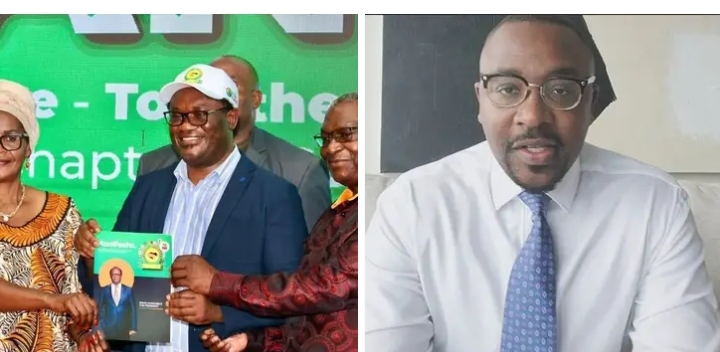
A Debt-Fueled Illusion: Why the Tonse Manifesto Risks Taking Zambia Backwards
By George N. Mtonga, MBA
There is a dangerous pattern in Zambian politics; one we must confront honestly.
Every few years, a manifesto emerges that promises everything: higher wages, lower taxes, more jobs, more infrastructure, more social protection, and faster growth. It reads well. It inspires hope. It speaks to real pain.
But behind the language, there is often something missing.
The numbers.
The Tonse Alliance manifesto is no exception.
At first glance, it positions itself as a “social contract” to transform Zambia into an upper-middle-income country within five years. That is an ambitious goal; one every Zambian aspires to be.
But ambition without arithmetic is not leadership. It is risk.
The Core Problem: Spending Without a Financing Plan
The manifesto outlines:
Expanded social programs (spend)
Increased public sector support (spend)
Youth and employment interventions (spend)
Infrastructure and industrialization (spend)
Tax relief for citizens and businesses (lowers revenue)
Each of these policies has a cost. A real cost.
Yet nowhere in the document do we see a clear, quantified financing strategy. There is no detailed revenue framework, no deficit ceiling, no borrowing limits, and no sequencing of priorities.
In simple terms:
We are being promised more spending and less revenue; at the same time.
That is not a development strategy.
That is a deficit.
Debt Does Not Wait for Growth
Zambia already carries a public debt burden of approximately $28.9 billion thats whats in the debt account this is even lower than where Brian Mundubile & Co left it ($31.1B 2021)
This is not theoretical. This is the reality we are managing today.
When a government increases spending without matching revenue, it borrows. And when it borrows at scale, debt rises quickly what happened from 2011 to 2021.
Based on the policy direction in the Tonse manifesto, even a conservative estimate suggests:
Annual deficits will rise significantly
Borrowing could increase by $10–15 billion over five years
That means Zambia could be pushed back toward $40–45 billion in debt within a single political cycle. That means the debtn balance goes from $28.9B to $45B an increase of $17B to the debt balance. Servicing this debt would eat up 50% of our budget like it did during PF days. You are now in that cycle where every the debt just increases. Because you invested in consumption.
We have been here before.
And we know how that story ends.
The Illusion of Immediate Transformation
The manifesto assumes that:
Growth will accelerate rapidly
Industrialization will generate revenue quickly
The economy will “catch up” to the spending
But economies do not work like that.
Growth takes time.
Reforms take time.
Revenue takes time.
Debt does not.
Debt accumulates immediately; year by year, dollar by dollar.
This is the fundamental flaw:
The manifesto front-loads spending and back-loads benefits.
That gap is financed by borrowing.
Who Pays the Price?
Debt is not just a number on a balance sheet.
It translates into:
Higher interest payments
Reduced fiscal flexibility
Pressure on the exchange rate
Increased cost of living
Fewer resources for future generations
Every kwacha borrowed today is a kwacha that must be repaid tomorrow; with interest.
And when debt rises too fast, the burden does not fall on policymakers.
It falls on citizens.
We Cannot Afford Another Cycle of Recklessness
Zambia has spent the last several years stabilizing its economy, rebuilding credibility, and restructuring unsustainable debt.
That progress is fragile.
A return to unchecked borrowing, no matter how well-intentioned. risks undoing those gains.
We cannot afford to repeat the cycle of:
1. Overpromising
2. Overspending
3. Overborrowing
4. And then asking citizens to endure austerity
Leadership Requires Trade-Offs
Real leadership is not about promising everything.
It is about making choices.
What do we fund now?
What do we delay?
What do we cut?
How do we pay for it?
These are difficult questions. But they are the only path to sustainable development.
Any manifesto that avoids them is not being honest with the Zambian people.
Hope Must Be Anchored in Reality
Zambians deserve better than slogans.
We deserve plans that are:
Costed
Sequenced
Sustainable
Transparent
The Tonse manifesto speaks the language of hope.
But without fiscal discipline, that hope risks becoming a debt-fueled illusion.
And Zambia has already learned, at great cost, what happens when illusion replaces discipline.
We must not go back.
George N. Mtonga, MBA
Very well argued.
Mundubile can’t produce a manifesto.
They that’s goodpresented is just the same outdated PF manifesto. Taking the country kunuma. Dununa reverse.
De javu. We been there. The opposition have no practical, workable solutions that is why all they do is whine and complain about hardships people are going through. They offer no solution because they have none or their solution are not viable.
Bringing back PF in whatever form will be a terrible mistake. PF was a disaster for our country and destroyed everything leaving smouldering ruins in its wake.
My vote is on President HH. He and his team have done very well considering the state our country was in when they took over power in 2021. He is our only hope.
well said and put.
the ills the writer has noted are what comes with voting
for Sata type of no school populist leaders. Harry kalaba
is exactly the type that thinks but by not using their
school knowledge or heads. Kalaba, Mumbi phiri,
davies mwila, chitotela, kambwili, kampyongo, chilangwa,
sikazwe freedom, kapata jean, sata himself, bowman, GBM and the majority of PF
leaders including Mandubile were, and still think exactly
like what writer says isn’t the way for economic development.
Zambia had, especially under PF, the most below level leaders.
people who should never have been considered for leadership. They understood no
nuts and yet the people entrusted their lives in such people.
Please do not make a mistake to vote for PF and all the people listed
above.
Why are we even wasting our precious time worrying about the impossible? PF has exactly the same chances of bouncing back to power as UNIP.