

🇿🇲 ANALYSIS | PF Dual Claims, One Ballot, & Politics of Survival
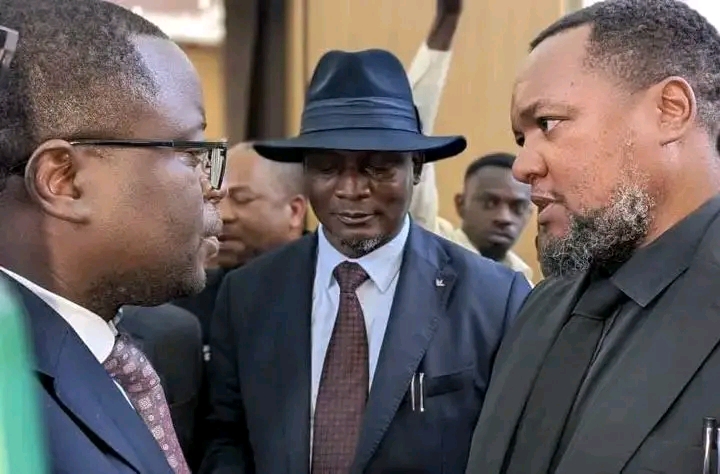
The scene at Mulungushi International Conference Centre was more than just another administrative meeting convened by the Electoral Commission of Zambia. It was a live demonstration of a party in dispute with itself. Two men, Makebi Zulu and Miles Sampa, both walked into the same room, both claiming to represent the Patriotic Front, and both positioning themselves as legitimate presidential contenders.
This is no longer an internal disagreement. It is now an institutional problem.
At the heart of the matter is recognition. Elections are not run on political emotion or factional loyalty. They are run on legal clarity. The ECZ cannot print a ballot paper with two candidates from one political party. It must recognise one lawful structure, one set of office bearers, and one authorised candidate.
Right now, PF does not offer that clarity.
The legal trail is messy. Court rulings have been interpreted differently by competing camps. One side leans on the justification of the October 2023 conference. Another challenges its legality and continuity under the party constitution. The result is a vacuum disguised as competition.
If this remains unresolved by nomination stage, the most probable outcome is not compromise. It is exclusion.
The ECZ, bound by law and precedent, is unlikely to validate parallel claims where there is no single recognised authority. In practical terms, that means both camps risk being rejected, not because neither has support, but because the party itself cannot present a coherent legal identity.
This is where the real political consequences begin.
Presidential battles make headlines, but parliamentary races determine survival. Members of Parliament do not operate in theory. They operate in constituencies where ballots must carry a clear party symbol, endorsed by a recognised structure. If PF fails to present a legally accepted hierarchy, its candidates risk being locked out entirely or forced to run as independents.
For sitting MPs, that is political suicide.
Running without a party structure removes mobilisation machinery, funding networks, and brand identity. It fractures voter confidence and weakens ground operations. In Zambia’s electoral system, party affiliation is not cosmetic. It is foundational.
This is why defections are accelerating.
When PF MPs cross over to the United Party for National Development, it is not always ideological. It is strategic. It is about securing a ticket that will actually appear on the ballot. It is about avoiding legal uncertainty and guaranteeing continuity.
Simply put, it is about survival.
The irony is sharp. A party that once commanded national power is now struggling to guarantee its own presence on the ballot paper. Internal fragmentation has moved from being a political weakness to becoming an existential threat.
Mulungushi was not just a meeting. It was a warning.
If PF does not resolve its leadership question with legal finality, it risks entering the 2026 election not as a divided force, but as a diminished one. And in politics, there is a difference. A divided party can still compete. A legally undefined party may not even qualify to do so.
The clock is now the most powerful actor in this story. And it is not on PF’s side.
© The People’s Brief | Editors
Chabonga, miles should contest, Zulu naaa…!
The Patriotic Front won’t be on the Ballot during the Presidential life of Mr Hakainde Hichilema.
These people are just wasting time.
The Registrar of Societies will never replace Robert Chabinga as President of the Patriotic Front.