

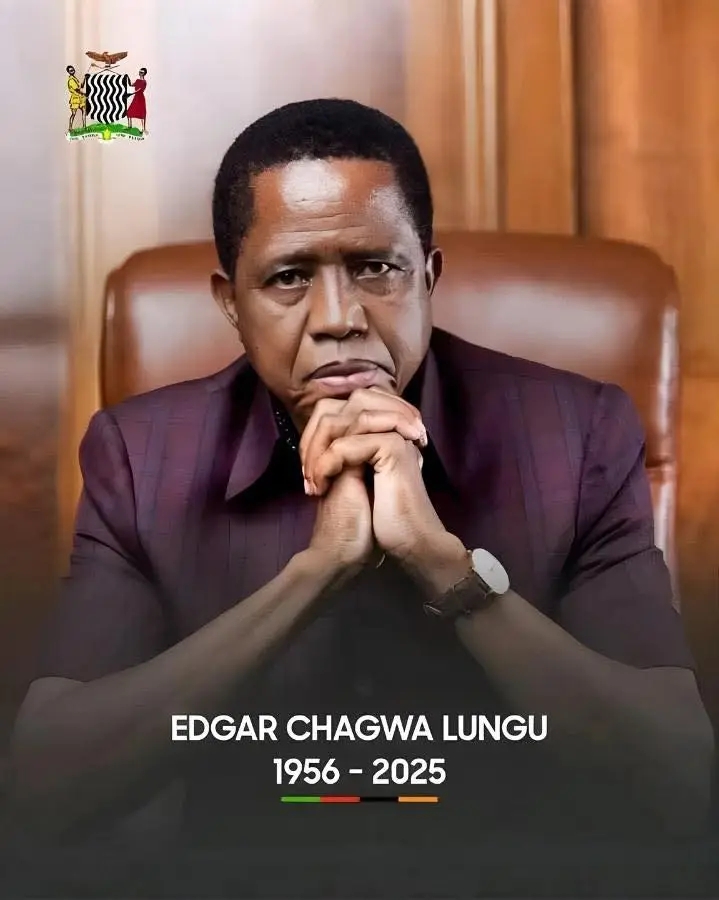
BREAKING NEWS: ECL BODY TO BE PLACED UNDER AVBOB CARE AS FAMILY RETAINS ACCESS RIGHTS
By Brian Matambo | Pretoria, South Africa | 30 April 2026
The Gauteng Division of the High Court of South Africa, sitting in Pretoria, has issued a fresh order in the escalating legal battle over the remains of Zambia’s Sixth Republican President, Dr Edgar Chagwa Lungu, setting aside the urgent ex parte order granted on 22 April 2026 and directing that the late President’s body be placed in the care of AVBOB Pretoria East.
The order, made before Honourable Justice PA van Niekerk on 30 April 2026, follows an urgent application brought by former First Lady Esther Lungu, alongside Bertha Lungu, Tasila Lungu, Dalieso Lungu, Chiyeso Lungu, Charles Phiri, and Makebi Zulu, against the South African Police Service, the National Commissioner of Police, the Minister of Police, the Government of the Republic of Zambia, Two Mountains Burial Services, and South Africa’s Minister of International Relations and Cooperation.
In a major development, the court records that the previous urgent ex parte order granted on 22 April 2026 by Judge Francis-Subbiah has now been “reconsidered and set aside.” That earlier order sat at the centre of last week’s storm, after the body of the former President was removed from Two Mountains Burial Services in Pretoria in circumstances that the family and its supporters have described as a shocking violation of the widow’s rights, the dignity of the deceased, and the sanctity of family consent.
The media reported last week that the Zambian government had taken custody of Dr Edgar Lungu’s remains after a South African court order, before a separate urgent order directed that the body be returned to the funeral home where it had been kept since his death. The media also reported that the family launched an urgent court bid after the body was taken from a mortuary without their permission by SAPS and Zambian authorities.
Reacting to the latest development, Makebi Zulu, the spokesperson for the Lungu family, said the new court-supervised arrangement was necessary in order to move the matter forward, particularly because there had been a possible misunderstanding regarding how the case was now proceeding before the Supreme Court.
Mr Zulu explained that, under the ordinary rules of the Supreme Court, the parties would only have been filing their submissions on 19 June, meaning that the matter would ordinarily have taken much longer than necessary. He said the parties had therefore agreed on an abridged process to shorten the proceedings.
However, he said that in the course of communication between the parties over how the matter should be handled, critical details appeared to have been lost. According to him, it was in that confusion that the body was illegally moved from Two Mountains Burial Services to the Forensic Pathology Services.
“We challenged that movement. We obtained an order and managed to secure the body,” Mr Zulu said.
He further stated that, for purposes of moving ahead, it was important that the order given by Judge Ledwaba be respected. He said the parties had also agreed on a mutually acceptable mortuary where the remains would be kept, with access limited only to the family.
“If any other person wishes to have access to the body, they must make an application to the court, with notice being given to the applicants in this particular matter, so that we can have a say regarding whatever purpose they may think they need the body for,” Mr Zulu said.
The new order now places the body of the late President under AVBOB Pretoria East, with the costs to be borne by the Government of Zambia. If AVBOB refuses the appointment, the court will appoint another mortuary. This is not a minor administrative shift. It is a legal intervention designed to remove the remains from the battlefield of unilateral control and place them under a clearer court-supervised arrangement.
Most significantly, the order preserves the access rights of the family. Until the Supreme Court of Appeal makes its decision in case number 1024/2025, the first to seventh applicants, led by Esther Lungu, are to retain their rights of access to the body in terms of the earlier court order of 25 June 2025. The court further states that any other person wishing to access the body for any purpose must first obtain a court order on notice to the applicants.
That clause cuts to the heart of the controversy. After a week in which the former President’s widow was subjected to the horror of learning that her husband’s body had been moved without her consent, taken to a pathology facility, and in effect desecrated, the court has now drawn a firm legal line: no one may simply walk in, take control, inspect, move, interfere with, or access the body without proper notice to the family and a court order.
For the Lungu family, this order is more than a procedural victory. It is a partial restoration of dignity after days of anguish. For the Zambian government, it is a serious legal rebuke against the appearance of force, secrecy, and overreach in a matter that should have been handled with humanity, restraint, and respect for the widow.
The political charge surrounding this case cannot be separated from the long and bitter rivalry between the late President Lungu and President Hakainde Hichilema. The dispute has been a fierce political battle that has left the former President unburied for nearly ten months, with the Lungu family insisting on burial arrangements that exclude President Hichilema, while the Zambian government insists on a state funeral in Zambia. The family objected to President Hichilema’s involvement in the funeral, citing the need for a dignified send-off.
But last week’s events changed the moral temperature of the dispute. This is no longer merely a disagreement over burial protocol. It has become a question of state power against a widow, executive ambition against family grief, and political theatre against the quiet dignity owed to the dead.
The High Court’s latest order makes one thing plain: the body of Dr Edgar Chagwa Lungu is not political property. It is not a trophy of state authority. It is not a campaign prop. It is the mortal remains of a former Head of State, a husband, a father, and a citizen whose family still has rights before the law.
Justice, even when delayed, must still have a pulse. Today, in Pretoria, the law has at least reminded the powerful that a widow is not without standing, a family is not without rights, and a dead President is not without dignity.
Does this Brian understand English. Very poor analytical skills. Go back to school and stop copying study hard.