By Hopewell Chin’ono
President Emmerson Mnangagwa wants to extend his term of office from 2028 to 2030. His term is supposed to end in 2028, and under Zimbabwe’s Constitution he cannot run again after serving for ten years. He wants to serve for 12 years and probably die in office if he can.
If it is to have any legitimacy, he must go to the people and make his case, then subject it to a referendum. Citizens must be allowed to debate it openly, in public meetings and through submissions to Parliament. Those in favour of extending the term of office, removing the direct election of the president by the people and handing that power to Parliament, and pushing through the many other changes contained in Constitutional Amendment Bill No. 3, are free to campaign and make their case.
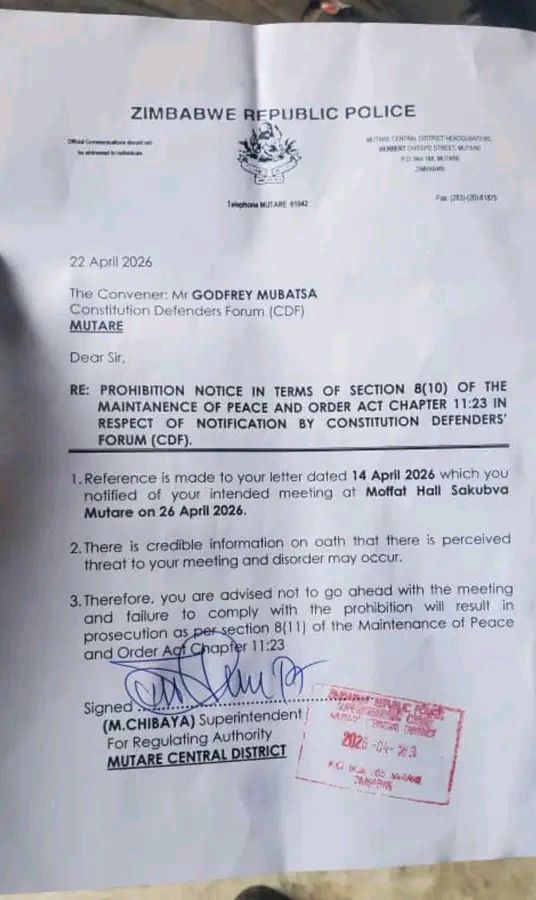
But the tragedy is that those opposed are being stopped. The government, using the police, is blocking dissent. As you can see from the latest notice banning the Constitutional Defence Forum from meeting in Mutare, there is no level playing field. The CDF leader and convenor, Tendai Biti, was arrested in Mutare a few weeks ago and is on bail for doing exactly what ZANUPF is freely allowed to do everyday.
The president must understand this. The moment you silence the opposing side, you destroy the legitimacy of the entire process and make the law discredited. Whatever comes out of it becomes contestable and illegitimate.
If he had allowed those against his amendments to engage freely, as his supporters are doing, he could at least claim fairness. Right now, he cannot, the behavior by his supporters and state security institutions barring those opposed have made the whole process contestable by those not only opposed from outside ZANUPF, but those inside too who disagree with it.
The second issue is the constitutional prescription of a referendum. The president does not want one, yet the Constitution requires it. That matter is before the courts, and the courts will determine it. But the principle is simple, you cannot rewrite the rules of the game while blocking the other side from speaking, and bending the constitution by removing the referendum.
More dangerously, by shutting down dissent, he is creating a pretext, a plausible excuse. If, by any chance, elements within the military decide to intervene, he has handed them an argument. They can legitimately say they stepped in because the constitutional process was being manipulated, because citizens were denied their right to participate, because debate was suppressed, and because a referendum has been blocked. He is opening that door himself.
The third reality is uncomfortable but true, and must be said and ventilated. Mnangagwa is going to push these amendments through by any means necessary. The opposition, as it stands, is weak, fragmented, and in many cases compromised. It is not in a position to stop him.
The only person with real leverage inside the system is Vice President General Constantine Chiwenga. If Chiwenga does not act, then these amendments are effectively done. The only institution with the capacity to halt this process is the military. If it does nothing, then the outcome is predetermined.
There is no point sugarcoating this. We must tell the truth so that when history is written, it reflects what actually happened, how it happened, and why it happened.
Even if Chiwenga were to succeed in stopping Mnangagwa, Zimbabwe would still remain under ZANUPF. It would simply be a shift from one faction to another, from Mnangagwa’s faction to Chiwenga’s faction. There is no credible opposition alternative at present. So the reality is as citizens, we have been left with only one alternative, choose which ZANUPF faction is palatable.
We have seen this before. In 2017, during the coup, the opposition as a political institution aligned themselves with the military intervention that removed former president Robert Mugabe. Those who opposed it, like Tendai Biti and Dr Alex Magaisa, had no viable alternative to rally behind because the opposition leadership itself supported the military coup process.
Urban populations were mobilised into the streets by the official opposition, their safety guaranteed by the military, because there was a shared objective. Once that objective was achieved, the system reset to its default, anti-democratic state.
If Mnangagwa succeeds now, the consequences will be long-term. The opposition, as we know it, will be effectively obliterated. Constitutional Amendment Bill No. 3 removes the direct election of the president by the people and shifts that power to Parliament.
At the same time, it weakens key institutions, including those responsible for delimiting constituency boundaries. The result doesn’t need a rocket scientist, it is predictable. Areas where ZANUPF has support will gain more seats, and areas where the opposition has support will be diluted..
We are then no longer talking about 2028. If the amendment passes, there will be no election in 2028. We are talking about 2030 and beyond, with power effectively secured for a generation unless something extraordinary happens.
That is the reality of Constitutional Amendment Bill No. 3. Anything else is denial, deception, or comfort talk.
The public has a right to know the truth, and to understand why certain things are happening. There is an unspoken reality in this debate, an ethnic dimension. Some people are quietly supporting this process because they believe it favours those from their own ethnic group. Others are opposing it because they see it as an ethnic project.
This cuts across not just ZANUPF, but the opposition as well. I have spoken to former opposition leaders who openly say they will support the amendment because Mnangagwa comes from their ethnic group and it keeps power within that group.
Others say they oppose it because it represents ethnic hegemony. These arguments are absurd and deeply regressive, but they are real. And if you ignore them, you fail to understand why certain people are silent, why some are not campaigning publicly, and why others are more vocal than the rest.
This is the unfortunate reality in Zimbabwe. In 2026, in a world of AI, technological breakthroughs, and high-speed trains, we are still trapped in primitive ethnic calculations. It is embarrassing, but it is the truth, and it must be confronted without sugarcoating it.
Let me end by being clear. If General Constantine Chiwenga does nothing, and if the military does nothing, then President Emmerson Mnangagwa will remain in power until 2030, and possibly beyond. And the opposition, as we have known it over the past two decades, will effectively cease to exist.
Zimbabweans must understand this reality because it shapes the choices you will make about your future. The political direction of the next four years will determine how you position your life, your family, and your livelihood.
So I will say it again. If Chiwenga does not intervene, and if the military does not act, it is a done deal. Mnangagwa will push through Constitutional Amendment Bill No. 3. And once that happens, meaningful opposition will disappear. What will remain are token MPs from a few urban areas, but no real opposition. Even urban councils, which have largely been in opposition hands for two decades, will be taken.
What you are witnessing is Zimbabwe coming full circle into a system where outcomes are predetermined, where elections are a formality, and where analysis becomes redundant because the script is already written.
If General Constantine Chiwenga does not act, and if the military does not act, and this Constitutional Amendment Bill is passed, that is the end of Chiwenga’s path to the presidency. He will not become president unless he or the military moves to stop this bill. The two are inseparable, they work hand in glove.
If that does not happen, then forget about a Chiwenga presidency. Power will remain within Mnangagwa’s camp, and after him, it will simply pass to someone else from his faction.
Mark these words. If this amendment becomes law, General Constantine Chiwenga will be relieved of his duties, what we call in journalism, he will be fired. That will be the end of his political career.