

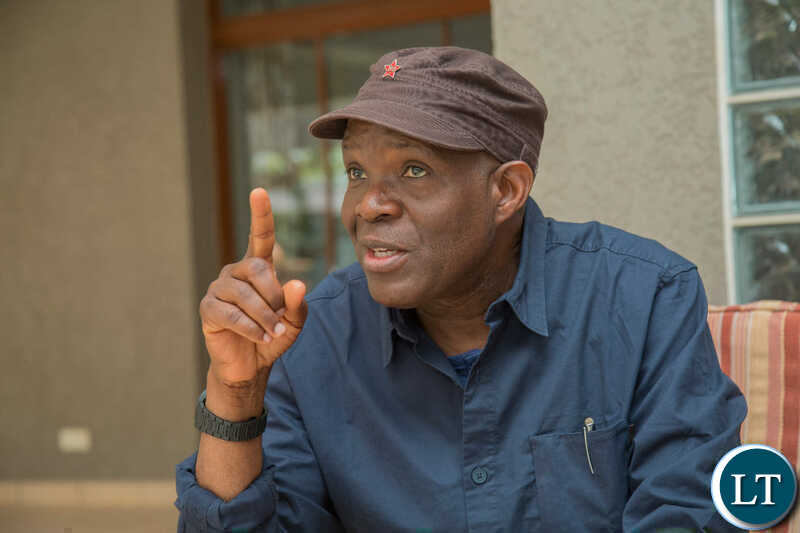
Socialist Party president Dr Fred M’membe has rejected public calls by Tonse Alliance presidential candidate Brian Mundubile for opposition political parties to unite ahead of the August 13 general election, saying serious alliance-building cannot be conducted through public declarations.
Dr M’membe said coalition discussions required structured engagement, trust and mutual respect rather than media announcements that placed political parties under unnecessary public pressure.
He disclosed that he had privately engaged several opposition leaders and insisted that genuine cooperation depended on common direction and meaningful dialogue.
“Calling us publicly is disrespectful,” Dr M’membe said in response to the invitation.
The remarks immediately exposed continuing divisions within opposition politics despite mounting pressure for coalition building ahead of the elections.
Different opposition parties have recently intensified calls for cooperation in an effort to avoid splitting votes against the ruling UPND, but disagreements around leadership, strategy and political direction continue surfacing publicly.
The latest exchange has now become one of the clearest signs yet that opposition consolidation remains deeply uncertain.
Political observers say the inability by opposition parties to build a united front could significantly strengthen the ruling party’s electoral position even in areas where public dissatisfaction exists.
Dr M’membe maintained that his party remained open to engagement but stressed that cooperation could not be forced through public pronouncements.
The Socialist Party leader has consistently argued that political alliances should be built around ideology, governance direction and structured agreements rather than temporary electoral arrangements.
The disagreement also comes at a time when concerns around opposition fragmentation are increasingly dominating political conversations across the country.
People’s Pact vice president Robert Sichinga recently warned that many Zambians dissatisfied with the UPND still remain unconvinced about who should replace President Hakainde Hichilema.
Political commentator Mulenga Kapwepwe also cautioned that opposition divisions risk creating a chaotic election environment if parties fail to coordinate effectively before nominations.
Meanwhile, Economic Front leader Wynter Kabimba has urged political parties not to drag institutions such as the Electoral Commission of Zambia into internal factional disputes.
Mr Kabimba said political parties should resolve leadership disagreements through courts and internal constitutional mechanisms instead of expecting electoral institutions to determine legitimacy battles.
The growing disputes are unfolding alongside increased pressure around campaign mobilisation, nomination fees and election preparedness.
The Electoral Commission of Zambia recently revised nomination fees upward for presidential, parliamentary and local government candidates ahead of the elections.
Governance activist Rueben Lifuka has also called for equal campaign conditions for all political players, warning that election legitimacy depends not only on voting day processes but also on fairness during the campaign period.
For now, opposition parties remain united mainly by criticism of Government rather than by a common political programme or agreed leadership structure.
The latest disagreement between Dr M’membe and Mr Mundubile suggests that opposition coalition negotiations remain fragile at a time when election momentum is rapidly accelerating.