

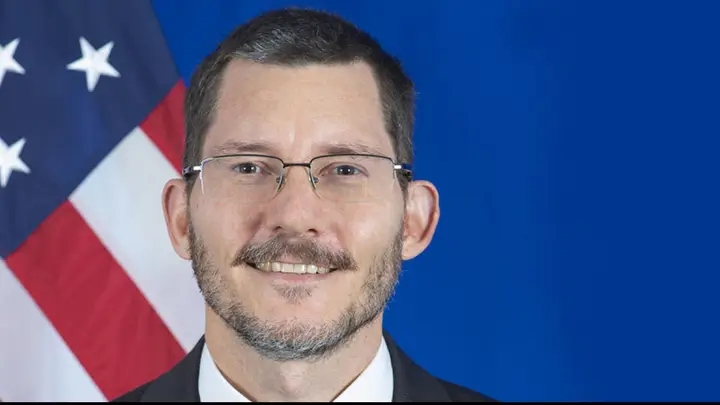
“Gonzales Departs in ‘Disgust’: A Diplomat’s Tears for Zambia”
… ‘not a single person has been arrested.’
Amb. AM. 1 May 26
I write this morning with sorrow and satire dripping from my pen, reflecting on the ‘disgust’ of US Ambassador to Zambia Michael Gonzales as he departs Lusaka for Washington from the speech he read.
Gonzale’s farewell was not the ‘polite’ bow of a diplomat but the clenched fist of a man who has seen too many atrocities, too much inertia, too much indifference. Smart Eagles
He cast aside the velvet restraint of diplomacy and spoke with the rawness of a mourner at a funeral, mourning not a person but a nation’s conscience.
“Last year I shed tears before the world when I announced a $50 million cut in US health assistance,” he said, his voice breaking.
Gonzales cried not for Washington but for the poor Zambians who went without medicine because their own leaders siphoned it off.
One year later, he lamented, “not a single notable person has been arrested… not a single notable prosecution has even begun.” This is not diplomacy. This is an indictment. Daily Nation Zambia
For decades, America poured billions into Zambia’s veins, raising life expectancy by twenty years, slashing malaria deaths, paying the salaries of 23,000 healthcare workers.
Yet when America paused funding, the health system “crumbled almost overnight.” Gonzales’ words sting: “Despite over $7 billion in U.S. health assistance since 2000… successive Zambian governments had not built systems.”
Instead, officials abdicated responsibility, letting Washington pay while they diverted funds into their own pockets. He cried for the sick, for the babies born with incurable ailments, for the poor whose poverty levels remain stubbornly high. Daily Revelation Newspaper
He cried for his own staff, harassed by ZRA officials who shook them down for fees that did not apply, dragged into court for permits never issued.
“Ten percent of my diplomats have family members who still haven’t received basic residency permits,” he revealed. This is not just harassment; it is humiliation.
Gonzales spoke of “illicit flows of cash” — $4 billion annually from Zambia bleeding into East Asia, money that could have funded hospitals, schools, clean water. If taxed, he said, it would bring an additional $1 billion for healthcare and education.
Yet the government looks away, according to Gonzalez. He spoke of meetings ignored, calls unanswered, and MOUs signed only to rot on shelves. “Our calls go ignored, questions unanswered, meetings cancelled,” he said.
The government’s favourite response? “Noted. With thanks.” Gonzales mocked this phrase, the bureaucratic lullaby sung to donors to lull them into silence.
But America is no longer silent. “We (USA) can no longer own the projects more than the Zambian government,” he declared. “Hope is not a strategy.”
He spoke of AVIC, the Chinese company convicted of fraud abroad, yet rewarded with a $650 million road contract here, subsidized by pensioners’ money. Yes, he said it.
“Even the Chinese government convicted AVIC’s Chairman to death for corruption,” he reminded us, yet Lusaka embraced AVIC while ignoring competitive bids by Zambian investors.
He asked the question investors whisper: “Can law abiding investors do clean business here (in Zambia)?” The answer, dripping with satire, is no.
He spoke of Sino Metals, whose tailings dam disaster unleashed carcinogenic heavy metals into the Kafue River, causing “generations of birth defects, cancers, heart and liver disease.”
He pleaded with leaders to act but was told the government would wait for the polluter to provide the report. He wept again: “When that tailings dam breaks, I will not be alone shedding tears.”
This is not the language of diplomacy. Diplomacy usually whispers. It couches criticism in euphemism. But Gonzales spat fire. He spoke of “systematic theft,” “dirty money flows,” “unmitigated petty corruption.”
Can someone deny it?
He spoke of “the rhetoric of ‘no sacred cows’” as “rubbish.” He spoke of “the hollow rhetoric of ‘rule of law’” that keeps investors away. He spoke of “Zambia does not need money. It needs leaders who govern for the people with integrity.”
These are not allegations. These are facts re FIC. Why hasn’t Zambia acted? Why does it go to the polls with this indictment hanging over it? How does a government campaign on integrity when its own Anti Corruption Commission is led by someone under investigation?
How does it promise jobs when investors flee, unwilling to pay “Sino brown envelopes of cash”? I don’t know.
Gonzales’ frustration is America’s frustration, and Europe’s too. “As America goes, so does the EU,” sceptics warn. What will Zambia say — deport him?
The love between Uncle Sam and Zambia is lost, the trust broken. He loved Zambia. His daughter took her first steps in Livingstone. He carries memories of the people here.
Yet he leaves “with a heavy heart wondering if realization of the Zambian dream will be deferred for yet another 64 years.”
He asked the people directly: “Is this the Zambia you want? Are you on course to achieve it? If not, what action will you take?” He cast aside diplomatic decorum to school Zambia, to provoke, to dazzle with disgust. He asked the question that haunts: is Zambia lost to America?
Diplomacy is a dance. One partner leads, the other follows. But what happens when the host refuses to dance? Diplomacy dies.
Gonzales gave us the autopsy: ignored calls, cancelled meetings, empty promises. “Without fundamental change,” he warned, “how can I ask American taxpayers, Congress, or President Trump to continue the massive aid budgets?”
He spoke of America’s hand “open and outreached for transparent, accountable collaboration,” but said bluntly, “No longer will we lead, while Zambian officials sit back unresponsively.”
Gonzalez reminded us of Dambisa Moyo, who made the same arguments seventeen years ago. Nothing has changed. The satire drips: donors begging recipients to take responsibility.
Gonzalez spoke of the hypocrisy of ‘constitutional amendments’ rammed through Parliament in defiance of the Constitutional Court. Investors rightly ask, “If they can do that to the constitution, what does that mean for the sanctity of my contract?”
He spoke of the harassment of his diplomats, the intimidation of opponents, the corruption that robs not only U.S. taxpayers but Zambians themselves.
He spoke of the “systematic theft of public resources” and the “theatre of commissioning a report to get a scandal out of the news cycle but taking no substantive action.” He spoke of the “non responsiveness” that has become the norm.
He spoke of “empty promises” that must be replaced with “tangible action.” He spoke of “commitments that must be honoured, laws that must be implemented and enforced consistently and equally.”
He spoke of “decades of paying for healthcare while national resources are pocketed.” He spoke of “ownership and systematic improvements that enable growth, development, and accountability.”
He spoke of “Washington’s hand open and outreached” but warned that “we can no longer own the projects more than the Zambian government.”
This is the voice of many Zambians who feel the same frustration. Gonzales spoke for them when he said, “Zambia does not need money. It needs leaders who govern for the people with integrity.”
He spoke for them when he said, “Hope is not a strategy.” He spoke for them when he said, “Our calls go ignored, questions unanswered, meetings cancelled.”
He spoke for them when he said, “Noted. With thanks.” He spoke for them when he said, “No longer will we lead, while Zambian officials sit back unresponsively.”
He spoke for them when he said, “Without fundamental change, how can I ask American taxpayers… to continue the massive aid budgets?” He spoke for them when he said, “I will not be alone shedding tears.”
He spoke for them when he said, “I depart with a heavy heart, wondering if realization of the Zambian dream will be deferred for yet another 64 years.”
The Bible says in Proverbs 29:4: “By justice a king gives a country stability, but those who are greedy for bribes tear it down.”
Gonzales’ speech is a sermon on this verse. He showed how greed for bribes has torn down Zambia’s healthcare, its investment climate, its governance, and its dignity.
He showed how corruption robs the poor, how illicit flows rob the nation, how inertia robs the future. He showed how justice absent is stability lost. And he wept.
The French have a saying: “Il faut arrêter l’abus, car l’abus tue.” Abuse must be stopped because abuse kills. Gonzales’ speech is a French indictment in English.
Abuse of aid kills the poor. Abuse of contracts kills investment. Abuse of trust kills diplomacy. Abuse of governance kills democracy. Abuse must be stopped because abuse kills.
So, I weep. I weep for the sick who wait for medicines stolen. I weep for the poor whose taxes vanish into East Asia says Gonzalez.
I weep for the investors who pack their bags. I weep for the diplomat who cried for Zambia and was mocked for his tears. Gonzales asked,
“How does Zambia go to the polls with this indictment?” many ask.
That is the sharpest satire of all: a donor begging the recipient to act. He leaves a sad man despite loving Zambia so much. He leaves, asking if Zambia is lost. He leaves with disgust.
And I, too, leave this column, as a former Botshafter.
And how does Zambia react to this? Gonzales is a bitter man, right? He needs a job.
The full video and script is available uncensored on the US Zambia Embassy Facebook page. What a time to be an International Relations pundit.
Don’t kill the messenger, learn.
–Amb Anthony Mukwita is a published author and International Relations Analyst.
So pathetic!! With active cases on court , what exactly does he want. To fast tract cases and arrest those implicated without giving them.a chance to defend themselves.
If he has evidence of others he knowns as crinminals in this regards why not present them. Making unsubstantiated statements without giving evidence of who is means to be arrested is irresponsible.