

🇿🇲 VIEWPOINT | Gonzales’ Farewell Broadside: Truth, Pressure, & Zambia’s Sovereignty Question
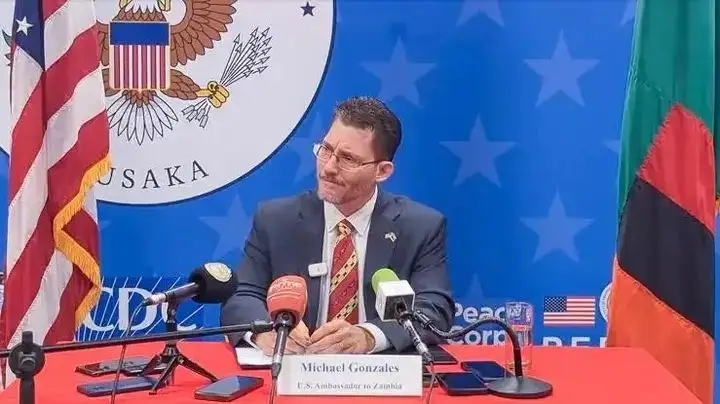
Outgoing U.S. Ambassador to Zambia Michael Gonzales did not deliver a routine farewell. He broke ranks.
Speaking in Lusaka on the night of April 30, during his official send-off, Gonzales broke from traditional diplomatic restraint and issued one of the sharpest public critiques of Zambia’s governance in recent memory. His voice, at times emotional, returned to a decision that shocked the sector last year. “I shed tears before the world when I announced a $50 million cut in U.S. health assistance,” he said, linking it directly to what he described as systematic theft of donated medicines and the absence of accountability.
This moment set the tone.
Gonzales did not merely reflect. He indicted. He questioned why, a year later, “not a single notable person has been arrested” and challenged the sustainability of a system that, in his words, “crumbled almost overnight” when donor funding was paused. He pointed to more than $7 billion in U.S. health support since 2000 and argued that successive governments had failed to build resilient systems, relying instead on external financing while internal leakages persisted.
The facts he raises deserve attention.
Zambia’s dependence on donor-funded healthcare is real. The fragility exposed during the funding pause cannot be dismissed as rhetoric. Nor can concerns around illicit financial flows, procurement irregularities, and bureaucratic inefficiency be waved away. Many Zambians, quietly and publicly, have raised the same concerns long before any ambassador did.
But Gonzales’ intervention did more than highlight governance gaps.
It crossed into territory that makes policymakers uneasy. Diplomacy is designed to manage disagreement, not dramatise it. When an ambassador publicly declares that “Zambia does not need money, it needs leaders with integrity,” he is no longer just reporting concerns. He is shaping political discourse within a sovereign state.
Tension lies here.
The United States is not a passive donor. Its assistance is strategic. Its partnerships are tied to policy interests, influence, and increasingly, global competition. Recent frustrations around stalled agreements, including those reportedly linked to healthcare frameworks and resource cooperation, provide context to the tone adopted in this farewell.
So the message must be read in full.
Part moral critique. Part policy pressure. Part strategic signalling.
This does not invalidate his concerns. It contextualises them.
Zambia must still confront its own realities. Corruption, where it exists, must be addressed. Public systems must be strengthened. Accountability must move from rhetoric to action. Not because Washington demands it, but because national development requires it.
But Zambia must also guard against a deeper trap.
A system that collapses when aid pauses is not sustainable. But neither is a system that becomes overly responsive to external voices at the expense of internal priorities. Sovereignty is not exercised through defiance alone. It is exercised through capacity.
“Hope is not a strategy,” Gonzales said. This is true. But dependency is not a strategy either.
His remarks, stripped of tone and theatre, leave Zambia with a difficult but necessary mirror. One that reflects both internal weaknesses and external expectations.
The danger is not in what he said. The danger is if Zambia responds only to who said it. Because long after Gonzales departs, the structural questions he raised will remain.
© The People’s Brief | Ollus R. Ndomu