

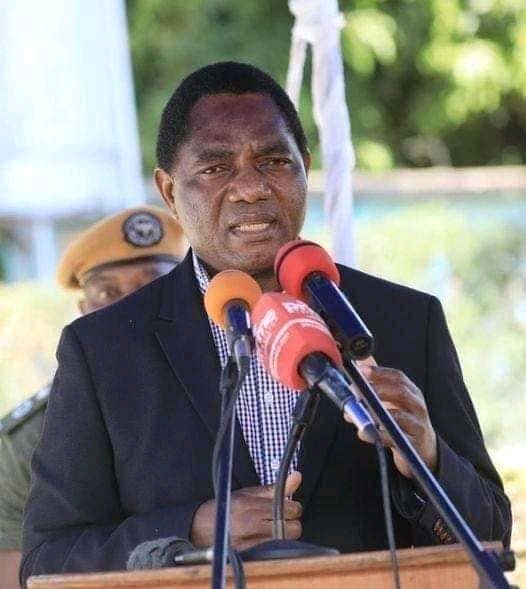
*Hichilema’s Popularity: A True Reflection of Zambian Sentiment*
By Lusungu Chirwa
Contrary to claims of widespread disapproval, largely made by some Zambians abroad, President Hakainde Hichilema continues to enjoy strong support from the local population. His policies, aimed at addressing the nation’s challenges, have bolstered his approval ratings during some of Zambia’s most difficult times.
A recent piece by Stephen Lock, published in the Daily Nation on October 14, 2024, and featured on the International Policy Dialogue website, highlights a growing trend of commentary detached from the realities on the ground. This article exemplifies the spread of poorly researched opinions that fail to reflect true public sentiment in Zambia.
*The Misinformation Narrative*
Lock’s article is a prime example of biased writing, carefully weaving distorted facts into a particular narrative. While Lock presents himself as an authority on Zambian politics, his detachment from local realities is glaring. Without firsthand interaction with Zambians in markets, buses, and other public spaces, Lock is ill-equipped to gauge the president’s true popularity. In fact, evidence suggests that Hichilema’s approval is growing, especially among grassroots communities benefiting from his decentralization efforts, such as the expanded Constituency Development Fund (CDF).
Lock frequently cites “critics” but fails to identify who these individuals are, thereby weakening the credibility of his argument.
*Economic Management and Debt: A Selective View*
Lock’s claim that Hichilema’s government has accumulated $18 billion in debt lacks context. He omits the crucial fact that much of this debt was inherited from the previous administration when Hichilema assumed office in 2021. The country was nearly bankrupt and had defaulted on its foreign debt. A fair analysis would have started by examining the dire economic state left by former President Edgar Lungu.
Lock’s assertions about inflation and economic growth also lack depth. Under the previous administration, inflation reached 15.5% by August 2020, driven by rising energy and food prices. Hichilema’s Finance Minister, Dr. Situmbeko Musokotwane, has since laid bare the reckless borrowing and unsustainable spending that characterized the Lungu era. The fiscal challenges of that period were severe, yet Lock seems intent on placing the blame for Zambia’s current economic woes on Hichilema’s shoulders without considering the broader context.
*Unfounded Law Enforcement Claims*
Lock’s allegation that Hichilema uses “lawfare” to silence political opponents is both lazy and unsupported by evidence. His claim that arrests have increased under the now-repealed defamation law is without merit. In fact, Hichilema was instrumental in repealing this law, which had been in place since 1968, underscoring his commitment to reform. Furthermore, the Human Rights Commission confirmed that there is no data to support Lock’s claim of an increase in arrests under Hichilema’s administration compared to his predecessor.
*The Interpol Election and Misrepresentations*
Lock’s commentary on Zambia’s failed bid for the Interpol Secretary General position is yet another example of how his article leans on rumor rather than fact. He neglects to mention that the Zambian candidate, Mubita Nawa, was the African Union’s agreed candidate, signaling significant continental support. Lock instead chooses to focus on baseless allegations, which, if true, would have disqualified Nawa from even being considered for the role.
*Misleading Analysis of Resignations*
Lock also criticizes Hichilema’s handling of the resignation of the Anti-Corruption Commission (ACC) Director General, suggesting it was mishandled. In reality, the resignation was not voluntary but rather a graceful exit after public admonishment by Hichilema for the DG’s poor performance. Lock’s failure to understand the cultural and political nuances of such resignations further diminishes the credibility of his critique.
*Conclusion*
Stephen Lock’s article is riddled with misrepresentations, selective facts, and unverified claims. His failure to engage with ordinary Zambians and his reliance on questionable sources result in an analysis that lacks balance. Hichilema’s leadership, focused on long-term solutions and reform, continues to win the confidence of many Zambians. As one young Zambian, John Zulu, put it, “Hichilema plants a tree for future generations to enjoy the shade. Only a foolish man will not recognize and appreciate that.”