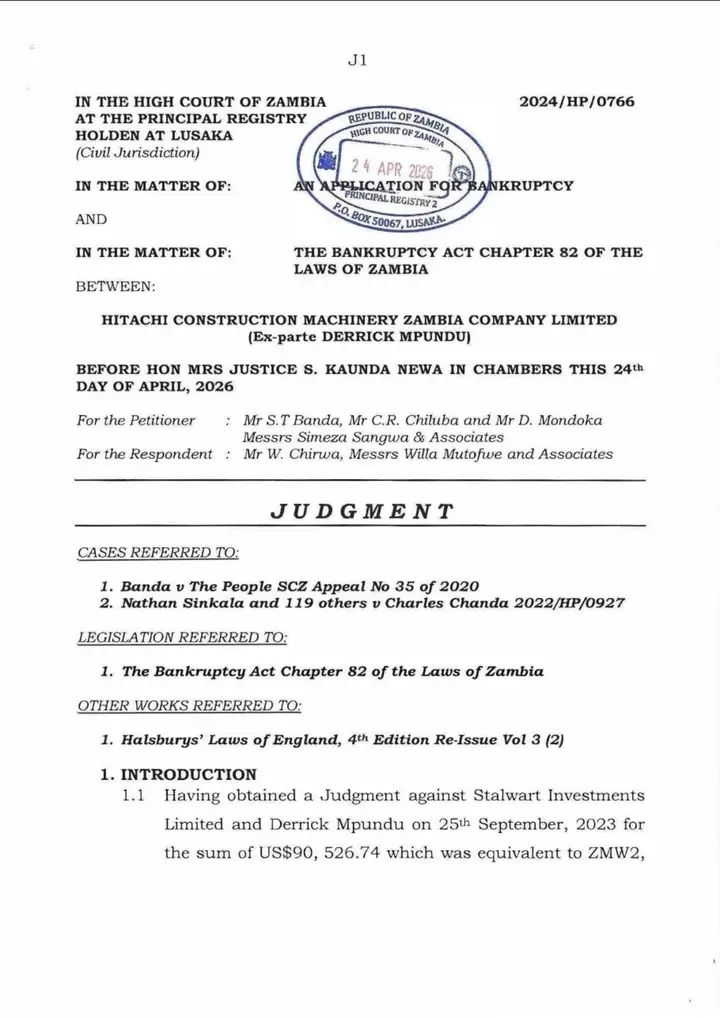
By Deeleslie Mondoka
HOW BANKRUPTCY WORKS IN ZAMBIA, AND WHY SILENCE IS NOT A STRATEGY
Picture this:
A man owes money, real money, not the kind you forget after buying lunch. A Court has already spoken, stamped its authority, and said: “Pay up.” But our good man, Mr. M, treats that judgment the way some treat gym memberships in January, full of promise, but never quite acted upon.
Now, in the Bankruptcy Act (Zambia), the law does not shout; it proceeds methodically.
STEP 1:
The creditor, here a company tired of waiting, arms itself with a judgment debt. That is step one, prove the money is owed and not a matter of debate.
STEP 2:
The creditor serves what is called a “bankruptcy notice.” Think of it as a final, polite knock on the door: “Pay within seven days, or we escalate.” If the debtor pays, all is forgiven. If he disputes, he must say so properly, legally, and on time.
But if he does nothing? Ah, now the law raises an eyebrow.
Because under Zambian law, silence in the face of a bankruptcy notice is not golden, it is costly. It becomes what the law calls an act of bankruptcy. Not dramatic, no fireworks, just a quiet but decisive legal misstep.
STEP 3:
The creditor files a “bankruptcy petition” in court. The Court then asks three simple questions:
– Is there a real debt?
– Was the notice properly served?
– Did the debtor ignore it?
If the answers line up, as they did here, the Court does not debate philosophy. It acts. It issues a receiving order, effectively saying: “Your estate is no longer entirely your affair; it is now under supervised management.”
An Official Receiver steps in, and the debtor must account for his affairs.
Moral of the story:
In bankruptcy issues, timeous compliance is not optional etiquette. A valid judgment must be obeyed or lawfully challenged within prescribed procedure. Failure to do either transforms private debt into public enforcement, where the court takes control of the debtor’s estate to ensure orderly and equitable satisfaction of creditors.
Kudos to the Simeza Sangwa & Associates crew: Chilando Reuel Chiluba, Solomon Themba Banda, and the ever-mysterious third person, for proving that in law, diligence is not optional. They pursued the debt with the persistence of a tax collector and the precision of a surgeon, until the law, quite properly, did the rest.
Disclaimer:
My commentary on this decision is no more a legal critique than a campfire tale is a treatise on thermodynamics. It is, rather, a dramatized retelling, a lively reenactment if you will, of the judicial clash, unburdened by the solemn drudgery of analysis and delivered with the unapologetic zest of a storyteller who knows a good duel when he sees one.