

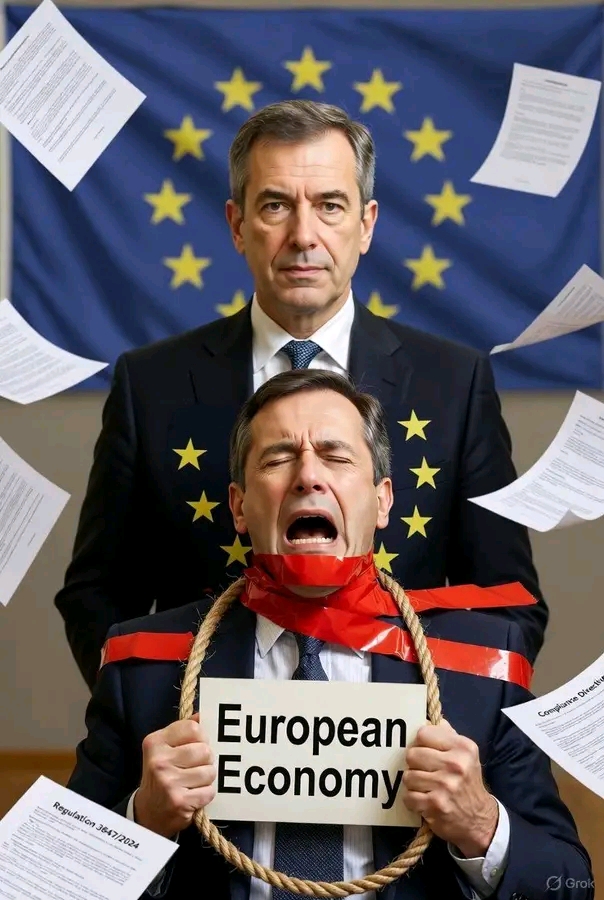
HOW EU BUREAUCRACY IS SLOWLY STRANGLING EUROPE’S ECONOMY TO DEATH
Between 2019 and 2024, the EU enacted approximately 13,000 laws.
The United States passed 3,000.
And somehow, America’s economy is growing at 2.5% while Europe limps along at 1.1%.
Coincidence? Absolutely not.
The EU has perfected the art of killing economic growth through paperwork.
While American companies like SpaceX revolutionize space travel with reusable rockets, the EU spent years crafting regulations for tethered bottle caps.
Cost to comply? Between €2.7 and €8.5 billion. Environmental benefit? Actually increased plastic use.
That’s EU bureaucracy in a nutshell: expensive, counterproductive, and completely detached from reality.
Over 60% of European companies say excessive regulation is their biggest barrier to investment.
Germany alone faces €65 billion annually in direct compliance costs, with another €146 billion lost in unrealized economic potential.
German businesses spend 218 hours per year on tax compliance.
Swedish businesses spend 122 hours. Guess which country is more competitive?
The EU’s latest masterpiece is the European Sustainability Reporting Standards: 400 pages, 1,444 data points that companies must track and report.
Because nothing says “competitive economy” like forcing businesses to fill out forms instead of innovating.
Meanwhile, 30% of Europe’s unicorn startups have fled to America since 2008. Young talent is following them.
European AI developers can’t compete with lighter American regulations or Chinese state support, so they’re building elsewhere.
The message from Brussels is clear: if you want to innovate, do it somewhere else.
ExxonMobil CEO called EU methane rules “the worst, most irresponsible piece of legislation I’ve ever seen passed anywhere in the world.”
He’s closing European operations. So are others.
Ineos, British chemical companies, American manufacturers.
They’re all leaving or downsizing because operating in Europe costs too much and delivers too little.
The EU promised this decade to make Europe “the most competitive, knowledge-based economy in the world.” That was 2010.
Today, US GDP is 42% higher than the EU’s, up from just 23% higher in 2008.
Europe isn’t catching up. It’s falling further behind. Brussels’ response? More regulations.
The AI Act imposes documentation and risk management requirements so burdensome that startups are told: innovate somewhere else. Europe was first to regulate AI.
It will be last to develop it.
German Chancellor Friedrich Merz recently criticized Brussels as “a regulatory leviathan, a bureaucratic mold suffocating economic processes.”
He’s right. But Germany itself built a bloated administrative apparatus that mirrors EU excess.
National bureaucracy plus EU bureaucracy equals economic suicide.
The pattern is consistent: EU drafts complicated rules, member states add their own layers, compliance costs explode, businesses either leave or never start, and European consumers pay higher prices for fewer choices while bureaucrats in Brussels pat themselves on the back for “protecting” people.
From whom? Innovation? Competition? Economic growth?
Europe’s economy isn’t stagnating by accident. It’s being deliberately smothered by people who think 400-page reporting standards create prosperity.
They don’t. They create consultants, compliance officers, and economic decline.
The EU recognizes the problem and promises to cut reporting obligations by 25%. But they’ve promised to reduce bureaucracy before. In 2015. In 2017.
Every time, new regulations outpaced old ones being removed. There’s no reason to believe this time is different.
Europe has trapped itself in centrally planned eco-socialism where political power concentrates in unelected Brussels officials who regulate every aspect of economic activity regardless of market competition or consumer benefit.
The explicit goal: more centralization, more control, more Brussels, less sovereignty.
While Europe writes rules, America and China write code.
While European startups drown in compliance requirements, American and Chinese companies scale globally.
While European energy costs run three times higher than competitors, manufacturers pack up and leave.
The EU calls itself a “regulatory superpower.”
It’s more accurate to call it a cautionary tale about what happens when bureaucrats run economies.
You get lots of rules, little growth, and a continent slowly suffocating under paperwork while the world moves on without it.
Sources: BusinessEurope, Brussels Reports, Consumer Choice Center, Mises Institute, Modern Diplomacy, ECIPE, Meta