

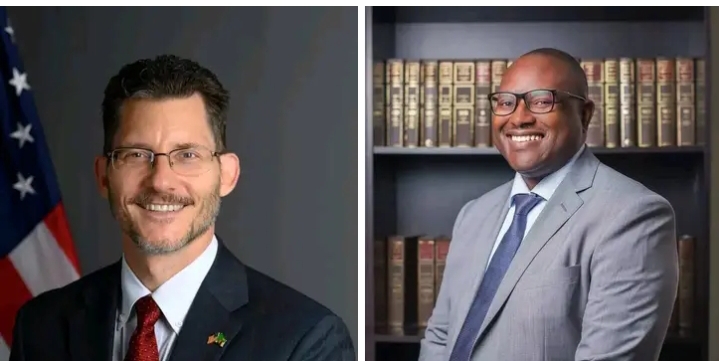
EXPLAINER | Inside the Zambia–US Fallout Over a Collapsed $2 Billion Health Deal
A rare and unusually public diplomatic rupture has emerged between Zambia and the United States, triggered by a farewell speech that has now escalated into a full policy dispute. Outgoing U.S. Ambassador Michael Gonzales, speaking on April 30, 2026, delivered what many in diplomatic circles have described as an indictment rather than a valedictory address, accusing successive Zambian administrations of corruption, institutional failure, and dependency on donor funding.
Within days, the Zambian government, through Foreign Affairs Minister Mulambo Haimbe, has issued a sharply worded rebuttal, framing the remarks as a breach of diplomatic conduct and a misrepresentation of the country’s governance trajectory.
The Ambassador’s remarks were not subtle. He stated that despite over $7 billion in U.S. health assistance since 2000, Zambia had failed to build sustainable systems, adding that when funding was reduced, the system “crumbled almost overnight.” More pointedly, he lamented that following revelations of stolen medical supplies, “not a single notable person has been arrested… not a single notable prosecution has even begun.”
Gonzales further alleged that Zambia loses approximately $4 billion annually through illicit financial flows, and criticised what he described as a pattern of unresponsiveness from government, saying, “our calls go ignored, questions unanswered, meetings cancelled.” to
Government’s response does not merely dispute these claims; it challenges the very manner in which they were made. In its official statement, Lusaka described the remarks as “deeply regrettable, undiplomatic, and inconsistent with the spirit of mutual respect.” It invoked the Vienna Convention on Diplomatic Relations, arguing that the Ambassador violated provisions requiring diplomats to avoid interference in internal affairs and to channel concerns through formal diplomatic processes.
The government stressed that such issues were never formally tabled through official channels, stating that this departure from protocol reflects a “lack of respect for the receiving State.”
But beneath this clash of tone lies a more consequential policy breakdown. Government confirms that negotiations over a proposed U.S.-backed health agreement, reportedly valued at up to $2 billion over five years, failed to conclude by the April 30 deadline. According to the Zambian position, the agreement stalled due to “terms… considered unacceptable,” particularly provisions relating to data sharing, which it says would violate citizens’ privacy rights. It further objected to attempts to link the health deal to a broader Critical Minerals Agreement, insisting that Zambia will not accept arrangements that grant preferential treatment to foreign entities.
However, the American perspective, as reported by the U.S. State Department and carried by international outlets including Al Jazeera, suggests a different narrative. It indicates that engagement deteriorated significantly in the final stages, with claims that Zambian officials became increasingly unavailable, declining meetings and failing to respond to correspondence ahead of the deadline. This claim aligns closely with the Ambassador’s own remarks about institutional non-responsiveness.
Government rejects this characterisation, insisting that the Ambassador was granted multiple high-level meetings, including with the President, and that negotiations were ongoing but unresolved due to substantive disagreements.
This divergence points to what may be the missing link in the current fallout: frustration on both sides over a failed strategic deal. For Washington, the proposed health package appears to have been structured within a broader framework tying development support to transparency, data systems, and resource cooperation. For Lusaka, the same framework raised sovereignty concerns, particularly around health data governance and mineral resource control.
The result is a breakdown not simply of a funding agreement, but of expectations about how partnerships should function.
Government’s rebuttal also attempts to dismantle the Ambassador’s governance critique with countervailing data. It cites 156 arrests and 76 convictions related to health commodity theft, notes a 30 percent increase in health sector funding, and highlights broader economic recovery indicators, including improved growth and renewed mining investment.
Zambia further challenges the Ambassador’s consistency, pointing out that cooperating partners, including the United States, were involved in shaping audit processes now being criticised.
Still, the Ambassador’s remarks resonate within certain policy and investor circles, particularly on issues of regulatory certainty and administrative efficiency. His question: “Can law-abiding investors do clean business here?” captures a concern that extends beyond diplomacy into the economic domain.
Government counters this by pointing to over $12 billion in mining sector investments and Zambia’s positioning as an emerging investment destination, suggesting that macroeconomic stability and reform efforts are yielding results.
The tone adopted by government in its response marks a notable shift. Describing aspects of the Ambassador’s commentary as “mischievous” and “delusional,” Lusaka signals a willingness to publicly contest external narratives in defence of its policy positions. This is not merely reactive. It reflects a broader recalibration in which Zambia is asserting a more independent posture in its engagements with traditional partners, particularly where agreements intersect with national resources and regulatory authority.
At the same time, the United States appears to be redefining its engagement model. The Ambassador’s warning, “we can no longer own the projects more than the Zambian government,” signals a pivot toward conditional cooperation, where continued support is tied to demonstrable institutional performance. This aligns with evolving global aid frameworks that prioritise accountability, sustainability, and domestic ownership over long-term dependency.
What emerges, therefore, is not a collapse of relations, but a moment of renegotiation. Zambia maintains that its relationship with the United States, dating back to 1964, is grounded in mutual respect rather than aid dependency. Washington, in turn, is signalling that future cooperation will be contingent on governance outcomes and responsiveness.
The collapse of the proposed $2 billion health agreement becomes the focal point of this tension, a deal that, in different circumstances, might have deepened cooperation but instead exposed fundamental differences.
For our readers seeking clarity, the essential question is not who is right, but what this moment represents. It reflects a changing diplomatic landscape in which African states are increasingly assertive about sovereignty, while Western partners are increasingly transactional in their engagement. Between these positions lies a narrowing space for ambiguity.
The Zambia–US relationship now enters a phase where outcomes will depend less on historical goodwill and more on alignment of interests, clarity of terms, and the willingness of both sides to recalibrate expectations in a rapidly shifting global order.
This is the Explainer, bringing clarity to national matters without fear or favour.
© The People’s Brief | Ollus R. Ndomu
Iwe ka Kellys
Politicians don’t change.Its rather contexts, frameworks, situations and circumstances that change making reactions to seemingly same events appear contradictory.Just ask your wife