

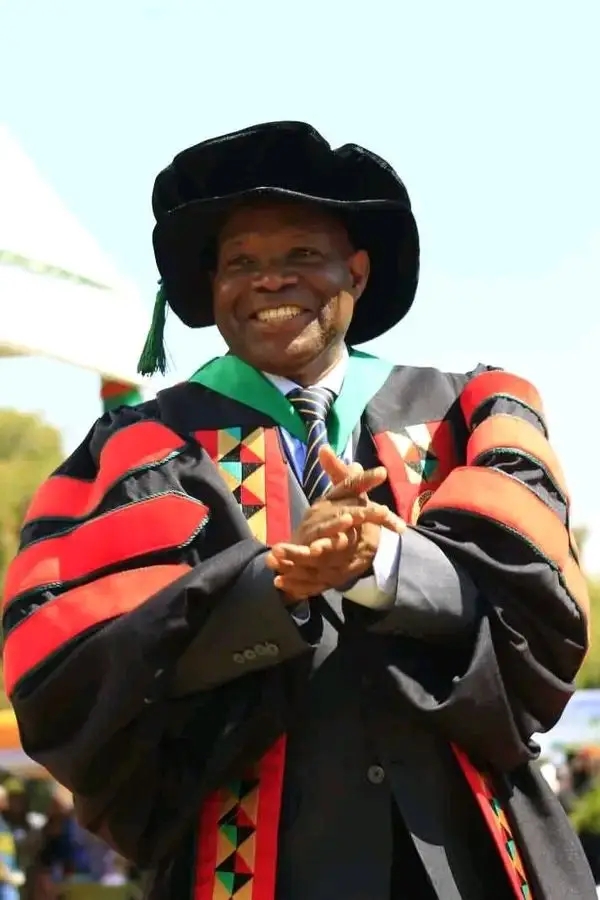
🇿🇲 EDITOR’S NOTE | M’membe Knows Economics, But Politics Still Escapes Him
When Fred M’membe unveiled Dolika Banda as his running mate weeks ago, the expectation in some political circles was that Zambia was finally witnessing the emergence of a serious ideological alternative to both the ruling UPND and the collapsing remnants of the Patriotic Front.
On paper, the formula appeared intellectually powerful.
M’membe is not politically lightweight in terms of credentials. He is a lawyer, veteran journalist, newspaper founder, and now an economist after obtaining a PhD in economics from the University of Zambia. Few opposition figures in Zambia possess that level of academic and intellectual authority. Dolika Banda brought technocratic credibility, financial governance experience, and corporate depth.
But politically, the project still feels stagnant.
And the reason is becoming clearer with every passing week.
M’membe has mastered criticism. He has not mastered political conversion.
Almost daily, the Socialist Party leader appears on Facebook attacking government slogans, mocking ruling party messaging, or dissecting economic failures. Recently, his attention turned toward the UPND’s “Salt Sana” slogan. Before that, it was debt, governance, inflation, and corruption. The criticism is often sharp, detailed, and intellectually structured.
But politics is not a university seminar.
Elections are not won by sounding more informed than your opponent. They are won by building emotional trust, organisational machinery, territorial penetration, and national momentum. That is where M’membe continues struggling despite his intellectual advantages.
His politics often sounds academically superior but emotionally disconnected.
Many ordinary voters do not experience him as hopeful. They experience him as permanently angry. The tone frequently carries ideological rigidity, intellectual impatience, and bitterness toward opponents rather than persuasion toward undecided citizens. In political communication, that distinction matters enormously.
People rarely vote for the person who sounds most intelligent in the room. They vote for the person who makes them feel politically safe, emotionally understood, and materially hopeful.
That gap explains why M’membe’s influence online and in intellectual spaces has never translated into electoral traction on the ground.
The Socialist Party remains visible in discourse but weak in structure. It has no dominant regional anchor. No major parliamentary machinery. No visible nationwide mobilisation network capable of competing constituency by constituency against either UPND or the broader PF ecosystem regrouping under alliances like Tonse.
And this is where the contradiction becomes sharper.
Following the collapse of PF credibility after 2021, many expected M’membe to emerge as the natural ideological opposition alternative. He had the intellectual profile. He had the anti-establishment credentials. He had media experience. He had economic vocabulary. In theory, he should have been the figure capable of converting national frustration into a disciplined reform movement.
That never happened.
Instead, PF-aligned political energy continues dominating opposition space despite the PF itself being rejected by voters in 2021. Even now, much of the opposition momentum sits around personalities linked to the same political culture Zambians voted out. That alone reflects M’membe’s biggest political failure: he has not succeeded in replacing PF emotionally within opposition politics.
And part of the reason is strategic.
M’membe speaks like a critic of the system, not like a future manager of the state.
There is a difference.
A successful presidential candidate must eventually transition from exposing problems to reassuring the nation that they can govern institutions, manage complexity, build coalitions, and maintain stability. M’membe often remains trapped in permanent confrontation mode. Every issue becomes evidence of collapse. Every government action becomes proof of failure. Every ruling party message becomes something to ridicule.
Over time, that style exhausts rather than expands political support.
Then there is the ideological problem.
Zambia is not naturally a deeply ideological voting country. Elections here are organised more through regional structures, personality trust, grassroots mobilisation, and economic sentiment than through doctrinal political theory. M’membe’s Marxist-Leninist orientation may excite sections of students and intellectuals, but it struggles to translate into broad national movement politics across rural and mixed constituencies.
This is why his campaigns consistently generate conversation without generating sufficient votes.
Even his strongest supporters often engage him intellectually rather than organisationally. They debate him online. They quote him. They admire his intellect. But admiration is not machinery. Retweets are not polling agents. Facebook engagement is not constituency penetration.
And while M’membe continues positioning himself as Zambia’s most intellectually prepared opposition figure, the political question voters increasingly ask is much simpler: if he understands the country so deeply, why has he failed repeatedly to build a movement capable of converting that understanding into power?
This question matters because Zambia’s political moment remains open.
UPND still faces genuine public frustrations around the cost of living, electricity, unemployment, and economic pressure. PF remains structurally wounded and morally burdened by its own record in government. This should have been fertile ground for a disciplined third-force alternative rooted in governance reform and intellectual credibility.
Instead, M’membe remains influential in debate but marginal in electoral mathematics. And in politics, ideas without machinery rarely reach State House.
— The People’s Brief welcomes reader responses, analysis, and opinion submissions. Write to us: editor.peoplesbrief@gmail.com
Share our work. Support independent journalism grounded in facts, context, and national conversation.
© The People’s Brief | Editor
For sure Mmembe isn’t going anyway.
He has no strength to even campaign.
Membe is like torn jeans.It just won’t get lost
The biggest challenge for M’membe is Socialist Party itself as not only a bad name/ title but marxist/leninist ideologies. No one will follow socialism of Cuba, Russia or Venezuela.