

NKHANI ZAMU MOBA VS. HARD DATA—MY RESPONSE TO NKONKOMALIMBA KAPUMPE’S ELECTORAL ANALYSIS
David T. Zyambo | 24 May 2026
Two days ago, I shared a video breaking down why traditional, gut-feeling campaigns are a recipe for failure in this election cycle. When you run a campaign based on old assumptions or political gossip, you completely miss the actual reality on the ground.
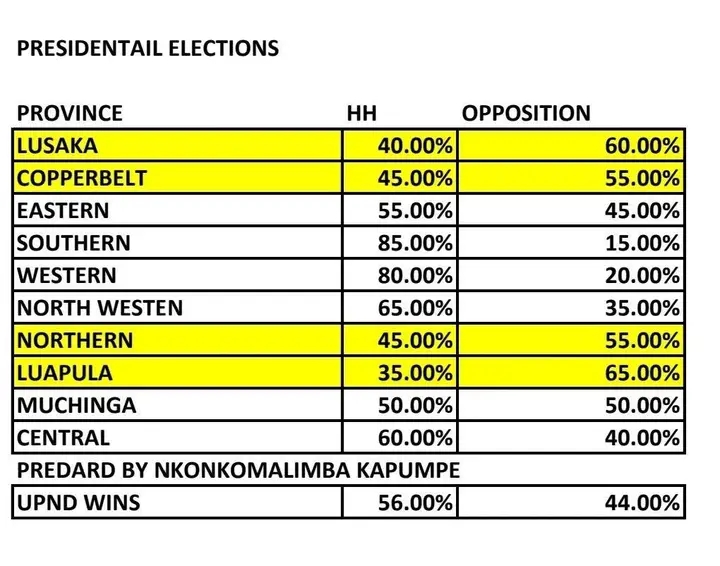
Then, yesterday, I stumbled on a preliminary provincial outlook by Nkonkomalimba Kapumpe—a political commentator I know personally and respect. He laid out a projection giving the ruling party an outright win, providing a real-time example of the exact intuitive political guesswork I had just warned against in my video address—an analysis that is completely detached from the reality of people’s daily lives.
Pundits like Mr. Kapumpe continue to play standard, outdated politics. He assumes urban equals volatile and rural equals safe, providing absolutely no data to back up his claims. In his analysis, he just assumes that “Rural constituencies are likely to lean UPND… while urban centers will be contested.” Based on what? He is operating on the old-school assumption that rural voters are politically static, insulated from economic hardship, and safely tucked away in the UPND’s pocket.
But when you check his political logic against the actual numbers shown in the accompanying data matrix I put together, where I overlay data from the Electoral Commission of Zambia (ECZ), the Zambia Statistics Agency (ZamStat), and the Jesuit Centre for Theological Reflection (JCTR), his entire argument collapses. If you look at the household deficit as a percentage of income—how much money families are short each month to cover basic needs—our rural areas are facing a severe, unyielding economic crisis. In Western Province, the average income is K2,309, while the basic survival basket costs K6,300, representing a 172.8% household deficit and a cash shortfall of K3,991. In Muchinga, the deficit is 383.9% with a K4,879 shortfall, and Eastern Province records the highest deficit in the country at 443.2%, leaving a monthly gap of K5,793.
Let’s drop the percentages and the English for a minute. When a mother in Chipata sits down at night wondering how she will buy mealie-meal tomorrow, she is not looking at an Excel spreadsheet. One thing stares her right in the face: Insala. Njala. Nzala. It is real hunger, a daily struggle to survive, and our political class is completely blind to it.
To suggest that these rural communities are automatic votes for one political party ignores the daily economic struggle of families facing severe financial hardships without any relief in sight. Look at how Nkonkomalimba Kapumpe treats Eastern Province. He claims the ruling party will comfortably make gains and cross the 55% mark because of “grassroots mobilisation” and “political defections.” This is a fatal analytical delusion. Defections of elite politicians in Chipata do not put food on the table in Lundazi, Katete, or Petauke.
Eastern Province records a 443.2% household deficit—the highest economic strain in the country. When people are short by nearly K5,800 every single month just to survive, you cannot buy their loyalty with political grandstanding. Pundits like Mr. Kapumpe think rural voters will quietly accept this severe hardship because of party branding. But abject poverty can weaken people’s loyalty to political parties, making their voting choices less predictable.
His logic breaks down even further when you look at the Northern Block. He looks at Northern Province and Luapula and claims they will lean toward the opposition simply because of “local political figures consolidating support.” Again, this is the old way of thinking—assuming voters are just passive followers who move wherever a local bigwig tells them to go. He is looking at the wrong map. If you look at the actual behavioural data, the story of Northern and Luapula is not about who the opposition “consolidates”—it’s a story of severe voter drop-off and deep apathy from a population that feels entirely forgotten.
This apathy played out clearly during the voter registration process this year, with the region recording the lowest number of new registered voters in the country. In 2021, while other regions were highly mobilised, Northern Province recorded a 58.9% female turnout, and Luapula recorded 60.3%. The reason is clear—voters have not seen how a ballot changes their household reality. The data matrix shows Northern Province with a 249.3% household deficit and a cash shortfall of -K4,746. Luapula households face a 408.1% cost-of-living-to-income deficit, leaving an absolute cash shortfall of -K5,783 every month.
When a region is chronically economically depressed and old-school campaigns just show up to trade promises for votes, the voters do not switch sides—they just stay home. Mr. Kapumpe thinks the opposition wins by default here, completely missing the fact that unless a campaign launches aggressive Get Out The Vote (GOTV) efforts and builds a data-driven machinery that targets this deep well of silent, angry voters who feel entirely left behind, nobody wins them.
But the peak of Nkonkomalimba’s analytical guesswork has to be how he treats Muchinga Province. He labels Muchinga a “swing region” and blindly projects a clean 50-50 split between the two major camps, claiming “candidate quality” and “campaign mobilisation” will decide the day.
This shows a complete disregard for historical voting behavior. Let’s remember the history: in 2011, Muchinga was not even a standalone province yet—it was the very heart of the Northern Province block that swept the Patriotic Front into power. When Michael Sata officially carved it out as its own province right after that election, it did not become a swing territory; it hardened into an absolute, unshakeable PF stronghold. Across the last three election cycles, Muchinga has never been close to a 50-50 swing province. In 2015, that stronghold delivered 87.1% of the vote. In 2016, it held firm at 81.9%, and even during the national shift of 2021, it still voted 75.3% for the Patriotic Front.
To call a region that was literally birthed out of a political stronghold, and has reliably delivered between 75% and 87% of its vote to a single political party for over a decade a “swing region” is not an analysis—it is a complete fabrication. A political bedroom does not turn into a 50-50 coin flip overnight because of “candidate quality.” What is actually happening in Muchinga, as shown by the data, is that the 383.9% household deficit is not making voters shift across the aisle to the ruling party; it is causing them to disengage from the process entirely. The record-low new voter registration numbers we saw this year prove that Muchinga is a story of deep, silent economic boycott—a reality that completely exposes the flawed logic of Kapumpe’s analysis.
Look at the accompanying data matrix again. There is no mathematical formula that can explain how a family in Eastern Province earning K1,307 can manage a K7,100 basket of basic goods. It is a daily, impossible struggle for survival. For a political commentator to sit in Lusaka, pull lazy assumptions out of thin air, and treat that hardship like a guaranteed vote is an absolute insult to what ordinary people are going through.
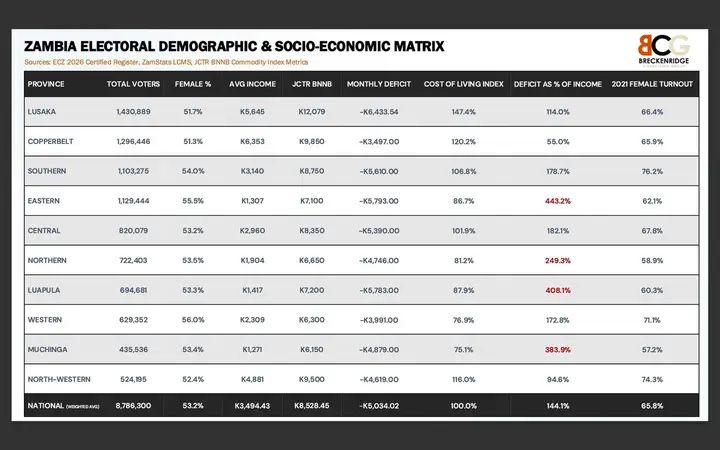
I did not make up these numbers. This data has been staring everyone right in the face from the ECZ, ZamStat, and JCTR—but it is very clear that our political class simply doesn’t know how to read it. They fail to see that when you look at the true national baseline, Zambian households are facing an average 144.1% deficit—meaning families across the country are short by over K5,034 every single month just to secure basic necessities. We blame the electorate for being politically blind, yet we are the ones failing to see the reality on the ground.
What is reckless is Nkonkomalimba Kapumpe blowing the final whistle and calling the match for the ruling party before the teams have even walked onto the pitch. Any seasoned political analyst knows that twenty-four hours is a lifetime in an election cycle—so much can shift. What more an entire 81 days? To read the ground accurately, you cannot ignore the hard numbers, take voter struggles for granted, or rely on bar-room stories (nkhani zamu moba). Our analysis must be heavily anchored in the data—both quantitative and qualitative. Hard data doesn’t choose sides, it doesn’t carry a personal agenda, it doesn’t buy into political hype, and it never guesses. It simply shows us the raw reality of what our people are going through, something Mr. Kapumpe has chosen not to see.
Though I am obsessed with data, I understand that spreadsheets alone do not translate into success at the ballot box. There is always a qualitative side to a campaign—the human spirit, the cultural shifts, the mood in the markets, and the quiet household conversations that statistics can only hint at. But when you back that qualitative reality with quantitative reasoning, you quickly realise that our people are voting on actual economic survival, and politicians who think they can buy or guess their way into office are in for a very rude awakening.
Viva HH Viva UPND.
Hmmm @David T Zyambo!. YOU ARTICLE ISN’T MAKING SENSE MY DEAR. Try writing something else.
Konkamalimba is 100% RIGHT.
RURAL VOTERS have benefited alot in UPND more than any other REGIME.
1. FREE EDUCATION – even me in Town my daughter pays for boarding fees ONLY. I just imagine if there was NO FREE EDUCATION
2. CDF- Rural Constituencies had benefitted ALOT more than URBAN.
3. FISIP and cash for vulnerable – Rural Constituencies have benefited ALOT. They have ALOT of elderly in the rural Constituencies AND ALOT OF OTHER BENEFITS UPND has brought to RURAL.
So ba Zyambo stop THE NONSENSE. Too much illusions with you. YOU DON’T EVEN HAVE DATA!!
While ,You re busy,,disputing and tearing apart,what Kapumpe had put up
We also know much more ,about how ,hatefull and your hatred is towards the UPND, and H H is,
And,if you think, the rubbish ,you ve posted here ,will boost ,translate into , Votes, to your ,fake Alliance victory,
You are very mistaken,and come August 13th,,You will be made to East ,a very Hot Humble ,Defeat Pie
Zambians know,,every reasons of our situations ,,,unless, you want to insult ,our collective,Wisdom,
We very well know, where we re coming from,we know too. ,who have caused our hardships
We,also ,too well know, where UPND,
found us, and where UPND, is taking us
We know, as well ,what UPND, has done is its first term, ,,equally ,We know too,
What UPND, can and will achieve and deliver given more time and another term ,so dont lecture us about anything
And ,finally, we know, what we shall vote for on August 13th