

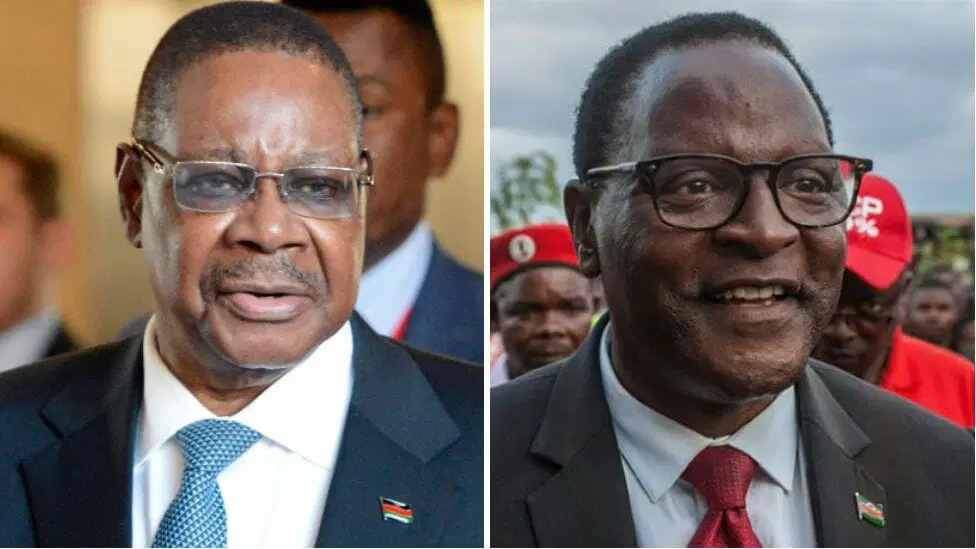
During his campaign stop in Salima on Friday, 12 September 2025, President Lazarus Chakwera made a striking comment regarding the presidential debates.
He stated, “But because time is already over, the person I really wanted to meet in a presidential debate is the DPP leader, Professor Arthur Peter Mutharika.”
At first glance, this remark signals a desire to engage directly with his main political rival in a structured, public forum.
However, a closer look suggests that it does not entirely align with Chakwera’s broader campaign approach, which has largely emphasized rallies, voter outreach, and policy messaging rather than high-stakes direct confrontations with the DPP leader.
By admitting that the debate will not take place due to time constraints, Chakwera avoids a situation that could expose his vulnerabilities or force him into unscripted exchanges with Mutharika.
In that sense, the comment may be interpreted as a carefully calibrated statement designed to appear conciliatory and open to debate while strategically sidestepping a potentially risky encounter.
Analysts note that Chakwera’s campaign has prioritized mobilizing his base and emphasizing the government’s achievements, rather than engaging in combative dialogue with the opposition.
This raises the question of whether the missed debate narrative is a genuine call for engagement or a subtle way to shift responsibility for the absence of direct confrontation onto the DPP, framing it as a lost opportunity for voters without actually risking campaign momentum.
For undecided voters, the remark may have mixed effects. On one hand, it could enhance Chakwera’s image as transparent, willing to be scrutinized, and confident in his policies.
On the other hand, it may also reinforce perceptions that his campaign avoids direct challenge with Mutharika, potentially leaving doubts about his ability to confront opposition criticisms head-on.
Moreover, the statement highlights the broader challenge in Malawi’s electoral landscape, where debates have struggled to become central fixtures of the political process, leaving citizens with fewer opportunities to witness leaders directly tested against each other.
Economic and governance context
Chakwera’s missed debate comment cannot be viewed in isolation from the broader economic and governance challenges facing Malawi.
The country continues to experience persistent fuel shortages, which have disrupted transport, commerce, and daily life for ordinary Malawians.
Forex shortages remain a critical issue, affecting imports, business operations, and remittances, and leaving citizens and enterprises struggling to access foreign currency for essential needs.
Passport delays and bureaucratic inefficiencies have compounded frustrations, limiting travel and mobility for students, businesspeople, and ordinary citizens.
Political violence against opposition figures and dissenting voices, including civil servants demanding better pay, has raised serious concerns about democratic space, freedom of expression, and respect for human rights.
Rampant corruption within key sectors of the government has eroded public trust, with high-profile scandals highlighting mismanagement of public funds.
Indecisiveness in appointing the right people to cabinet and other crucial positions—and a reluctance to remove underperforming officials—has further undermined effective governance.
These persistent failures intensify scrutiny of Chakwera’s leadership and magnify voter concerns about his ability to deliver on promises.
In this context, the absence of a direct debate with DPP leader Professor Arthur Peter Mutharika may be perceived as symptomatic of a broader avoidance of accountability, reinforcing voter frustration among undecided and critical constituencies.
The combination of economic hardship, governance inefficiencies, and missed opportunities for public accountability through debate can significantly influence voter sentiment, particularly among younger, urban, and politically active populations.
Chakwera under pressure compared to Mutharika
The missed debate with DPP leader Professor Arthur Peter Mutharika also underscores the current political pressure facing President Lazarus Chakwera.
Unlike Mutharika during his tenure, Chakwera has had to contend with widespread public dissatisfaction over the government’s inability to deliver on promises that directly affect citizens’ daily lives.
Fuel shortages remain acute, forcing car owners, taxi drivers, and ordinary commuters to spend hours waiting in long queues at filling stations.
Similarly, the delayed distribution of affordable fertilizer has sparked frustration among farmers, threatening productivity and creating political vulnerabilities ahead of the 16 September elections.
The incumbent president has publicly acknowledged these failings, recently appealing to Malawians for forgiveness and seeking a second chance to address these economic hardships.
In contrast, Mutharika’s period in office, while also facing criticism, did not provoke the same level of urgent public grievance over basic commodities and inputs, allowing him to project a relatively stable leadership image during electoral cycles.
This juxtaposition frames Chakwera’s campaign in a defensive position, where his messaging must not only highlight achievements but also reconcile public frustration with perceived governance lapses.
The missed debate with Mutharika, therefore, is not merely a campaign tactic—it also amplifies the scrutiny of Chakwera’s record, emphasizing the electorate’s expectations for accountability, delivery on promises, and effective management of the economy.
By publicly seeking forgiveness, Chakwera aims to soften voter dissatisfaction and remind the electorate of the potential for corrective action under his continued leadership.
Voter impact
The missed debate narrative could resonate differently among various demographic groups.
Young voters, who often value direct engagement, transparency, and public scrutiny, may perceive Chakwera’s remark as a missed opportunity to hold leaders accountable, potentially generating skepticism about his willingness to confront the opposition.
Rural voters, who tend to rely more on rallies and direct outreach, may be less influenced by the debate narrative and more swayed by Chakwera’s promises and visible engagement in their communities.
Urban, educated, and first-time voters, however, may interpret the statement as an attempt to shift blame or avoid substantive discussion, which could influence their decisions at the ballot box.
Business communities and civil society groups, already concerned about economic mismanagement and policy failures, may see the missed debate as an indicator of risk-averse leadership, reinforcing doubts about Chakwera’s ability to address pressing economic challenges.
Ultimately, the remark could energize Chakwera’s supporters who appreciate his focus on rallies and campaign messaging, while simultaneously leaving a window for undecided voters to question the depth of his campaign’s commitment to open scrutiny and accountability.
Conclusion
Chakwera’s comment about the missed debate with DPP leader Professor Arthur Peter Mutharika underscores both the importance he publicly places on political dialogue and the calculated nature of his campaign strategy.
While it may resonate with voters seeking accountability and transparency, it also exposes a tension between appearance and strategy, showing that Chakwera is cautious about direct confrontation with his main rival.
The impact on different voter demographics will likely vary, with younger and urban voters potentially reading deeper into the missed opportunity, while rural communities remain focused on in-person engagement and messaging.
As Malawi approaches the 16 September elections, undecided voters may interpret the statement in different ways—either as a display of openness or as evidence of a campaign that prefers controlled messaging over unscripted debate.
Ultimately, this remark reflects the intricate balance political leaders must strike between signaling confidence, managing electoral risk, and addressing widespread economic and governance challenges in a highly competitive environment.
Final countdown
As the final moments of the campaign approach, with only 78 hours remaining before the 16 September 2025 elections, Malawians are poised to make a decisive choice.
Citizens will determine whether to continue along a path marked by the devaluation of the Malawi Kwacha, rising prices, and economic uncertainty, or to pursue a future with a more stable local currency, controlled inflation, and greater economic predictability.
The outcome will reflect not only political preferences but also the electorate’s assessment of which leadership can effectively manage the economy, deliver on promises, and restore confidence in the nation’s governance.