

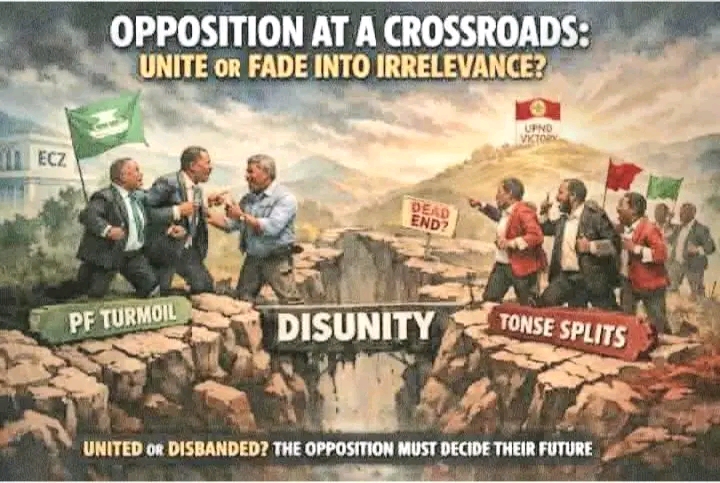
PF TURMOIL, TONSE SPLITS, AND THE COST OF DISUNITY
THE deepening turmoil within the Patriotic Front (PF), compounded by expulsions, counter-claims to authority, and emerging factional divisions within the Tonse Alliance, has moved beyond internal disagreement. It now presents a defining moment for the opposition one that will determine whether it remains politically relevant or gradually fades into irrelevance.
Political parties survive on unity, clarity of leadership, and respect for constitutional order. The PF Constitution provides mechanisms for discipline and internal governance, while the Tonse Alliance Constitution emphasises collective decision-making and consensus among member parties.
Persistent defiance of these frameworks weakens institutional credibility and erodes public confidence. Where internal rules are repeatedly contested or ignored, the very foundation of political organisation is placed at risk.
The danger of continued fragmentation is clear. Factionalism does not merely divide leadership; it confuses supporters, weakens grassroots structures, and creates uncertainty ahead of elections. In such circumstances, the opposition risks surrendering political ground without a contest.
History shows that ruling parties often benefit not from their own strength alone, but from the disunity of their opponents. The current confusion within PF and the Tonse Alliance risks unintentionally handing electoral advantage to the UPND.
Beyond individual parties, this crisis raises a broader question about opposition unity in Zambia. A fragmented opposition struggles to provide effective checks and balances, articulate alternative policies, or mobilise public support. When opposition parties fail to present a united front, voters may disengage or default to the incumbent, not out of endorsement, but due to lack of a credible alternative.
The role of law and institutions remains central. The Electoral Commission of Zambia will recognise only legally constituted leadership and properly authorised alliances. Failure to resolve disputes in a timely and lawful manner risks disqualification of candidates, delayed nominations, and prolonged court battles outcomes that further weaken opposition capacity and visibility.
The editorial choice before PF and its alliance partners is therefore stark. They must either recommit to unity through lawful structures, dialogue, and constitutional discipline, or accept the reality that continued division may render them politically obsolete.
In extreme cases, disbandment or realignment may become unavoidable if cohesion cannot be restored.
Ultimately, politics rewards organisation, unity, and clarity. Without these, even established parties can quickly be forgotten.
The opposition must recognize that survival and relevance depend not on internal power struggles, but on collective purpose, respect for the law, and a shared commitment to offering Zambians a credible and united alternative.
ROANFM EDITORIAL
Where did this all begin, okey the coming back of ECL caused Sampa to create confusion then came the death if ECL which should have been managed by putting him to rest and immediately charting the way forward but what did OF do, they refused to bury and refused to organize until after burial which never material used, now confusion set in until it was realized that burial would not take place hence the tomoil. In my view without burial there will be no unity in Pf.
No one will miss the gang of thieves, the lawless cohort called PF. Good riddance. Zambia is bigger than criminals. Zambia is moving ahead, becoming a better place without them.