

By Rev Walter Mwambazu
So, had a chance to study the bill last night and I now present the bill itself, and all the pros and cons and my conclusion at the bottom.
I treated the official National Assembly listing/PDF as the reference point instead of the piece meal shavings online. Parliament lists it as The Public Gathering Bill, 2026 — Bill No. 71 of 2026, intended to protect assembly/association, regulate public gatherings, and repeal/replace the Public Order Act, 1955. This can be obtained in full from their website.
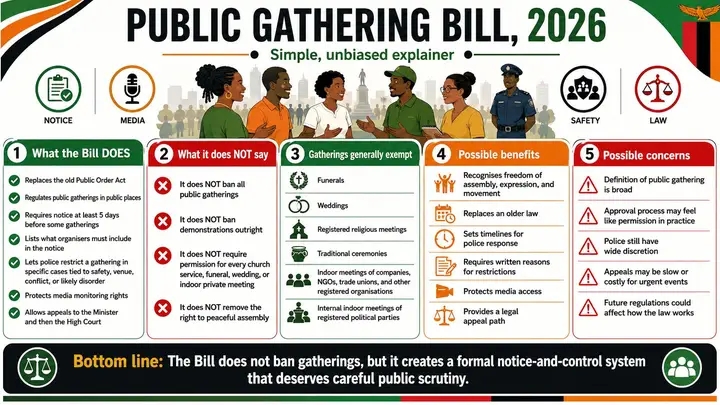
🇿🇲 PUBLIC GATHERING BILL, 2026 — SIMPLE EXPLAINER
Yes I tried to use less words but that risks diluting or misrepresenting the document but I’ve tried.
So, there is a lot being said about the Public Gathering Bill. Some concerns are fair. Some claims are exaggerated. Here is what the Bill actually says in simple language.
✍🏾 1. What is the Bill about?
The Bill seeks to replace the old Public Order Act. It deals with public gatherings such as meetings, processions and demonstrations held in public places.
It says a “public gathering” involves three or more people in a public place, including meetings, assemblies, processions or demonstrations.
✍🏾 2. Does it ban public gatherings?
No. It DOES NOT ban public gatherings. It creates a system where organisers must give notice to the police before holding certain public gatherings.
✍🏾 3. How much notice is required?
An organiser must notify an AUTHORIZED police officer AT LEAST FIVE DAYS BEFORE the proposed public gathering.
The notice must include things like:
📌 date, time and location
📌 route, if it is a procession
📌 purpose of the gathering
📌 estimated number of participants
📌 organiser’s contact details
📌 safety and crowd-control arrangements
✍🏾 4. Does it mean every gathering needs police approval?
No, not every gathering.
The Bill DOES NOT apply to several types of gatherings, including:
👉🏾 registered church/religious meetings
👉🏾 funerals
👉🏾 weddings
👉🏾 traditional ceremonies or traditional meetings
👉🏾 indoor meetings of companies, NGOs, trade unions or registered organisations
👉🏾 indoor internal meetings of registered political parties to discuss party affairs 👍🏾
👉🏾 lawful meetings of state institutions
So the claim that people will need police permission for every church service, funeral, wedding or indoor meeting is NOT SUPPORTED BY THE TEXT SHOWN.
✍🏾 5. What powers does the police officer have?
The authorized officer is required to:
🛡️ protect freedom of peaceful assembly
🛡️ protect freedom of expression and movement
🛡️ act without bias
🛡️ consider public order and public safety
🛡️ Minimize disruption to traffic, property and workplaces
🛡️ intervene only where there is serious danger to public order or safety
The officer may restrict a gathering if:
📛 another gathering is already planned at the same place and time
📛 the venue is unsuitable for crowd or traffic control
📛 the venue interferes with lawful business
📛 the place is protected or restricted
📛 there is a reasonable belief of likely disorder, property damage or danger to public safety
✍🏾 6. Can police simply ignore the notice?
The Bill sets timelines. Police must acknowledge receipt within 24 HOURS. They must approve WITHIN THREE DAYS, unless there are grounds for restriction.
If an organiser is affected by a decision, the Bill allows an appeal to the Minister, and then to the High Court.
✍🏾 7. What does the Bill say about media?
It PROTECTS THE RIGHT OF THE MEDIA to monitor a public gathering. Police, organisers, participants and others are required to respect that right.
✍🏾 8. What is prohibited?
The Bill prohibits:
👉🏾 wearing military, defence force or security-style attire at a public gathering, unless it is for theatre, circus or similar performance
👉🏾 carrying firearms or weapons at public gatherings, except where allowed in the course of public duty
👉🏾 holding an unauthorized public gathering where notice was required, a restriction was issued, or the gathering is contrary to the Act
✍🏾 9. What are the possible benefits?
✅ It replaces the old Public Order Act.
✅ It clearly recognizes freedom of assembly, expression and movement.
✅ It gives police timelines instead of open-ended delays.
✅ It protects media monitoring of gatherings.
✅ It creates appeal routes for aggrieved organisers.
✅ It requires reasons when a gathering is restricted.
✅ It tries to balance protest rights with public safety.
✍🏾 10. What are the possible concerns?
⚠️ The definition of public gathering starts at only three people, which is very broad.
⚠️ Although it talks about notice, the “approval” process may still feel like permission in practice.
⚠️ Police discretion remains significant, especially where they “reasonably believe” disorder or danger may occur.
⚠️ The first appeal goes to the Minister, not directly to an independent body.
⚠️ Court appeals may be expensive or too slow for urgent gatherings.
⚠️ Exemptions for some public officials may be seen as unequal, although some of those exemptions do not apply during election periods.
⚠️ Future regulations will matter because details like forms, restricted areas and fees can later be prescribed by the Minister.
BOTTOM LINE
The Bill DOES NOT say Zambians need police permission for every funeral, wedding, church service or private indoor meeting.
It also DOES NOT ban demonstrations or public meetings.
But IT DOES create a formal notice-and-approval system for many public gatherings in public places, and that system will depend heavily on how fairly and consistently police officers apply it.
A fair reading is this:
The Bill has some rights-protecting improvements, but it also has areas that need public scrutiny to prevent abuse.
Let us debate the Bill based on what it actually says — not fear, rumours or political spin.
I have attached the link to Parliament website where you can find the document for your own study.
The link https://www.parliament.gov.zm/sites/default/files/documents/bills/N.%20A.%20B.%2071%20of%202026%2C%20The%20Public%20Gathering%20Bill.pdf
”NAB 71, 2026 Public Gathering Bill”