

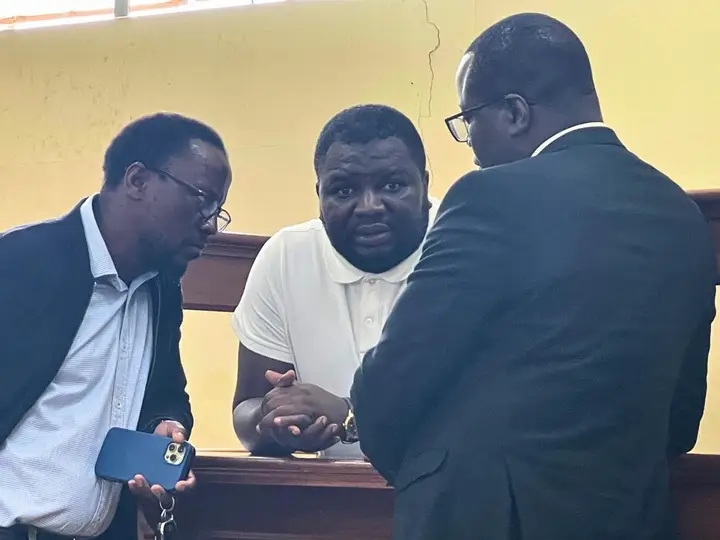
Nakacinda Goes on Hunger Strike
By Brian Matambo
Lusaka, Wednesday, 20 May 2026
Patriotic Front Secretary General Raphael Mangani Nakacinda has gone on hunger strike at Chimbokaila Prison in Lusaka after allegedly being denied access to his lawyers and the ability to communicate with them.
The development came to light today when food was taken to Mr Nakacinda at the prison, but he refused to receive it, stating that he was on a hunger strike.
According to Mr Nakacinda, he has been denied access to his legal team, denied use of a phone to speak to his lawyers, and denied the ability to properly instruct counsel in the multiple criminal cases he is facing.
He is currently serving a sentence arising from a defamation of the President conviction and is also involved in other serious matters, including seditious practices and an espionage case.
The hunger strike raises grave human rights and fair trial concerns, especially because some of the matters before the courts carry serious legal consequences. An accused person must be allowed full access to lawyers, adequate time to prepare a defence, and the ability to instruct counsel without obstruction.
Article 14 of the International Covenant on Civil and Political Rights guarantees every accused person the right to adequate time and facilities to prepare a defence and to communicate with counsel of their own choosing.
The Nelson Mandela Rules on the treatment of prisoners also require that prisoners be treated with respect for their inherent dignity and protected from cruel, inhuman or degrading treatment.
Mr Nakacinda is also said to be concerned for his safety inside prison after allegedly narrating an incident in which an unknown liquid was reportedly nearly poured on him, raising fears that he may be at risk.
This is no longer a routine prison matter. It is a matter touching on constitutional rights, fair trial protections, human dignity and the rule of law.
If the State has cases against Mr Nakacinda, those cases must proceed before competent courts. But he must be allowed to defend himself. He must be allowed to speak to his lawyers. He must be allowed to instruct them. He must be allowed access to the basic tools of justice.
A hunger strike by a prisoner facing multiple criminal cases is a serious alarm. The authorities must urgently intervene, guarantee his access to lawyers, investigate his safety concerns, and ensure that his health is monitored before the situation deteriorates further.
When an accused person stops eating because he believes the justice system has cut him off from his own defence, the country must pay attention.
Just serve your sentence and become a free man. Can’t you see CK, he is now free and he is even contesting Roan.
Kulya fye akabwali ba wishi. Mwalafwa kunsala. Nikulimba boss.
Bad timing. Iwe uzafa nanjala. Why didn’t you go on hunger strike long back and not within the election period. Now you know how bad your mouth smells.
He needs to lose some weight anyway.
On a serious note, the authorities should give him access to his lawyers. He has to adequately prepare for his defence.
Good. As it is there is shortage of food in prison. Look at him suffering all alone while his so called friends are busy filing nominations and campaigning.