

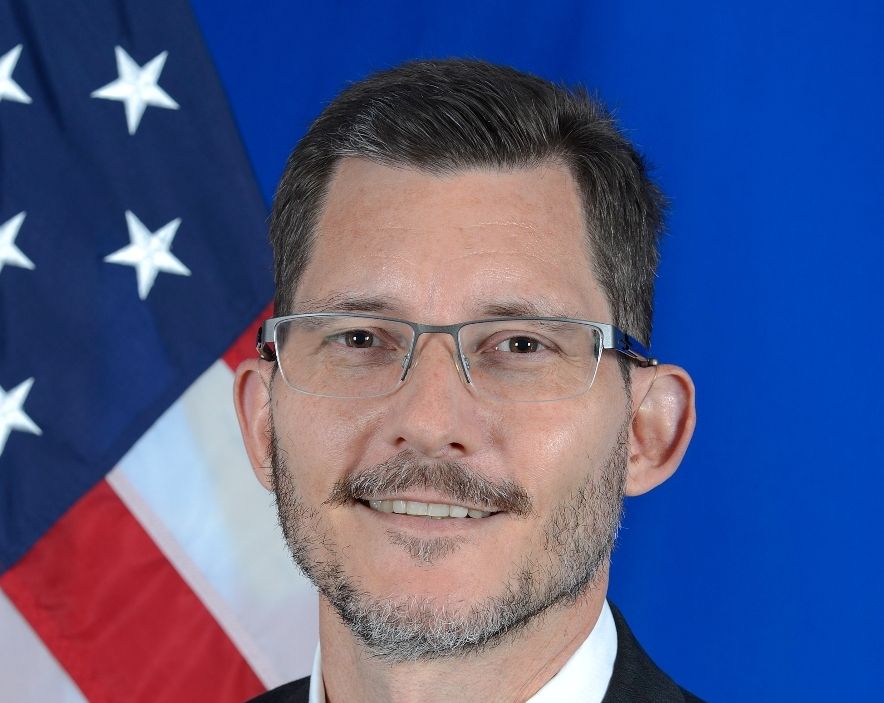
THE MAN WHO CRIED, CURSED, AND WALKED OUT: WHO REALLY IS MICHAEL GONZALES?
He arrived in Zambia as a friendly face of American goodwill. He is leaving with a lit match in his hand. Outgoing United States Ambassador Michael C. Gonzales is not going quietly. His farewell has been anything but diplomatic.
THE FIRST VISIT: A BACKPACKER WITH A DESTINY
The first time Michael Gonzales set foot in Zambia, he was a college student hitchhiking through the country on his way to see ancient ruins in Zimbabwe. That was in the 1990s. He was doing independent research in Namibia on education reform, funded by a grant from Occidental College in Los Angeles. Nobody gave him a motorcade. Nobody offered him a residence in Lusaka. He was just another young American bumping along dusty roads.
Nearly three decades later, he returned. This time with a title, a salary funded by American taxpayers, and a mission handed down by President Joe Biden. He relocated to Zambia with his wife Carol, a foreign service officer with the U.S. Agency for International Development, and their 12 year old daughter Hailey. A family operation embedded inside the American foreign policy machine.
THE CAREER BEHIND THE SMILE
Gonzales is a career member of the Senior Foreign Service, class of Minister-Counselor. Before Zambia, he served as director of analysis of Africa in the State Department’s Bureau of Intelligence and Research, and held leadership positions as deputy chief of mission in Kathmandu, Nepal and Lilongwe, Malawi. He also served as political and economic counselor in Harare, Zimbabwe and Addis Ababa, Ethiopia.
This is not a man who stumbled into diplomacy. He previously served as Deputy Assistant Secretary of State for West Africa and African Regional Peace and Security, and as the acting U.S. Special Envoy for the Sahel Region. He knows Africa. He knows its governments.
One detail worth knowing: before joining the State Department, Gonzales was an Antitrust Analyst for the U.S. Department of Justice. The man who came to preach accountability in Zambia spent his early career prosecuting corporate wrongdoing at home. That background matters.
THE LGBTQ AGENDA: A QUIET WAR NO ONE FULLY REPORTED
This is where it gets uncomfortable for those who want to see Gonzales only as a hero.
Gonzales and the U.S. Embassy made promoting equal rights for LGBTQ persons a deliberate priority in Zambia, calling the community one of the most vocally marginalized in the country. He did not just raise the issue privately. He directly engaged one on one with representatives from the police, the Home Ministry, and even the president himself.
He framed his approach carefully. “This isn’t about America imposing our values and our desires, but being guided by the concept of ‘first, do no harm,'” he said.
Zambians were not convinced. The country’s Penal Code criminalizes same sex relations. The majority of Zambians, including church leaders, view his LGBTQ advocacy as cultural interference dressed up in the language of human rights. What many do not know is that this was not personal passion. In 2021, the Biden administration issued a presidential memorandum that specifically prioritized the promotion of LGBTQ rights as a core component of U.S. foreign policy. Gonzales was not freelancing. He was executing orders. The question ordinary Zambians must ask is: who made that a condition of American friendship with Zambia?
THE CRYING PRESS CONFERENCE: PERFORMANCE OR PAIN?
On the 8th of May 2025, Gonzales stood before cameras at the U.S. Embassy in Lusaka and announced a decision that shook the country.
The United States was cutting $50 million, that is 1.4 billion kwacha, in annual aid provided to Zambia for medications and medical supplies. The reason: country wide, systematic theft of donated medicines over more than a year, with minimal responsive action from the Zambian government.
An investigation of around 2,000 pharmacies in Zambia between 2021 and 2023 found that nearly half of them were selling medicines and products paid for by U.S. aid funds. Drugs meant to be free for sick Zambians were appearing on pharmacy shelves with price tags.
Twenty nine minutes into the press conference, Gonzales was wiping away tears. “I’ve cried over this because I know that it’s not going to be senior officials or the senior people who are going to hurt. I know it’s going to be the poor family in rural Zambia whose baby gets malaria and they won’t have access to antimalarials,” he said.
The internet called him a hero. NPR ran a full feature. But others asked harder questions. This theft had been known since 2021. He brought the issue formally to senior Zambian government leaders on April 3, 2024, with high level officials from multiple ministries, law enforcement agencies, and the executive in attendance. He then held over 33 follow up meetings. And yet he waited until May 2025 to cut the money. Why did it take four years from discovery to action? That question deserves an answer.
THE BILLION DOLLAR DEAL AND THE MINERALS ACCUSATION
Then came the bombshell that Gonzales spent his final days fighting to contain.
The United States has been pushing Zambia to sign a memorandum of understanding governing over $1 billion in U.S. health funding covering HIV, malaria, maternal and child health and disease preparedness. The deal also requires about $340 million in co financing from the Zambian government.
In March 2026, The New York Times reported that it had obtained the draft of a memo indicating that the State Department was considering withholding lifesaving assistance to people with HIV in Zambia as a negotiating tactic to force the government to sign a deal giving the United States more access to its critical minerals.
Gonzales pushed back hard. He rejected what he called “disgusting and patently false” allegations that Washington was threatening to withhold life saving healthcare support unless Zambia handed over access to critical minerals.
But the State Department never denied the memo existed. The State Department press office, in an unsigned email, said only that it would not comment on purportedly leaked documents or on deliberative diplomatic discussions. That is not a denial. That is a dodge.
Gonzales said Washington had faced “effectively zero substantive engagement” from Zambian officials since January, with calls going unanswered and meetings cancelled. The Zambian government says any concerns should be raised through proper diplomatic channels. Both sides are pointing fingers. Meanwhile, health advocates have warned that the deal links the money to mining access and poses data sharing risks. Ordinary Zambians living with HIV sit in the middle.
THE FAREWELL THAT BURNED BRIDGES
In his farewell address, Gonzales delivered a scathing indictment of successive Zambian governments, accusing them of enabling corruption, failing to take ownership of public systems, and jeopardising future American support.
He accused President Hichilema’s government of corruption and dishonesty, stating that Hichilema’s fight against corruption is bogus and is being selectively used to arrest and persecute political opponents.
As far back as January 2026, Gonzales had published a State Department essay arguing that U.S. foreign assistance too often enabled corruption and should be restructured around mutual accountability and performance based outcomes. He was already writing his closing argument months before he packed his bags.
WHAT GONZALES LEAVES BEHIND
The man is complex. He came with genuine commitment to Zambia, built over decades. He pushed back when Zambia’s government ALLEGEDLY stole medicines meant for sick children. He survived a recall attempt and outlasted one U.S. administration into the next. He continued to serve under two ideologically distinct U.S. administrations from Biden’s progressive multilateralism to Trump’s transactional pressure politics. That is no small thing.
But he also carried an agenda. The LGBTQ push was not optional for him. It was policy. The billion dollar health deal may have strings attached that go beyond health. And the tears at the press conference, however genuine they appeared, came four years after the theft was discovered.
Gonzales leaves Zambia with its medicine shortages, its stalled health deal, its government on the defensive, and a $1 billion question mark hanging over the relationship between the two countries. He arrived as a hitchhiker with a backpack. He is departing as a diplomat with unfinished business.
The man cried in public. Whether Zambia should cry after him is a different question entirely.
_____
Zambian Angle