

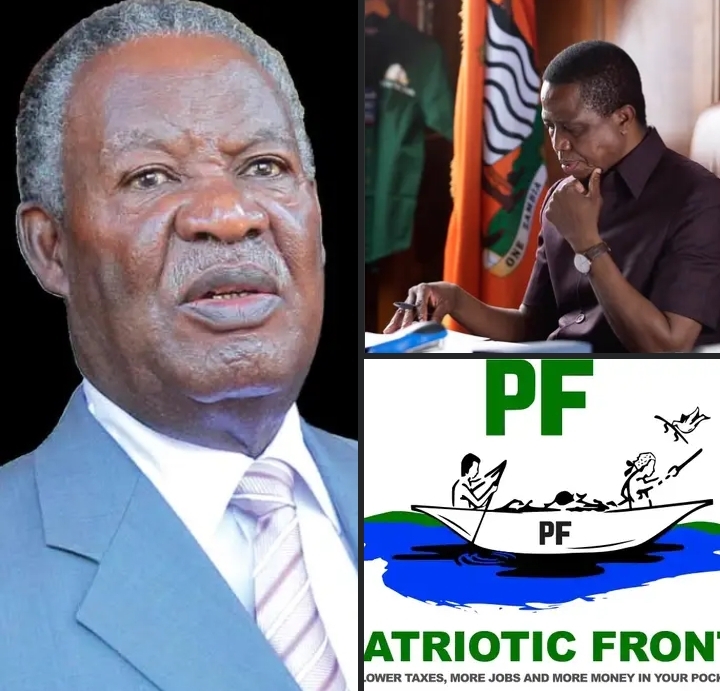
THE RISE AND FALL OF THE PATRIOTIC FRONT: FROM MICHAEL SATA TO EDGAR CHAGWA LUNGU
When the Patriotic Front (PF) was founded in 2001 by the late President Michael Chilufya Sata, it emerged as a populist movement that promised to speak for the poor, the forgotten, and the marginalized. Over the years, the party grew from a one-man political crusade into Zambia’s most formidable political force, culminating in its 2011 electoral victory. But just a decade later, the same party that once united millions under the slogan “Don’t Kubeba” would find itself fractured, discredited, and defeated.
This is the story of the rise and fall of the PF—from the visionary leadership of Michael Sata to the turbulent years of Edgar Chagwa Lungu.
The Rise of a Populist Movement: The Sata Era (2001–2014)
Michael Sata, a charismatic and combative politician, founded the Patriotic Front after breaking away from the Movement for Multiparty Democracy (MMD). Initially dismissed as a regional party with little national appeal, Sata’s PF steadily gained ground through a relentless grassroots campaign that resonated with ordinary Zambians.
His message was simple but powerful: development, jobs, and accountability. His fiery speeches in local languages and his relentless criticism of corruption and foreign exploitation—especially of Zambian resources—won him immense popularity, particularly among urban and working-class voters.
After three failed attempts, Sata’s persistence paid off in 2011 when he defeated incumbent President Rupiah Banda. His victory was hailed as a triumph for the common man—a people’s revolution.
Under Sata’s leadership, the PF embarked on ambitious infrastructure projects: roads, hospitals, schools, and public housing. His “Link Zambia 8000” road project symbolized his commitment to physical development. Yet, Sata’s presidency was also characterized by centralized decision-making and a growing culture of political intolerance.
When Sata’s health began to deteriorate, the once-united PF started showing signs of internal division as factions emerged around potential successors.
The Lungu Era: Consolidation and Decline (2015–2021)
Following Sata’s death in October 2014, the PF plunged into a fierce succession battle. Edgar Chagwa Lungu, then Minister of Defence and Justice, emerged victorious in a tightly contested party election, eventually becoming Zambia’s sixth Republican President in January 2015.
Lungu inherited a party built on populism but divided by internal rivalries. Initially, he was seen as a unifier—a calm and conciliatory leader who could sustain Sata’s legacy. His 2016 victory over Hakainde Hichilema consolidated PF’s hold on power, but beneath the surface, cracks began to widen.
Lungu’s administration was marked by accusations of corruption, authoritarianism, and economic mismanagement. The once-vibrant PF machinery began to rely more on patronage and less on grassroots mobilization. The slogan “Don’t Kubeba” lost its meaning as power became concentrated among a few elites, many of whom were accused of enriching themselves at the expense of the people.
Economic challenges—rising debt, unemployment, and inflation—deepened public frustration. The PF’s development agenda was overshadowed by allegations of state capture, intimidation of opponents, and media censorship.
As Lungu’s inner circle grew more powerful, dissent within the PF was silenced, and the party lost its connection with ordinary citizens.
2021: The Fall from Grace
The 2021 general election was the tipping point. The UPND Alliance, led by Hakainde Hichilema, capitalized on the PF’s weaknesses—particularly the rising cost of living and disillusionment among young voters. Despite the PF’s extensive campaign and state resources, the Zambian people voted for change.
For the first time since 2011, the PF faced the harsh reality of rejection. Its dominance was shattered. Edgar Lungu conceded defeat, but not before making history as one of Zambia’s few leaders to lose power peacefully.
After Power: Internal Chaos and Identity Crisis (2021–Present)
In opposition, the PF has struggled to redefine its purpose. The party has been rocked by leadership wrangles, factionalism, and accusations of betrayal. With no clear ideological direction, the once-mighty movement now battles to remain relevant.
Several figures—including Given Lubinda, Brian Mundubile, Chishimba Kambwili, and Makebi Zulu—have emerged as potential successors, each claiming to be the rightful torchbearer of Sata’s legacy. Yet, unity remains elusive.
The party’s internal confusion has been compounded by ongoing corruption investigations targeting former ministers and officials. Many within the PF view these as politically motivated, while others see them as a reckoning for past excesses.
The Legacy and the Lessons
The PF’s journey from populist revolution to political decline is a cautionary tale in Zambian politics. It demonstrates how movements rooted in the people’s struggles can lose touch when power becomes an end in itself.
Michael Sata’s PF stood for hope, defiance, and empowerment. Edgar Lungu’s PF, in contrast, came to symbolize control, excess, and fear.
As the party struggles to rebuild, one question lingers: Can the Patriotic Front rise again—or will it remain a relic of Zambia’s political past?
Only time will tell whether the spirit of “Don’t Kubeba” can once again find meaning in a new generation of leaders.
By John Mwape
Ilelanga News. November 13, 2025.
John, good essay; but with a wrong title.
It was: “ Donchi kubeba”, coined by Guy Scott; for PF members to accept UPND vote money without the obligation of voting for UPND.
The reality is that PF is a real political party with a plethora of divergent political views and healthy competition.
In contrast,UPND is a corporation with a membership based on loyalty and unquestioning obedience.
The apparent woes in the party are temporary.Every primary school child knows who is sponsoring confusion in this political party, ask Chabinga and Sekwila.
PF is not in free-fall. As you have inadvertently advised, we are watching this space.
You seem to not know that UPND was not in power at the time of donchi kubeba. It was MMD in power under the late former president Rupiah Banda. The problem with PF is that you never want to accept your mistakes. Was it UPND that collected the 200K nomination fees from candidates who wanted to stand on the position of president in PF, but the convention was never held?
This is a sterile topic.Mistake conceded,Mr /Ms Straight forward.
By the way, the UPND organisation will never disappear.As stated earlier, it is a “Brotherhood “ run on quasi Masonic principles.
Have manners you hater. You lost power clean and square despite your misplaced confidence at the time and you are repeating the same mistake even when you are in a worse off situation now. Sorry you.
Mr /Ms. Jake,why should I hate myself? You are my fellow human being,you cry, feel hungry etc; I do and feel all these things! Expel hatred from your psyche . However, disagrement between us is not wrong but healthy Ba dala.