

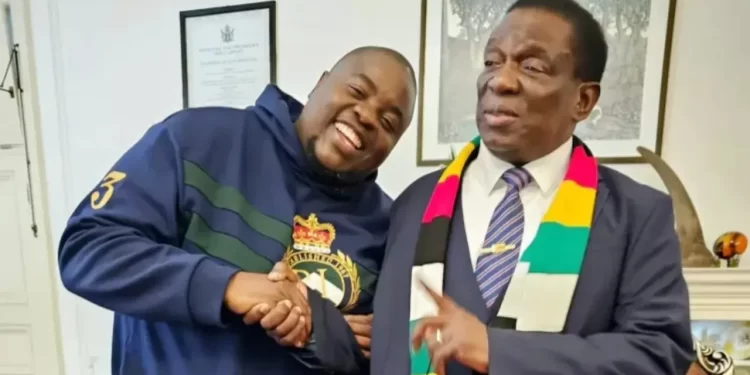
The Zanu-PF Youth League, led by Deputy Secretary for Youth Affairs John Paradza, has taken a firm stance against a proposed US$3.6 million donation by President Emmerson Mnangagwa’s ally and businessman Wicknell Chivayo to Members of Parliament, warning that such financial gestures risk undermining the independence of the legislature.
In a statement on Monday afternoon, the youth wing said it had noted reports circulating on social media regarding the intended disbursement of funds to legislators for constituency development.
While acknowledging that Chivayo is free to engage in philanthropic activities, the Youth League stressed that any contributions to public institutions must be handled in a manner that does not compromise governance structures.
“We are not opposed to philanthropic efforts, but we firmly take a stand against any attempts, real or perceived, to influence any arm of Government, be it the Executive, Judiciary or Parliament,” read the statement signed by Paradza.
The Youth League stated that Parliament remains the backbone of Zimbabwe’s democracy and must operate free from external financial influence. It warned that donations directed at lawmakers could create perceptions of impropriety and weaken public confidence in the legislative process.
Instead, the group encouraged that any well-intentioned financial support be channeled directly into community-based development initiatives, rather than through State institutions.
It said such an approach would ensure that assistance reaches citizens without raising questions of accountability or institutional integrity.
The statement also called on legislators to uphold ethical standards and resist any actions that could bring Parliament into disrepute.
“Members of Parliament must be guided by integrity, transparency and the need to maintain public trust in the execution of their legislative duties,” the Youth League said.
The group further urged Parliament to reject the proposed donation, arguing that Zimbabwe’s legislative institution must remain anchored within constitutional frameworks and protected from any form of perceived transactional engagement.
Adding to the debate, social justice advocate Tendai Ruben Mbofana framed the proposed donation as a potential gateway to state capture.
Mbofana argued that the scale and structure of the proposed funding raise critical questions about both political influence and the origins of wealth used to finance such largesse.
He linked the issue to broader concerns about governance and accountability, warning that allowing private financial influence over legislators could erode democratic institutions.
“This supposed donation must be halted immediately,” Mbofana stated.
“It is an ethical minefield and a conflict of interest that taints every member of the house who accepts it.
“Our lawmakers cannot be the beneficiaries of a man whose business dealings are under a cloud of international suspicion.”
Central to his critique is the contention that companies associated with Chivayo, including Intratrek Zimbabwe, IMC Communications, and Intratrek South Africa, operate largely as special purpose vehicles rather than major industrial enterprises.
According to Mbofana, these entities have limited operational footprints and have been linked to controversial public contracts, notably the long-delayed Gwanda Solar Project, which has faced scrutiny after significant public funds were disbursed without completion.
He further cited external investigations, particularly in South Africa, which allegedly flagged inflated procurement costs in election-related tenders, suggesting that large sums may have been transferred through intermediary companies.
These claims, while not adjudicated in Zimbabwean courts, have intensified calls for transparency regarding the businessman’s financial activities.
Critics argue that the proposed donation is intended to influence legislators to vote in favour of the Constitutional Amendment No. 3 Bill, which seeks to extend President Emmerson Mnangagwa’s term of office beyond 2028.
Great and interesting positions taken by these two critics. Well written points raised by the Journalists This is what we want from investigative Journalist. If Zimbabwe seeks to change its these kinds of observations and positions that will point to leaders and goverance critics of how and what leaders should be. Hope the Legislative members take the right stand.