

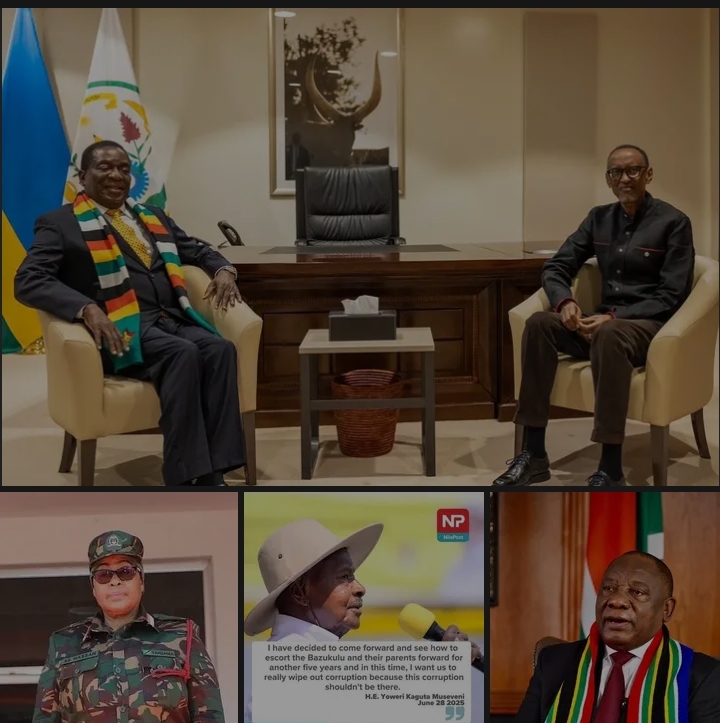
Authoritarian Arithmetic: When 85% Becomes the New 50% — Mnangagwa and the Art of Constitutionalised Dictatorship:
By Reason Wafawarova
When President Emmerson Mnangagwa speaks of “breaking barriers” and “vision beyond elections,” he is not dreaming of economic transformation. He is plotting the burial of constitutional democracy — one legislative amendment at a time. His latest pursuit of a 2035 presidency is not a political accident. It is part of a regional trend in which incumbents have learned to trade ballots for legality, and coups for constitutions.
Gone are the days when African dictators needed tanks, militias, and ballot-stuffing in the dead of night. The modern strongman drafts his tyranny in perfect English, hands it to Parliament, and calls it reform.
1. From Mugabe’s Fear to Mnangagwa’s Fraud:
Robert Mugabe ruled through violence, fear, and the theatre of blood. The 2008 election remains the most infamous illustration of this barbarism. After months of delay in announcing results, it became evident that Morgan Tsvangirai had beaten Mugabe — though narrowly short of the 50% plus one required to avoid a runoff. What followed was a state-engineered campaign of terror: beatings, killings, displacements. The opposition withdrew to save lives, but its name stayed on the ballot.
Mugabe won 85.1% in a re-run that had no opposition, no voters, and no moral standing. It was an election without contest — a ritual of affirmation, not a test of legitimacy.
Mnangagwa was part of that machinery. He watched, learned, and refined the lesson: that terror is costly, messy, and internationally embarrassing. What if you could achieve the same result through legality — through Parliament, procedure, and constitutional vandalism masquerading as reform?
Thus emerged the Breaking Barriers Initiative, an audacious project to legalise political eternity. The target is not the opposition anymore; it is the Constitution itself.
2. The Tanzanian Template: Calm Repression:
If Mugabe’s Zimbabwe was a dictatorship drenched in fear, Samia Suluhu Hassan’s Tanzania offers a softer, quieter method — repression wrapped in calm.
In October 2025, President Hassan secured an 85.4% “landslide” in an election that saw fewer than 15 million of 37.6 million registered voters turn out. Her opponents were conveniently eliminated: one jailed and facing the death penalty, another disqualified on “technicalities.”
Protests were banned. Tanks patrolled Dar es Salaam. A “wave of terror,” Amnesty International called it — abductions, torture, disappearances. Yet, to the international community, Tanzania looked stable. No gunfire, no chaos, no CNN headlines.
Hassan has mastered the authoritarian art of silence. Where Mugabe ruled by fear, she rules by invisibility. The streets are quiet because everyone is afraid to speak. The prisons are full because the ballots are empty.
Mnangagwa admires this model deeply. He sees in it a reflection of his own ambition — to replace the sound of gunfire with the sound of gavels, to use law instead of bullets, to perfect the dictatorship without the disorder.
3. Rwanda: The Mathematics of Perfection:
If Tanzania perfects silence, Rwanda perfects numbers.
In 2024, Paul Kagame claimed victory with 99.5% of the vote and a reported 98.2% turnout. Opposition leader Victoire Ingabire was, as usual, behind bars. The “competition” was Frank Habineza, rewarded with 0.5% of the vote for his civic participation. The polling stations were empty, yet the statistics overflowed.
Kagame’s Rwanda has become the mathematical summit of modern autocracy. The fewer the voters, the higher the turnout. The fewer the candidates, the bigger the victory.
Mnangagwa understands this arithmetic. His dream is not to mimic Kagame’s precision but to borrow his logic: that legitimacy can be manufactured in spreadsheets. You do not need real voters when you have real statisticians.
4. Uganda: The Science of Endless Continuity:
Then there is Yoweri Museveni — Africa’s grand professor of incumbency. His has been a 39-year lecture on how to stretch time itself.
Museveni’s constitution once limited presidents to two five-year terms. Then came an amendment to make it three. Then four. Then five. When the age limit threatened to disqualify him, it was simply deleted.
In every election since 1996, opposition leaders have been arrested, teargassed, or barred. His main rival, Bobi Wine, has spent more time under house arrest than on the campaign trail. The police have become an electoral commission of their own, deciding who may speak and who may breathe.
Museveni’s genius is in branding — every constitutional mutilation becomes a “continuation of stability.” Each violation of law is repackaged as “reform.”
Mnangagwa has borrowed that vocabulary. He calls it the Breaking Barriers Initiative. Museveni calls it the Path to Peace. Both are the same story: men who mistake their longevity for the nation’s stability.
5. Mnangagwa’s Copybook:
From Mugabe, Mnangagwa took the ruthlessness of power. From Museveni, he took the legal manipulation. From Kagame, he learned control by fear disguised as order. From Hassan, he borrowed calm repression.
His 2035 project is the fusion of these methods. Where Mugabe sent militias, Mnangagwa sends bills. Where Mugabe silenced critics with the gun, Mnangagwa silences them with the bribe. Where Mugabe rigged the ballot box, Mnangagwa rigs the law.
It is tyranny, civilised.
The goal is not simply to stay in power. It is to erase the very idea that leadership can change hands — to turn the presidency into property, and the Constitution into a footnote.
He now points to the region as justification: “Why are we criticised for seeking stability when others rule unopposed and the world applauds them?”
It is the dictator’s favourite excuse — comparative sin.
6. The ANC’s Irony:
South Africa stands as a reluctant contrast. Its ANC recently sank to 40% of the vote — a humiliating fall by African liberation standards. Yet that loss was democracy’s victory. It showed that political mortality is not national collapse. It showed that legitimacy comes not from inflated numbers but from accountability.
Mnangagwa, by contrast, looks at South Africa and sees failure. To him, 40% is weakness, not maturity. He envies Kagame’s 99%, Hassan’s 85%, and Museveni’s eternity. He cannot comprehend that democracy is supposed to humble leaders, not immortalise them.
If anything, South Africa’s fragmentation — the emergence of MK, EFF, and DA — is proof that freedom works, even if messily. The noise is not dysfunction; it is evidence of choice.
7. Authoritarian Arithmetic:
Across the region, a new arithmetic governs power.
85% without opponents counts as a landslide.
99% turnout with empty polling stations counts as participation.
40% with real competition counts as crisis.
This is the new political mathematics of Africa’s strongmen — where legitimacy is inversely proportional to freedom, and where democracy is celebrated most loudly where it least exists.
Mnangagwa’s bid for a 2035 presidency is simply the Zimbabwean chapter in this continental syllabus of control. But there is a difference.
Mugabe at least understood that tyranny is sustained by fear. Mnangagwa believes it can be sustained by cleverness — that a constitution rewritten in legal jargon is safer than one destroyed by violence. Yet the outcome is the same. When the law serves only to entrench the ruler, it ceases to be law at all.
8. The Cost of Legality without Legitimacy:
A country cannot legislate its way out of illegitimacy. The more Mnangagwa bends the law to his will, the more brittle it becomes. The day the law finally breaks, so will his rule.
Zimbabwe’s tragedy is not just that its elections are stolen. It is that its democracy is being murdered in broad daylight — not by soldiers in uniforms, but by lawyers in suits.
When the President becomes the legislator, the judge, and the beneficiary of every clause, the nation becomes a fiefdom with a flag.
And so Mnangagwa’s 2035 dream joins the gallery of Africa’s authoritarian arithmetic — Mugabe’s 85%, Hassan’s 85.4%, Kagame’s 99.5%, Museveni’s infinite continuity.
The numbers differ, the principle does not.
9. The Final Lesson:
Power in Africa has perfected its camouflage. It no longer roars; it whispers. It no longer steals the ballot box; it redefines it. It no longer shoots the opposition; it sues them.
But tyranny, however elegantly dressed, remains tyranny.
Mnangagwa’s project to rewrite Zimbabwe’s destiny under the guise of reform is not a show of strength. It is an act of fear — the fear of facing the people, the fear of expiry, the fear of accountability.
And yet, like all the others before him, he forgets one truth of history: you can ban elections, bribe the courts, and muzzle the media — but you cannot legislate legitimacy.
The 85% will always haunt the 50%.
In the arithmetic of authoritarianism, numbers are easy to invent. What’s impossible to fake is consent.
VERY great article!!