

⬆️ MONITOR | Cadre Tensions, Police Seals PF Secretariat, & The Narrative Control Battle
The People’s Brief has been tracking the escalation around the PF Secretariat since Saturday’s attack. What is unfolding now is no longer just a security story. It is a political perception war, an information battle and a test of state neutrality as Zambia edges toward 2026. The police presence at the Secretariat, the government’s insistence on peace and the online interpretation of these developments form a triangle of tension that needs careful unpacking.
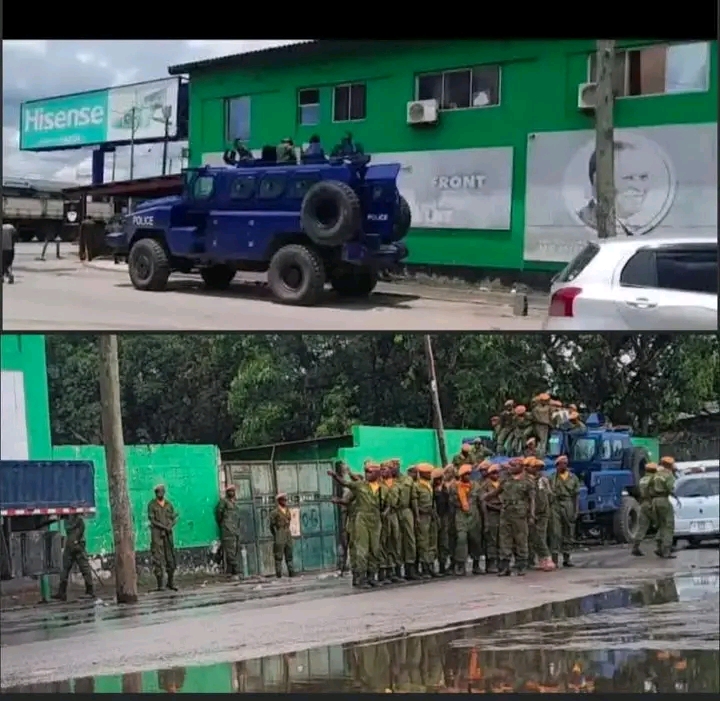
The first development is the visible police deployment at the PF Secretariat. News Diggers and other outlets have reported that officers are camped outside the building. Officially, this is framed as an attempt to prevent further violence and maintain order after Saturday’s chaotic scenes. But online perception tells a different story.
Our sentiment monitoring show a dominant narrative suggesting this police presence is being viewed as the state indirectly enforcing the Chabinga court order. In the eyes of many PF supporters, law enforcement is not keeping peace, but locking down PF operations on behalf of Robert Chabinga, who insists he is the legally recognised PF president. That perception has spread fast because it aligns with existing fears inside the PF that the state is picking a side in their internal dispute.
The government has tried to push back. Chief Government Spokesperson Cornelius Mweetwa condemned the attack on the PF Secretariat and distanced the UPND from the violence. He insisted that no cadres were sent and that there will be “no return to caderism” under President Hichilema.
His tone was firm, but online responses show that the public is divided. Non-partisan viewers welcomed the call for law and order. PF supporters, however, framed it as political theatre. The hardline opposition base says Mweetwa is trying to pretend the UPND is clean while ignoring that the attackers wore ruling party regalia. This gap between official assurances and public trust is widening.
Another layer has emerged. UPND-aligned voices have been quietly defending the presence of police at the PF Secretariat, arguing it is a safety measure. But PF platforms have been posting videos and captions claiming the police are “sealing” the Secretariat, not protecting it.
The fact that Chabinga himself announced that PF offices across the country are “out of bounds” has fed a perception that the state is helping him execute his directive. The timing makes the perception stronger: the attack happened days after the court order, the police arrived soon after, and the party’s structures remain split.
Facts and narrative have diverged.
On the UPND side, the worry is different. Sentiment analysis shows many ruling-party supporters fear infiltration. They believe Saturday’s attackers could be PF coordinated effort to embarrass the government and paint the President as losing control. They also fear that premature statements by UPND officials Father Frank Bwalya’s remarks and others on the Chingola stoning fiasco created communication confusion that weakened the party’s credibility when the police later issued a more serious report contradicting them.
This internal concern resurfaced after Mweetwa stressed that he alone speaks for the party. That signal was not lost on the base.
Inside PF, the mood is chaotic. The party is still split between the Lubinda bloc and the Chabinga bloc. The court order shutting the Secretariat until further notice has added legal uncertainty to the internal war. Scenes of police outside the building are being used by both factions to argue legitimacy.
Lubinda’s faction says the order is selective and politically assisted. Chabinga’s faction says law is finally being followed. Meanwhile, aspirants pushing for the convention are unsettled, because without access to the Secretariat, mobilisation and verification processes are compromised.
Across social media, the dominant narrative is that the state has entered the ring, whether intentionally or through perception. In Zambia, perception often eclipses fact. If large sections of the opposition believe the government is helping Chabinga, the state risks being framed as partisan even if it is not.
If sections of the ruling party believe there is an attempt to destabilise the President through manufactured violence, the UPND risks sliding back into the opposition mindset that has already damaged its communication strategy.
What is clear from our monitoring is that the PF meltdown has now become a national mood influencer. The violence in Chingola, the stoning of the President, the arrests, the attack on the Secretariat and the police deployment have created a charged environment where every move is politicised.
The government must manage perception. The PF must resolve its internal war. And law enforcement must demonstrate equal application of the law. The stakes are rising, and the battle for narrative control has already begun.
© The People’s Brief | Monitor Desk