
By Given Mutinta
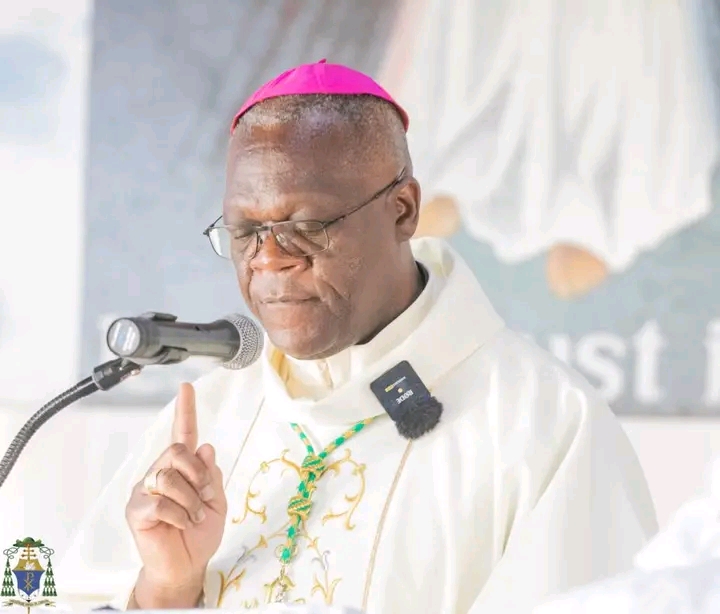
FROM THE LUCIFER OF ZAMBIA TO BIRTHDAY WISHES TO ARCHBISHOP BANDA
There is never a dull moment in Zambia’s political scene.
Not long ago, we were faced with an unusual tableau: the Zambian government levied serious accusations against Dr Alick Banda, the Archbishop of Lusaka, but a few days ago publicly extended birthday greetings to him.
This abrupt change from branding a prominent religious leader as the “Lucifer of Zambia” due to his critiques on governance to offering celebratory greetings has shocked the citizenry.
This event transcends a simple act of courtesy; it signals potential underlying machinations within the current political administration, raising questions about underlying strategic maneuvering, genuine reconciliation efforts, or a calculated attempt at political expediency ahead of the crucial 2026 general elections.
The relationship between the State and the Church under President Hakainde Hichilema has been characterized by periods of cooperation punctuated by sharp disagreements, especially when issues of corruption, human rights, and poor governance surface.
Archbishop Banda, as the head of the Catholic Church in the capital, commands significant moral authority, making his pronouncements weighty in public discourse.
The ruling party has accused him of being biassed, but his criticisms of what he sees as a decline in governance standards since 2021 are reflective of larger concerns held by civil society.
The initial harsh response from the government, labelling him with such a severe epithet, clearly indicated a zero-tolerance approach to what it perceived as unwarranted external interference or politically motivated attacks.
Such strong language suggests a desire to delegitimize the critic rather than engage with the substance of the critique, a common tactic in the current politically fraught environment.
The sudden change of heart from an organisation that has attacked him repeatedly, as indicated by the birthday wishes, is intriguing.
One prevalent interpretation centres on political expediency directed towards the 2026 elections.
Zambia’s political environment remains highly competitive, and securing endorsements or, at minimum, neutralizing significant opposition voices, becomes paramount for President Hichilema’s administration seeking a second term.
The Church, especially in Lusaka which has the highest number of registered voters in 2021, about 1, 243, 619, remains a powerful mobilization bloc, capable of influencing voter sentiment across various demographics.
By attempting to mend fences with the Archbishop of Lusaka, President Hichilema might be trying to pre-empt a unified front from the religious community against him in the coming electoral cycle.

This strategy of rapprochement could be aimed at softening the ground, demonstrating a willingness to engage maturely, even if the underlying tensions remain unresolved.
A second, perhaps more nuanced, explanation involves strategic reconciliation, potentially catalysed by recent shifts in the regional and domestic political matrix, notably the passing of former President Edgar Lungu, who was known to have a close relationship with the Archbishop.
The death of Lungu seem to have necessitated a realignment of allegiances and communications, creating space for new relational manoeuvres.
It appears that the prior animosity between Archbishop Banda and President Hichilema was largely due to the Archbishop’s political alliance with Lungu. As a result, President Hichilema was persuaded to abandon his animosity towards the Archbishop and instead use Lungu’s permanent departure as an opportunity to re-establish his relationship with the Archbishop and Church leadership independent of prior political battles.
This may suggest a forward looking strategy aimed at stabilizing the national dialogue, acknowledging the Church’s permanent role regardless of who occupies the highest office, or it could be a simply political manoeuvre by President Hichilema to maximise political benefit in the 2026 election.
Furthermore, the recent diplomatic outreach to neighbouring Zimbabwe provides a compelling parallel instance of President Hichilema’s capacity for swift shifts in posture.
President Hichilema’s administration had previously characterized the previous Zimbabwean elections under President Emmerson Mnangagwa as a sham. Yet, last week he visited Zimbabwe for the inaugural Zambia–Zimbabwe Bi-National Commission characterised with unusual hugs and smiles with President Mnangagwa representing a pragmatic diplomatic re-engagement.
If the government is willing to engage with a leader whose election it questioned for national or regional stability reasons, the rationale for extending an olive branch to a domestic religious leader Archbishop Banda, albeit a critic, becomes understandable within a framework of pragmatic governance or political expediency.
These incidents point to a pattern in President Hichilema’s political approach, in which he is willing to temporarily suspend ideological rigidity in favour of strategic or relational necessity. A clear example of President Hichilema’s mastery of realpolitik.
However, the inherent fragility of this reconciliation remains a crucial issue to follow with interest. Goodwill built upon expediency is often conditional. If Archbishop Banda continues his robust critique of governance—demanding accountability on issues such as tribalism, rule of law, corruption, debt restructuring, cost of living, or transparency—President Hichilema’s government’s patience may quickly wear thin.
The true test of this change of heart will be President Hichilema’s reaction to future, substantive criticism from the Archbishop, unless he has been compromised, which is unlikely, and will never criticise poor governance in President Hichilema’s administration.
Thus, the Zambian government’s gesture towards Archbishop Banda is pregnant with meaning, reflecting the complex interplay between political survival, strategic positioning for the next election, and the ongoing effort to manage powerful non state actors. Whether this signifies a genuine commitment to improving civil society relations or merely a temporary tactical retreat to secure political dividends remains uncertain. As the adage suggests, only time will truly reveal the depth and sincerity behind the sudden display of birthday goodwill.
From the political terraces, the visit to Zimbabwe and birthday wishes serve as a potent reminder that in the volatile arena of politics, alliances are fluid, and perceived adversaries can swiftly become necessary partners in the pursuit of political stability or electoral success.
Birthday wishes am sure were directed to him in his personal capacity as a zambian citizen who is leading the roman Catholic Church as a bishop not as a political opponent