

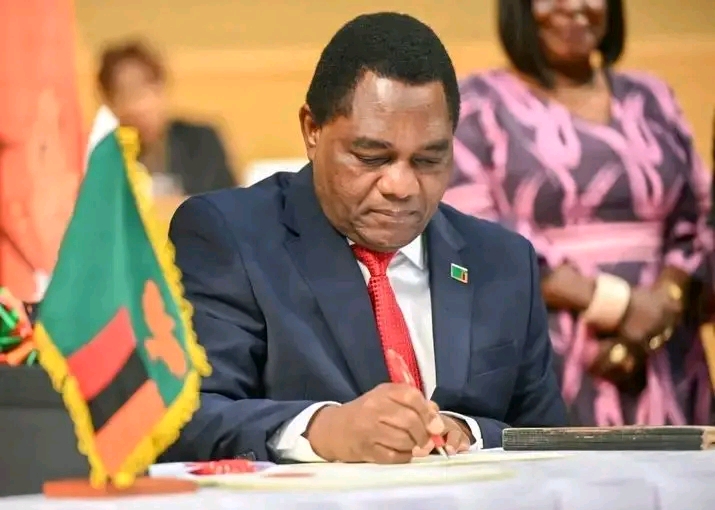
🇿🇲 EXCLUSIVE | Hichilema’s Final National Values Address: A Presidency Framed by Reform, Recovery & Reputation
President Hakainde Hichilema will this morning address the National Assembly on the progress made in the application of national values and principles, in what is set to be his final such address before Parliament dissolves ahead of the August general elections.
The address, scheduled for Friday, 20 February 2026, is not ceremonial. It is constitutional. Under Articles 8, 9 and 86 of the Zambian Constitution, the Head of State is required to report to Parliament and the nation on how the country is upholding national values such as democracy, human dignity, good governance, integrity, and sustainable development.
Acting Clerk of the National Assembly Loveless Mayaka has confirmed that members of the diplomatic corps and invited guests are expected to be seated by 08:30 hours, while citizens can follow proceedings live on Parliament Radio and Parliament TV
But beyond the constitutional obligation lies a deeper political moment.
This is President Hichilema’s last national values address before dissolution. It comes at a time when his government argues that Zambia has transitioned from economic emergency to economic recovery. Since assuming office in August 2021, his government has defined itself around three pillars: debt restructuring, macroeconomic stabilization, and institutional reform.
When he entered State House, Zambia was in default, inflation was elevated, foreign reserves were thin, and investor confidence had eroded. Four years later, the narrative from Treasury is markedly different. Inflation has returned to single digits.
The Kwacha has strengthened significantly over the past year. The IMF Extended Credit Facility programme has concluded after 38 months. Public finances show a narrower deficit. Mining production is rising. Agricultural output has rebounded after improved rainfall and reforms in the FISP e-voucher system.
On the international stage, Zambia’s image has shifted from a case study in sovereign distress to what multilateral institutions now describe as a reforming frontier economy. The country has been visible at global platforms such as the African Mining Indaba, with President Hichilema telling investors that “all minerals are critical minerals” and that Zambia seeks value addition rather than raw extraction.
Diplomatically, his administration has re-engaged traditional partners while courting Gulf investors, European institutions, and the United States.
But the address will not unfold in a vacuum of praise.
Economic stabilization does not automatically translate into universal prosperity. Poverty levels remain high. Youth unemployment remains a structural challenge. Energy constraints still surface periodically. The mining expansion narrative is ambitious, with a target of 3 million metric tonnes of copper by 2031, but scaling production requires sustained capital, reliable power, and social licence from communities affected by environmental incidents.
Politically, the President faces an opposition that is fragmented but vocal. Questions persist over governance, executive appointments, cabinet reshuffles, and allegations from critics about political selectivity in prosecutions. His administration insists that institutions operate independently and that there are no political prisoners. The President himself has repeatedly framed his leadership as one anchored in forgiveness and institutional autonomy, conscious of his own past experiences in opposition.
The economic outlook heading into dissolution is cautiously optimistic. Mining output is expanding. International reserves have strengthened. Bond market demand has surged in recent months, signalling renewed investor appetite. The Kwacha’s appreciation has shifted political conversation, with critics struggling to counter a currency story that now favours the incumbency narrative. But appreciation also raises expectations.
Citizens want to know when macro gains will convert into lower living costs, stable jobs, and visible industrial growth.
Today’s address is therefore more than a report card. It is an attempt to define the legacy phase of this administration before voters return to the polls.
Will President Hichilema frame the past four years as a disciplined repair of a broken system? Will he lean into economic data and international validation? Or will he focus on governance ethics and national cohesion?
For diplomats seated in the gallery, the speech will be a signal of policy continuity. For investors watching on broadcast channels, it will be an assessment of stability heading into an election year. For ordinary citizens, it will be a moment to measure promises against lived experience.
Constitutionally, the address is an annual address. Politically, it is a closing argument before dissolution.
© The People’s Brief | Ollus R. Ndomu