

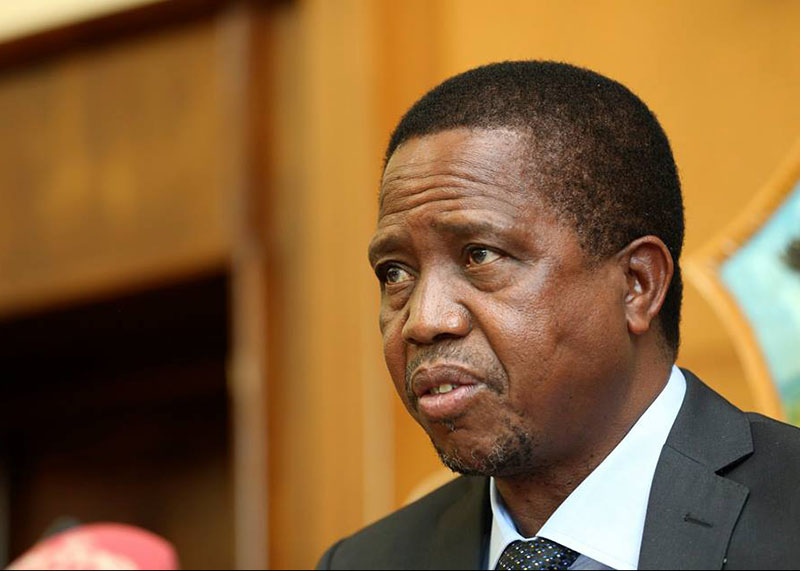
Lungu family goes back to SA Supreme Court
EDGAR’S Lungu family has gone back to the Supreme Court of Appeal in South Africa, asking for the reinstatement of their appeal over the custody and burial remains of the former Head of State.
The latest move comes barely a day after the Pretoria High Court facilitated the handover of Lungu’s body to the Zambian government through the South African Police Service, paving way for possible repatriation.
This followed a position taken by the Supreme Court that the family had failed to meet a March 30, 2026 deadline for filing their argument which in turn rendered their appeal time lapsed.
Attorney general Mulilo Kabesha later clarified that the body would not be repatriated immediately because the police were still carrying out investigations into the cause of Lungu’s death.
However, in court papers seen by Kalemba, the Lungu family is now arguing that their appeal was wrongly treated as having expired.
In a founding affidavit filed before the Supreme Court of Appeal of South Africa, the family’s lawyers insist that their submissions were still well within the official timelines prescribed by the court rules.
“Our heads of argument were prepared and tendered well within the period contemplated by the Rules of this Honourable Court. The suggestion that the appeal has lapsed is, with respect, legally unsustainable,” reads part of the affidavit.
The lawyers explain that while the parties had initially agreed to fast track the matter by setting earlier deadlines, those timelines were flexible and revised multiple times by mutual consent.
“The date of 30 March 2026 was never a rigid, court imposed deadline but a product of good faith engagements aimed at expediting the matter. It cannot override the clear provisions of the Rules,” the document states.
According to the family’s legal team, the applicable rule allows appellants six weeks after lodging the court record to file their arguments, a deadline they say had not yet expired.
“The Rules are explicit. An appeal lapses only upon failure to comply with the prescribed period or a directive of the President of the Court. Neither scenario arises in this case,” the lawyers argue.
Despite maintaining that the appeal remains valid, the family a “conditional application” asking the court to reinstate the appeal and grant condonation only if it finds that the matter had indeed lapsed.
“In an abundance of caution, and to avoid any procedural prejudice, the applicants seek reinstatement and condonation. This is not an admission of default, but a safeguard against a disputed interpretation,” the affidavit explains.
The family attributes the delay, if any, to a genuine misunderstanding arising from evolving timelines agreed upon by all parties.
They further argue that the delay estimated at just under two weeks from the initially agreed date is minimal and does not justify shutting them out of court.
“To non-suit the applicants under these circumstances would elevate form over substance and result in a grave injustice,” the affidavit states.
On the merits of the case, the family maintains that their appeal has strong prospects of success, accusing the High Court of making fundamental legal errors.
They also take issue with the High Court’s treatment of the legal framework surrounding human remains.
“The recognition of a purported contractual arrangement over a corpse is inconsistent with established legal principles and risks unsettling settled jurisprudence,” the affidavit reads.
The family further contends that the application of Zambian law in the matter was procedurally flawed.
“Foreign law was purportedly applied without the requisite expert evidence, and the Attorney General was impermissibly treated as an expert in his own cause, a clear misdirection in law,” the document adds.
The family argues that allowing the appeal to proceed would not harm the respondents, while refusing it would have severe consequences.
“There is no demonstrable prejudice to the respondents. Conversely, the applicants stand to suffer irreparable harm if denied the opportunity to ventilate their case fully before this Court,” the lawyers stated.
By Catherine Pule
Kalemba, April 23, 2026
Under 5 Malukula lawyer…. thats the problem when you only know how to write wills and rarely actually win cases. At this point the 2 governments have achieved their objectives of verifying identity of the corpse and cause of death……which we all wonder why the family and malukula have been avoiding
The Lungu family’s appeal is frivolous and vexious.It will be thrown out with costs
And where is that idiot Dr.Sishuwa Sishuawa.He has deliberately shied away from this case he was so sure Lungu would win.Am sure he is busy scraping the bottom of a garbage bin for another of his voluminous bullshit write-ups