

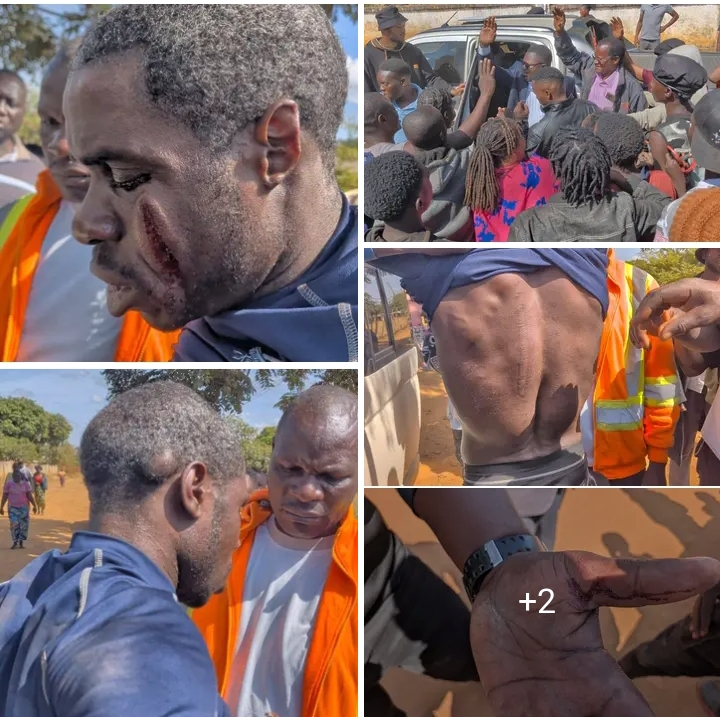
Mwiimbu’s boys almost k!lld Victor Cheelo in Chikuni
A Day Meant for Democracy Turned Violent at Charles Lwanga Primary
What should have been a peaceful exercise of democratic rights at Charles Lwanga Primary School in Monze East descended into chaos and bloodshed.
The nomination of Independent Candidate Victor Cheelo, a moment meant to mark civic participation, was instead met with intimidation, weapons, and targeted violence. The sanctity of the nomination center was violated within minutes of the process being completed.
Eyewitness accounts confirm that a group of identified cadres arrived immediately after Mr. Cheelo finished filing his nomination.
They came armed with pangas, knives, and other weapons, with the clear intention of forcing entry into the registration center. This was not a spontaneous altercation. It was a coordinated arrival with premeditated hostility.
The few police officers stationed at the center were overwhelmed by the sheer number and aggression of the attackers.
Weapons were brandished openly, and law enforcement was unable to contain the situation before violence erupted.
When the state’s security apparatus is overpowered in a designated civic space, it signals a dangerous collapse of order.
The attackers did not hide their motive. Witnesses report hearing them shout, “Tinacivutikila chipani eeci, “we have suffered a lot for this party.” In another chilling chant, they demanded, “Ulikuli Victor timupeye” “Where is Victor, we want to unalive him.”
These words make clear that the at
Victor Cheelo had successfully filed his nomination as an Independent Candidate for Monze East Constituency moments before the attack.
His supporters, present to witness this constitutional act, were followed and assaulted by the armed group.
The Mwiimbu cadres who came armed were eventually overpowered and scattered in all directions after facing resistance. The fact that violence was only halted through physical confrontation, rather than through law enforcement intervention, underscores how far the situation had deteriorated.
A nomination center became a battlefield, and participants fled for their safety.
This incident does not stand alone. The UPND in Southern Province has continued to record pockets of violence within its own strongholds following the adoption process.
When internal contests are resolved through force rather than process, the entire democratic space suffers. What begins as intra-party intimidation quickly metastasizes into a threat to political competition.
Zambia’s reputation as a beacon of peaceful transitions is built on the principle that every citizen can contest, campaign, and vote without fear. Attacks on candidates and their supporters, carried out openly with weapons, erode that foundation. If nomination centers are unsafe, then the entire electoral process is compromised before it even begins.