

NINETY DAYS TO GO, AND STILL NO COHERENT MESSAGE
David T. Zyambo | 16 May 2026
On Friday, May 15, 2026, the doors of the National Assembly in Lusaka swung shut. Parliament stood dissolved. With exactly ninety days on the clock before Zambians head to the polls on August 13, the policy debates and ministerial prestige are officially over. Every politician in the country is back on the gravel roads that they did not fix, trying to secure our vote.
Over the next three months, the country is going to get very loud. The rallies will flood every town along the line of rail and spill into the furthest villages. The Facebook drama will multiply. The billboards will bloom along every major road from Livingstone to Kasama. But if you look past the noise—and you have to look past it, because the noise is exactly the problem—you will realise that most of these campaigns are already missing the entire point. They are not asking the most basic question of all.
Why do we actually campaign?
Not to see who can pull the biggest crowd at a rally. Not to rack up viral numbers on a Facebook video that only people in Lusaka and the Copperbelt are watching. We campaign to persuade. We campaign to build a critical mass of people who trust us enough to wake up early on election day, walk to a polling station, stand in a long line, and place their mark beside our name. That is the singular objective. Everything else—the rallies, the billboards, the handshakes, the manifestos—exists entirely in service of that one moment: a voter, alone in a booth, choosing you.
So here is the question that too many Zambian politicians skip entirely: how do you earn that trust? How do you move a person from indifference to conviction? The answer is not money, though every campaign needs it. It is not party affiliation. It is not even charisma, though charisma helps. The answer is a message. A simple, clear, compelling, consistently delivered message—one that people can repeat back to you, one that tells them not just what you stand for, but why it matters to their lives.
I tell this to every group that comes through my “Communicating with Impact” masterclass. We communicate in order to be understood. When we are understood, we can persuade. When we persuade, we influence. When we influence, we win. That is the chain. Break any link in that chain, and the whole effort collapses.
And this is precisely where Zambian politics fails—at the most foundational level.
Instead of building that chain, our politicians do the exact opposite. They treat a campaign like a buffet of grievances. On Monday they are obsessing over a foreign diplomat’s commentary on our governance. On Tuesday they are dragged into toxic debates about tribalism and regional loyalty. By Wednesday they are throwing tantrums over whose name belongs on a newly commissioned bridge. By Friday they are hung up on a fellow politician’s son enrolling in a military programme. By the following week they are entirely consumed by a public argument over something someone said at a funeral.
The logic, such as it is, seems to be: talk about every problem and you will appeal to everyone. But this logic collapses under its own weight. When you talk about everything, you communicate nothing. The message becomes background noise—and noise does not move people. It confuses them. A confused voter is not a vote you win. It is a vote you lose by default, before you have even asked for it.
In our political culture, the default instinct for a politician is that more is more—more noise, more speeches, more press conferences, more presence. But to win, you have to go against everything they believe in: stop talking so much. Pick one massive, undeniable issue—and there is plenty of subject matter right now. Reduce it to a single sentence. Then say that exact same sentence every single day until election day.
Look at how the most successful political campaigns in modern history actually operated.
I worked on Barack Obama’s 2008 campaign, starting out as a volunteer, and it remains the textbook example of this discipline. He would speak at a rally in New York at ten hours in the morning and be on a stage in Chicago by fifteen hours in the afternoon. If you watched the New York rally, you did not need to tune in to Chicago. Every single word he said at ten, he said again at fifteen. The same stories. The same phrases. The same lines delivered with the same energy. Word for word. Rally after rally. State after state. Week after week. Until the night before Election Day.
This was not redundancy, and it was not a shortage of ideas. It was the most sophisticated understanding of political communication in modern history. People thought he was effortlessly brilliant. He was. But the brilliance was in the discipline—the flat refusal to be distracted even when opponents attacked his character. It came from a deep understanding that simplicity, consistency, and repetition are the only way to get through to people. They are the only path to critical mass.
Obama did not think voters were too slow to understand his message at once. He understood something far more precise: the human mind does not change on first hearing. It changes on the fifteenth. Or the thirtieth. When a message has been repeated so many times that it becomes completely familiar, it stops feeling like a campaign slogan and starts feeling like your own thought. That is the exact moment it moves you. That is the moment it becomes a vote.
Simplicity. Consistency. Repetition. This is not merely a communication strategy; it is a steady continuum that finally reaches critical mass. It is a law of political physics.
Winston Churchill—former British Prime Minister and one of the greatest communicators who ever lived—understood this instinctively. In the middle of the Second World War, with Europe falling and Britain standing virtually alone, he did not speak about the economy and trade and the empire and post-war reconstruction all at once. He spoke about one thing. Survival. Defiance. He distilled it into five words the world has never forgotten: “We shall never surrender.” Simple. Consistent. Repeated. And this message held a nation together through its darkest hour.
The principle is the same whether you are rallying a wartime Britain or canvassing the Copperbelt. You pick one thing. You reduce it to a sentence. You say that sentence every single day to everyone you interact with. Barack Obama built a historic presidential campaign on just three words: “Yes We Can.” Faced with the worst economic downturn since the 1930s, he did not offer voters a lecture on structural macroeconomics. He offered them an emotional anchor. Three words that told people: we are going to get through this together.
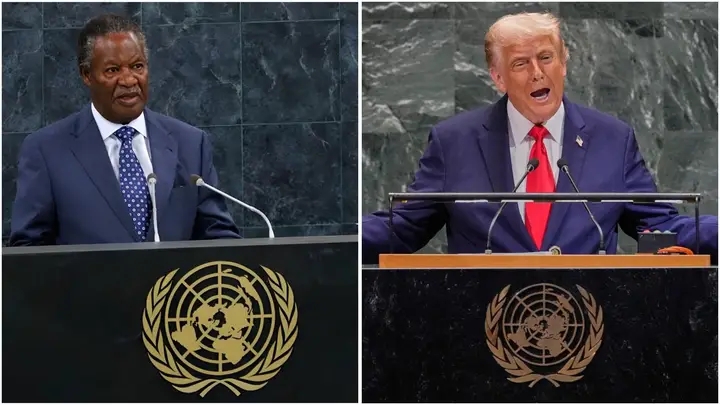
And look at Donald Trump on the other side of the fence. Though people criticize him for his rambling and unpredictable speaking style, he understands this law of political physics better than most. If you ignore the drama of his rallies and just look at how his brand works, it’s brilliant. He took the massive frustration of millions of voters and compressed it into four words: “Make America Great Again.” It doesn’t matter how far off-script he goes during a speech; those four words are the anchor he always comes back to. He does not switch messages based on the bad headlines; he bends the headlines to fit his message
Now let’s bring it home.
Michael Sata. Zambia. 2011. “More Money in Your Pockets.” That was it. That was the whole campaign. And here is what makes that example so remarkable—our economy at that time was actually performing reasonably well. By the numbers, people genuinely had more in their pockets than many of them do today. And yet the country followed Sata. Not because the message was statistically perfect. But because it named something people felt. It told them: this man understands my life. This man is thinking about me.
That is what a message does. It does not just inform. It connects.
Look at the current political class and ask yourself the hard questions. What is the opposition’s one sentence this election season? What is the ruling party’s single, undeniable message? If you cannot answer those questions in under ten seconds, then neither can the voter. And a voter who cannot summarise why they should choose you will not choose you—they will simply choose whoever makes the loudest noise on the day.
Zambian politicians today change their messages like clothes—impulsively, erratically, and always without explanation. Different grievance every morning. Different outrage every week. And then they wonder why the public does not follow them. The public does not follow because it cannot. You cannot ask people to board a train that changes its destination every single morning. Political loyalty is not given to the loudest voice in the room. It is given to the clearest one.
Finding your message is only half the work. The other half is delivery—and this is where our politicians commit their second unforgivable error: they do not want to pay for media.
Let us be clear about what voter outreach actually costs, and what it is worth. In 2012, Barack Obama ran the first presidential campaign in the history of politics to raise over one billion dollars. Of that historic sum, sixty percent—more than six hundred million dollars—went to media outreach. Not to salaries. Not to rallies. Not to party cadres. To media. To reaching voters, repeatedly, on the channels where they actually lived.
Before you dismiss me as someone out of touch with extravagant figures that have no relevance in Zambia, look past the staggering amount and focus entirely on the allocation. The lesson is not in the absolute number. It is in the percentage.
Our demographics have shifted dramatically over the last thirty-five years, yet politicians still want to play politics the same old way. Say a serious Zambian presidential candidate manages to raise one million dollars. Do you see them spending six hundred thousand of it on media? They will not. They will spend it on fuel, on renting massive sound systems, on busing supporters from one province to another, on paying people who hold little significance, on printing hundreds of thousands of chitenge and t-shirts that will be worn once and forgotten. They treat media as an afterthought—an optional extra to be considered only if there is loose change left at the end of the week.
The veterans of Zambian politics will hear this and laugh. They will tell you I am applying American rules to a Zambian reality. They will argue that our voters are different—that they respond to physical momentum, that they want to see who can make the loudest noise, that a massive rally is the only signal telling people a candidate is serious. They believe the Zambian voter simply wants to jump onto whichever bandwagon looks the biggest.
But bola iyaku kuntamofye umwela yakale, abantu ba bomfya imitwe nomba. The mathematics of that mistake is when you spend all your campaign capital on buses, t-shirts, and open-air spectacles, you are paying to manufacture the outward illusion of momentum. You are buying an expensive performance that mostly plays to an echo chamber of people who were already on your side anyway. The rally does not persuade the undecided voter in Mansa or Mongu who never attended; it merely entertains the converted. And while the converted do need to be kept mobilised, the most important thing is to keep them reminded. They do not need a stadium concert every week—they need a continuous, daily message that keeps them ready to fight for you.
Obama’s sixty percent media allocation was built on a completely different understanding of political physics. He was not trying to impress people who were already on his side. He was trying to reach the person who had not yet decided—the farmer in a rural county who would only hear about him through a community radio advertisement, the young mother in a suburb who would see his face on television during the evening news.
He understood that the path to victory runs through the unconvinced, not through the already-loyal. And the unconvinced are not at your rally. They are at home.
We are now officially in campaign season. The window of opportunity is open. But it will not stay open forever. Here is the assignment: Pick one thing—the single most urgent, most relatable, most emotionally resonant issue facing the people you want to serve. Reduce it to a sentence. Not a paragraph. Not ten bullet points. Not a list of priorities. One sentence. Then say that sentence to anchor every rally, in every interview, on every community radio programme, in every WhatsApp group, in every church hall and market and bus station where people gather. Say it simply. Say it consistently. Say it until ordinary Zambians are saying it back to you, to each other, to their neighbours.
That is how you campaign. That is how you persuade. That is how you build a following. And that is how you win the vote. Everything else is noise.
The article makes a lot of sense. Our politicians’ emphasis on rallies is misplaced to some extent. Personally I cannot attend a rally. I have far more important issues to attend to than listening to a politician (who will be late to start with) at a rally.
However, a rally meets some social yearning for a large proportion of our people who love the mob mentality at a rally.