

The repugnant scent of recolonisation: Zambia’s complacency and USAFRICOM
By Richard Chomba
Africa’s former colonial masters, including their allies in her plunder, would have been foolish
If, after relinquishing direct political control over her sovereignty and over her natural resources, they faded into the shadows of global trade and industry, spheres of life they had dominated for years thanks to her raw materials and cheap labour.
Their lust for wealth and power was, and still is, insatiable, so, naturally, a plan was devised to perpetuate their dominance and Africa’s dependence on them. Anyone who stood in the way of this scheme was to be taken out of the way.
This they achieved through state sponsored coups, proxy wars as well as outright military invasions of foreign countries, and covert assassinations. Kwame Nkrumah, himself a victim of a CIA orchestrated coup, foresaw this, writing: “now that African freedom is accepted by all … as inescapable fact, there are efforts in certain quarters to make arrangements whereby the local populations are given token freedom while cords attaching them to the ‘mother country’ remain as firm as ever….
The intention is to use the new African nations, so circumscribed, as puppets through whom influence can be extended over states which maintain an independence in keeping with their sovereignty.
The creation of several weak and unstable states of this kind in Africa, it is hoped, will ensure the continued dependence on the former colonial powers for economic aid, and impede African unity.
This policy of balkanisation is the new imperialism, the new danger to Africa.”
Nkrumah’s words have come to pass.
The post-colonial era which has been characterised by the pillaging of African nations by more developed, more powerful, states, bears a stark resemblance to the colonial days. The hand of imperialism, in the background, controls the politics (through
self-centered, corrupt, politicians) and economies of African states. The peripheral political arena is a stage for opposing imperialist forces to battle it out for the control of raw materials and monetary flow in the countries in question. These forces were, largely the USSR and the USA (in collusion with the UK & other Western-European democracies) in the cold war period.
After the USA and its allies emerged victors of the cold war: after the fall of the Berlin war and
the disintegration of the Union of Soviet Socialist Republics (USSR); a new foe for western interests was unveiling.
While they were preoccupied with the USSR, China had been rising. In the early 2000s through to the early 2010s, it became apparent to western neoliberals, that their clandestine exploitation of African states had been challenged by ‘modern imperial China’. Through the use of a USA-invented playbook on dominating African states, China financed much needed infrastructural projects, burdening developing African countries with too much debt than they are able to pay back, and thereby making African states beholden to Chinese influence in key sectors of the economy, and governance.
This, as one would imagine, has not sat well with the USA, the UK, Australia, the EU, and other US allies such as Japan and India, political and economic foes of China. Deliberate, and well coordinated, policies and steps to counter Chinese influence in Africa have since been taken by these countries.
As the US senate majority leader senator Charles Schumer (D-NY) said in 2021 during the senate’s passing of the US Innovation and Competition Act (a bill aimed at curtailing Chinese global dominance): “passing this bill… is the moment when the senate lays the foundation for another century of American leadership… this bill could be the turning point for American leadership in the 21st century… the world is more competitive now, than at any time since the end of the second world war. If we do nothing, our days as the dominant super-power may be ending. We don’t mean to let those days end on our watch! We don’t mean to see America becoming a middling nation in this century, we mean for America to lead it!”
The bill, as the name suggests, aims to maintain America’s superiority in tech and innovation globally, which has been challenged by China; or, in my view, it aims to simply regain it.
This fit,however, won’t be simple. All things considered, to say that China became the most superior country in the world in areas of technological innovation, manufacturing, construction, and global trade & finance; with the west paying a blind eye, would be foolhardy. Western countries, through their corporations and elites (the one-percenters) did in fact fund China’s rising.
In 1978, Chinese ‘paramount leader’ Deng Xiaoping, thought it was prudent if China was to become a force to be reckoned with in manufacturing, global trade and development. That is, if modern day China were to reclaim the past glory of ancient China – which was an economic and military force to reckon with – Chinese communism which had governed the Peoples Republic of China since its founding in 1949 by Mao Zedong (chairman of the Chinese Communist Party) needed to be modified. In order for China to become a prosperous communist state, Deng articulated, it had to
adopt some capitalist practices. He made reforms that would allow private ownership and private businesses. Special economic zones were set up in Shantou, Zhuhai, Xiamen, and Shenzhen. These small towns and villages, at that time, were now designated as capitalist havens in a communist republic.
They attracted vast amounts of capital, following these reforms, from western corporations and the “one-percenters”, owing to the cheap labour and low taxes and regulations that they provided. Deng’s little experiment was resounding a success. Now China, a country that was among the poorest in the world when he came to power, houses the second largest GDP in the world, and has become “the world’s factory”. China became rich, and the “one-percent” became even richer.
China started tunnelling its profits to the developing world to finance infrastructure development programmes, as was earlier alluded to, among other things, in a bid to gain leverage over the leaders of these nations who preside over raw materials that it desperately needs for its economic expansion.
This has worked well for China, and Africa has
continued to be exploited by foreign powers, with its leaders as accomplices. China simply used the western blueprint on how to rip-off Africa, to rip-off Africa. In fact, every other powerful country with a foothold on the continent uses a western invented system to exploit the good people of Africa, that is, through self-centered leaders. These leaders have no problem relinquishing their counties’ sovereignty through allowing foreign powers to set-up military bases, and military command offices, so long as they are promised funds for “development”, which they are then able to loot for themselves. They also see these outposts of foreign military installations as a means to safeguard their power. After taking a careful look at the world governance and economic system, and the “leaders” of this system – its chief architects – and how that this system subjugates African nations, perpetually; it begs the question: how did Africa’s colonisers and their allies in her plunder manage to subordinate African nations for this long, even after they gained the right to govern themselves? Well, a simple answer may be: they never intended to let go of Africa’s vast natural resources. It was theirs and theirs for good, and so was Africa: theirs to control, in all spheres.
As Lee Wengraf puts it in her book, ‘Extracting Profit’: through the structure of investments,
aid, loans, trade and trade policy; western governments – and if I might add: Eastern governments – Bretton Woods Institutions (the IMF and World Bank) and the pre-colonial imperialist as well as capitalist forces, acting collectively, perpetuated relationship dynamics
between the global elite, the “one-percenters”, and African states (developing countries) such as Zambia that abrogate the basic principles of fairness and equity.
These relationship dynamics between them, and the African political elite, are the same ones that existed during the colonial era: the country’s natural resources are ransacked, while a few vitiated indigenous black people, at the helm of local leadership, benefit.
In the independence era, colonialism gained a new name, it morphed into “the post-colonial era”. The underlying fundamentals set up by “the exploitative
coalition”, in 1944 at the Bretton Woods conference, only anchored, to quote senator Schumer, “American leadership” in this new era of sly white-collar thievery. A good majority of leaders of the African nationalist movements that fostered independence were the ‘spoiled children’ of the colonial era which preceded our token political independence. Most of them lacked a conscience, and were already in cahoots with imperial powers while they “fought for independence”. They understood their role as “puppet leaders” very well (lest we forget, this phenomenon of puppet African leaders started in the colonial days). These “patriots’” motive for gaining independence
was their need to sit – to bring it home – on top of the Zambian food chain: their insatiable lust for having more wealth and power, and their desire to control the finance attached to the national developmental agenda, as well as their fellow countrymen. They wanted to call the shots. They could read and write, while the majority couldn’t. Their education was meager compared to national leaders in the western world, but they were, nonetheless, highly educated compared to the rest of the populace, and so they became the aristocracy of Zambian society following our independence.
Post colonialism, just as Northern Rhodesia was oriented to supply “advanced nations” and the corporations within them with raw materials to feed their industrial needs, independent Zambia did not depart from that course which had detrimental effects to the environment, and little to no positive ramifications to the microeconomics of the majority of citizens (serve for a few politically tied individuals), as well as the macroeconomics of the country as a whole. The country continued to depend on foreign aid and started to entertain unsustainable debt, the “restructuring” of which only meant that the noose of foreign control of the nation’s economy and politics only became tighter. In Northern Rhodesia western bankers and trading companies would greatly benefit from financing and servicing of the mining sector, while mineworkers earned a meager income.
Nothing much has changed in present day Zambia. European, American, Chinese, Japanese and Indian capital, to mention but a few, pretty much runs the show today in not only the mining industry, but other facets of the economy too.
This is done openly and covertly – directly and indirectly – and always in collusion with complacent government leaders. Workers have continued to be exploited. Opposition political parties exist because they yearn to be the ones benefiting from the exploitation of our lands and our peoples, and not their counterparts with “the democratic mandate to rule”.
Democracy itself is a facade western leaders use to remove and install defiant and complaint national leaders to western interests, respectively. The global-east, specifically one-party China, makes use of democracy in countries such as Zambia in the same vein as western interests. We, therefore, now have a situation where different interests keen to take over the reins of power in our country fund their preferred puppets, to help subjugate the general populace, and specifically the local economy, under their control. One puppet leaves office, another swoops in.
Democracy saves western interests the hustle of having to fund proxy wars and covert assassinations to take out leaders who are antagonistic to their “good-for-the-world” agenda.
Leaders such as the DRC’s Patrice Lumumba, whose defiance and detest of western hegemony over the Congo’s vast natural
resources and economy were very deep-rooted and public. He proclaimed (shortly before his CIA facilitated assassination): “the Congo’s independence is a decisive step towards the liberation of the whole African continent…. I call on all Congolese citizens, men, women and children, to set themselves resolutely to the task of creating a national economy and ensuring our economic independence”.
Of course, the hawkish always justify their evil acts. Just like when they overthrew a democratically elected leader through a coup to install a puppet king, the Shah, who was sympathetic to western interests in Iran (Iranian oil), but yet repressive to his fellow citizens, or when the US secretary of state smiled and waved at cameras during the welcoming of a murderous despot – the current president of Equatorial Guinea: Teodoro Obiang Nguema Mbasogo – to Washington, a man who tortures his opponents like a barbarian, but nonetheless almost exclusively allows American companies to extract much of its $9 billion annual worth of oil and gas.
The latter came to power through a bloody coup in 1979 that toppled his uncle, Equatorial Guinea’s first head of state: Francisco Macias Nguema; and has been in power ever since. They, the US and its allies, have no problem in associating with Rwandese president, Paul Kagame, also a murderous dictator, famous for killing his opponents and repressing domestic dissent, and who’s been in power since 2000 through manipulation of the electoral system.
In apartheid South Africa, US capital would go in, and come out multiplied enroute to the United States, unremorseful of the horrors that the majority of black South Africans were experiencing at the hands of the apartheid regime.
Wengraf writes: “by the mid-1970s, US policymakers explicitly acknowledged the urgency of managing “political risk” vis-á-vis the apartheid regime so that US and white-South African capital retained “control of the richest and most strategically important part of Sub-Saharan Africa. Despite growing condemnation of apartheid rule, at the time, the value of US investment in South Africa was approximately one-third of its total investment in Africa and increased by 300 per cent from 1960 to 1975. Given the importance of this economic relationship, the United States was content to sidestep opposition to apartheid, despite the knowledge that “there was little evidence that US firms deliberately adopted a socially conscious policy of avoiding support of the South African government or its apartheid policies.”
Apparently, making money under oppressive regimes is for the greater good; that is: American greed. At the dawn of the independence error that followed shortly after the end of the second world war, there was a well-orchestrated strategy by the USA to forge political and economic bonds with the newly independent African states.
The goal for US policy at this time was to possess a greater advantage over the newly independent African nations – of course the foundation for this had already been set at the Bretton Woods conference – than their arch-rivals: the USSR; and also, Africa’s former colonisers – the Europeans (the aim here was to bypass them and reach the source of their much-desired raw materials directly and not through their allies: the colonialists).
In fact, the assassination of Patrice Lumumba in 1961, was a covert maneuver against, not just the DRC, but Marxist USSR too, and was seen as a necessary evil in the safeguard of America’s imperial interests in the DRC. What factors have led to Africa’s mass, as well as perpetual, plundering; that is, from the colonial days until now? Aside from imperial ambition, is the greed and self-interest exhibited by local leaders. Pre colonialism, colonial explorers, eager to obtain African land – rich in natural resources – for themselves, would entice African leaders with gifts such as fabric, beads, wine, whiskey, and mirrors.
That was enough, coupled with promises of more of such gifts, in certain instances, to sign off on property rights to the colonialists. Additionally, cowardice! Because of fearing white firepower, black leaders tended to easily give up natural resources for a fraction of their actual worth. So long as they benefited, it didn’t matter that the rest of the population continued to suffer without having their resources benefit them, or take them out of poverty.
Post colonialism, the majority of African leaders, especially those in power – or those allowed to be in power by the west – continue to entertain imperial interests for all the same reasons as their ancestors who allowed colonialism to flourish.
The independence era paved way for the subtle
recolonisation of Africa by western, as well as eastern, powers. Always in on the plot to ransack Africa has been the African political elite. Selfishness and cowardice characterise Africa’s bourgeoisie till this very day.
This is the unspoken truth, even when they stand before local audiences claiming they want to develop the country. Those who would genuinely want to develop local communities, prioritising local control of the economy, are taken out. Despots who give priority to western demands are left in their power sits, up to several decades in some cases.
It’s surprising how comfortable government leaders are with this status-quo – well maybe it’s not so surprising seeing as only they, and not the larger society, benefit from treaties made with “Africa’s owners”! This is very appalling to anyone with a live moral compass.
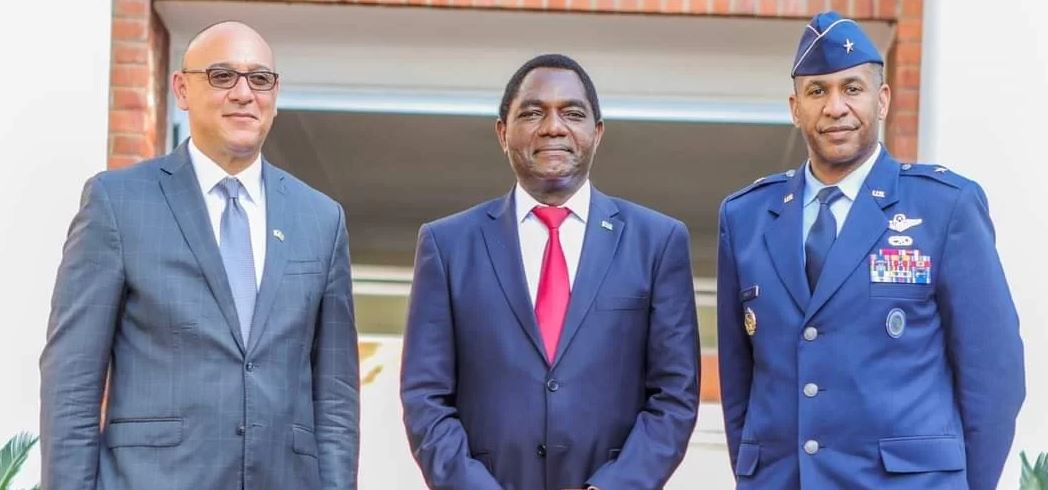
Recently in Zambia, news surfaced concerning the setting up of USAFRICOM offices at the US Embassy in Lusaka. Some called it a military base. Clarity then came from the US Embassy that what’s being set up is an “Office of Security Cooperation”.
Due to failure by both parties to not make public the contents of the MoU between Zambia and the US DoD, such confusion was to
be expected – and, knowing both parties involved, maybe they deliberately hid the details so as to have a last word about the said offices, thereby controlling the final narrative that would stick in people’s heads, while making the real intent of such an office classified.
Be that as it may, what is USAFRICOM? What’s the purpose of setting up shop in Zambia? Wouldn’t it have been more prudent to have held a consultative meeting with all stakeholders before agreeing to the establishment of these ‘offices’? Whose interests does USAFRICOM aim to serve? Is it imperial interests?
The United States Africa Command, or USAFRICOM, is one of eleven Unified Combatant Commands (CCMD) of the United States Department of DefenCe (US DoD). The CCMD is a joint military command, and each command is composed of units from at least two of the six branches of the US Armed Forces: Army, Marine Corps, Navy, Air Force, Space Force and Coast Guard. Together, the Unified Combatant Commands oversea at least 750 outposts, or military bases, of the US DoD globally, in at least 80 countries.
It costs the US taxpayers an estimated $80 billion to construct and service military bases, as well as pay US military service members stationed on these bases, annually. Each unit of the Unified Combatant Command conducts extensive and continuous missions in its area of operation. Units of the CCMD are organised either on a geographic or a functional basis. USAFRICOM, as the name suggests, is a unit of the CMMD that conducts its operations on the African continent.
USAFRICOM’s military operations on the continent include helping African governments and their militaries fight regional conflicts and maintaining military relations with 53 African nations which don’t include Egypt (that falls under the United States Central Command). The major factors that define USAFRICOM’s operations on the continent are: “the growing threat of international terrorism”, safeguarding the USA’s oil, gas, and mineral interests; and the Sino[1]Africa relations that have been forged-strong in the last 22 years. USAFRICOM’s strategy, according to General Carter F. Ham (retd), is “to strengthen democratic institutions” and “boosting broad-based economic growth”. Currently, USAFRICOM is headquartered at Kelley Barracks in Stuttgart, Germany.
Certain high ranking, current and retired, US army officers have, however, stressed the merits of having a section of USAFRICOM staff headquartered on the continent, claiming it would be a positive factor in aiding USAFRICOM to better execute its programmes. Cognisant of the political backlash, and controversy, attached with the notion of setting up a headquarters of a branch of the US Army’s combatant division on the continent, then president of America, George W Bush (who has mining interests in North Western Province of Zambia), claimed no large-scale US military base would be set up to house USAFRICOM’s headquarters on the continent (though Camp Lemonnier that houses some 2,300 US Army servicemen exists in Djibouti, but is nonetheless not the USAFRICOM HQ), rather, a network of “cooperative security locations” at which “temporary activities” would be conducted seemed like a more viable option.
It has been reported that several African countries such as Liberia and Nigeria have in the past been competing to house USAFRICOM headquarters because it comes with a lot of financial incentives to the host nation, or government politicians.
At the same time, several nations have been opposed to the setting up of a USAFRICOM HQ on African soil. These include South Africa, and Libya.
Seeing as the government of the Republic of Zambia has agreed, without first engaging the general public through various stakeholders, to house this “office of security cooperation”, (which is a part of a larger network of “cooperative security locations” on the continent), it’s only safe to conclude that this hasn’t been done for the mutual benefit of our two countries.
Three entities are involved here, one stands to benefit more, the other will benefit slightly, the other doesn’t benefit at all – these are: US interests in Africa, Zambia and the region; Zambian government politicians; and the people of Zambia, respectively.
US military offices, in whatever form, do come with an influx of money to the hosts that house them, and it’s apparent here that the people in charge of our government want to reap something for themselves.
Personally, I find it discouraging to galvanise around national leaders that are comfortable with defeat, with being willful accomplices in aiding and abetting an imperial power to be “great for the next 100 years”, implying we, as a country and continent, will remain subdued by it for the next 100 years, and that we’ll get caught up in the cross fire for the battle over our natural resources between this power and its arch rivals, and that our people will remain poor while a few politicians get richer – that is, if nothing is done to rectify the situation. I actually find it disgusting.
This work isn’t a review of the UPND’s first 10 months in power, that will come later on. It’s the author’s thoughts on neocolonialism, imperialism, and the leadership vacuum that exists in resisting them.
Note: thoughts espoused in this op-ed are the author’s and do not reflect the worldview of the publishing entity in any way!
The author is a Pan-African socialist and serves as a research assistant – International
Relations, at Amini Center for Policy Research – a youth led public policy think-tank. Email: richard.chomba@acpr.org, phone +260 975 559420
richardchomba3@gmail.com