By Amb. Emmanuel Mwamba
ZCCM Records show;
Chililabombwe alone has over one billion tonne of copper reserves old records reveal
….Nkonkola Deep has reserves worth in excess of $200billion…
The purported discovery of copper on the Copperbelt and is being announced now is well documented under ZCCM.
Someone has just accessed these earlier explorations records and begins to make grandiose announcements..
Tuka shibuka lilali?
For example look at the exploration details of copper finds in Chililabombwe (Kilila Bombwe).
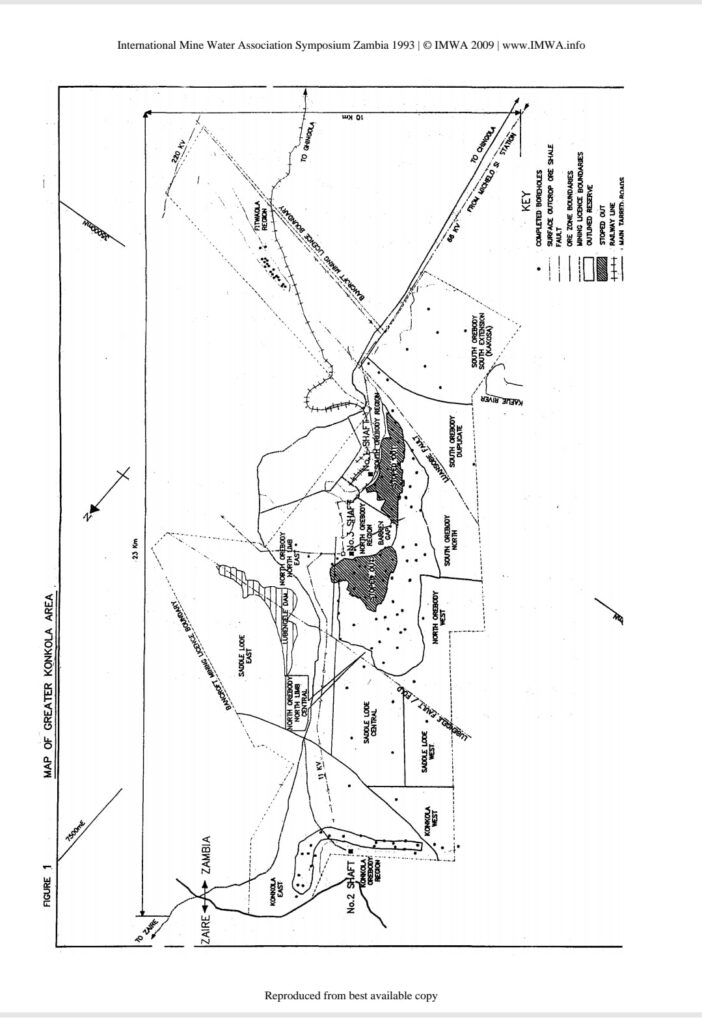
Greater Konkola (refer to Fig. 1) which is an area of 23 km x 10 km
contains a number of orebodies viz. Konkola, Kirila Bombwe, Saddle
Lode, Kakosa and Fitwaola.
Exploration and mining activities to date have
revealed a good knowledge of the behaviour of these orebodies.
The greater Konkola area can support a geological model of about a billion
tonnes of ore resources at 3.1 1% total copper.
Hence this area represents
the potential for high output mining operations in the long term.
The Konkola orebody was exploited for a brief spell in 1957/58 by No 2
Shaft.
Mining was discontinued due to economic reasons.
Investigations
in 1973 and 1988 both concluded that re-opening would be uneconomic
at the metal prices then prevailing.
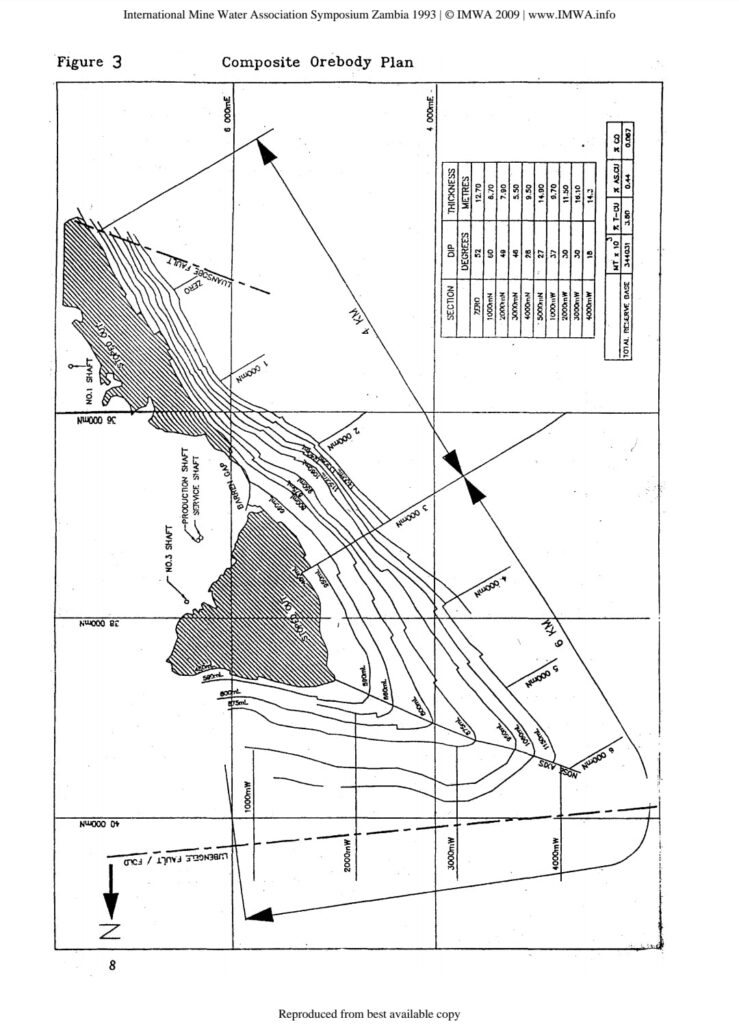
The Kirila Bombwe orebody (refer to fig. 2) was divided into Kirila Bombwe South and North sections due to the existence of a large barren
gap on upper horizons.
These are being exploited by No 1 and No 3 Shafts respectively.
The orebody is continuous below 700m depth. It has
been explored by surface boreholes down to a depth of 1900 metres in the southern part and 1150 metres in the northern part.
The ore reserves which can be exploited by the two shafts are now limited
ui’g, economic production
and at the current rates and efficiency of mining, economic
start declining
will start declining by the year 2000 at No 3 Shaft and 2005 at No I
Shaft, or continued copper production it was necessary to plan for mining at depth in this orebody.
Hence the Konkola Deep Mining
Project.
A number of studies have been undertaken to assess the feasibility of
mining at depth and to draw up a most suitable plan consistent with the company’s corporate objectives.
Preceding study helped as a
stepping stone for the following study by effecting improvements and
incorporating new ideas. The latest of these studies was completed in
April 1992.
This represents ZCCM’s latest plans for Konkola Division.
This paper attempts to put forward the philosophy and concepts which
formed the basis of this KIRILA BOMBWE OREBODY
Because of the existence of the barren gap, the two ore zones, Kirila Bomwe South and North have been treated in the past as two separate orebodies and two separate mines.
Their growth in all aspects from
exploration to ore production and future planning took place as two
separate entities.
Because of various reasons such as the dip and thickness
of reserves, rates of mining, start of mining ete., the two mines ended in the configuration that they are today.
Down-dip advance of mining in
the South orebody is far more (950mL) than in the North orebody
(590mL).
Initial attempts at long term planning for Konkola saw the two mines as
separate, independent entities.
When it was realised that below 700m level, the orebody is continuous the thinking changed.
The orebody was
viewed as one and planning to exploit it to its full potential started taking shape.